Have you noticed that many who have claimed that they are disciples of Christ and Christian messengers never even mention Jesus Christ let alone bear witness concerning him? Such absence is telltale and indicative that something is wrong.
Jesus himself counseled:
“You will tell a tree by the fruit it bears.”
If the “tree” is devoid of fruit should tell you something as well.
Some of these even claim to be part of the bride class and yet never mention the bridegroom.
They teach only about the older prophets prior to Christ and skip the Christ himself and what he said ; the one whom they claim they serve and belong to eternally.
Why?
Jesus gave this command before departing the Earth:
“Go therefore and make disciples, baptizing them in the name of the Father, the Son, and the Holy Spirit teaching them ALL OF THE THINGS I HAVE COMMANDED YOU…” Matthew 28.
How can one meet this basic command without mentioning Jesus or mentioning what he himself said?
Did he command, “Go therefore and make disciples of Elijah or Isaiah or Daniel teaching them what these prior prophets said”? No. And while teaching what these prior prophets of God said is a very good thing, it cannot substitute for bearing witness to Jesus Christ.
These are aiding in suppressing and hiding the name and the teachings of Jesus Christ, which pleases his enemies and not him.
Students of the Bible understand that Jesus provided a ransom sacrifice spotless and unblemished as required by God to redeem mankind from the slavery to sin and death that Adam and Eve cursed all their descendants to.
1 John 2:1,2
My little children, I am writing these things to you so that you may not sin. But if anyone does sin, we have an advocate with the Father, Jesus Christ the righteous. 2 He is the propitiation for our sins, and not for ours only but also for the sins of the whole world.
It should not be overlooked that the chosen one to be offered, had to be a ‘firstborn’ of at least equal value as Adam the firstborn of humankind.
Adam’s sin caused mankind to fall out of grace with God. It became necessary for there to be a means of reconciliation.
God found it acceptable to devise an act of propitiation that would be sufficient that he would open a means to be put right with him.
Propitiation is an action meant to regain someone’s favor or make up for something you did wrong.
He provided His only begotten son to serve as a sacrifice for atonement.
The meaning of the word atonement is simply at-one-ment, He was sacrificed to make all things in Creation at one with God again.
No firstborn animal of a lesser life form would meet the requirements satisfactory to God to serve as the ransomed one.
There is only one other firstborn mentioned in the Scriptures that would possibly qualify. That was the firstborn of creation, the only begotten son of God.
Although he was of much higher stature and value than Adam, he was the only possibility. There were actually no other option; no one else to be considered.
God in his wisdom and foresight withheld immortality from his only begotten son until after his resurrection for this purpose.
Romans 6:9
We know that Christ, being raised from the dead, will never die again; death no longer has dominion over him.
Had God not withheld immortality from His son, this ONLY choice would not have been able to serve as the sacrifice that offset (atoned) for Adam’s transgression. He would not have been able to give up his life because he would not have been able to die. There would have been no one else worthy.
This demonstrates that Almighty God, the Father, knows all thing and he knows the finale from the very beginning.
God’s superlative sacrifice is of sufficient value to cover all things in both Heaven and on Earth. More was being brought back to oneness with God than fallen man. His sacrifice covers things that occurred in the Heavens as well.
1 Corinthians 15:20-28
20 But in fact Christ has been raised from the dead, the first fruits of those who have fallen asleep. 21 For as by a man came death, by a man has come also the resurrection of the dead. 22 For as in Adam all die, so also in Christ shall all be made alive. 23 But each in his own order: Christ the first fruits, then at his coming those who belong to Christ. 24 Then comes the end, when he delivers the kingdom to God the Father after destroying every rule and every authority and power. 25 For he must reign until he has put all his enemies under his feet. 26 The last enemy to be destroyed is death. 27 For “God has put all things in subjection under his feet.” But when it says, “all things are put in subjection,” it is plain that he is excepted who put all things in subjection under him. 28 When all things are subjected to him, then the Son himself will also be subjected to him who put all things in subjection under him, that God may be all in all.
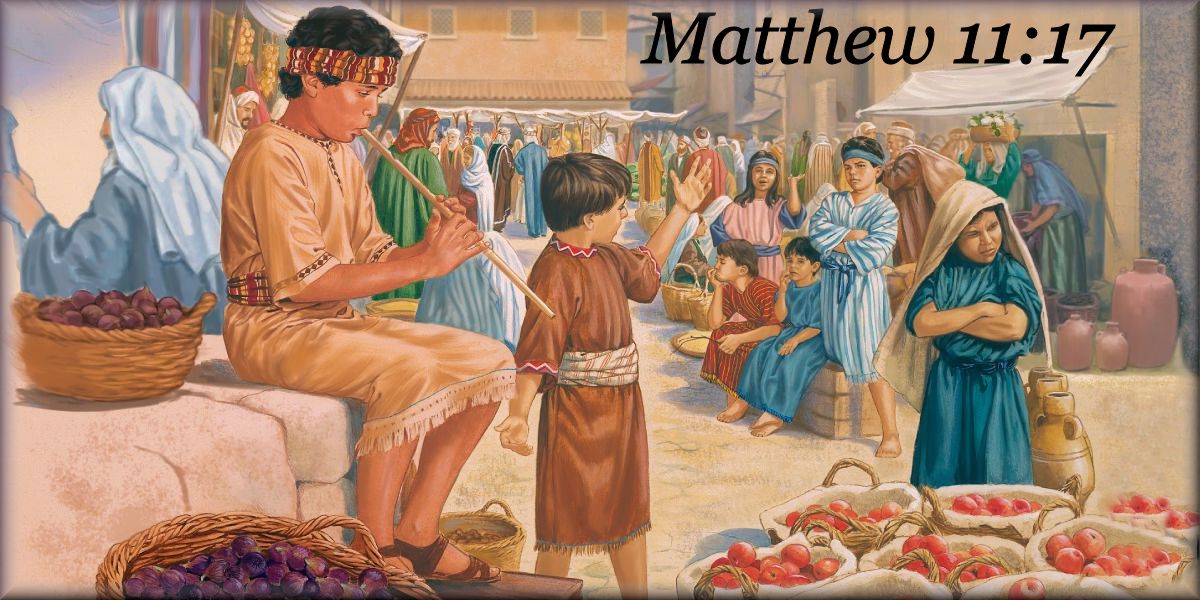
“We played wedding music for you, but you wouldn’t dance!”
“We played wedding music for you, but you wouldn’t dance!”
What did Jesus mean?
Matthew 11:16,17
16 “Now, to what can I compare the people of this day? They are like children sitting in the marketplace. One group shouts to the other,
17 ‘We played wedding music for you, but you wouldn’t dance! We sang funeral songs, but you wouldn’t cry!’
That the people of his day, like the people of this day, often stage situations expecting others to automatically play a role they have been presented with. They behave like children who have put on a choreographed skit and then get frustrated that you will not play the part they have created for you.
Instead of excepting and conforming to what God was leading, they desired to bend things to their desire and will. They did not want to lend their allegiance to a Heavenly kingdom with a Heavenly leader, but to an earthly kingdom and a man-made rulership.
In the preceding verses, Jesus draws his listener’s attention first to John the baptizer and then to himself.
Matthew 11:7(b) -10
“When you went out to John in the desert, what did you expect to see? A blade of grass bending in the wind?
8 What did you go out to see? A man dressed up in fancy clothes? People who dress like that live in palaces!
9 Tell me, what did you go out to see? A prophet? Yes indeed, but you saw much more than a prophet.
10 For John is the one of whom the scripture says: ‘God said, I will send my messenger ahead of you to open the way for you.’
But John did not fit their expectation either and was rejected by the great many of his fellow Israelites. They saw him as some weird guy who didn’t fit in.
John the Baptist was born a son of one of the Priests of Israel. It would be expected that he would follow in his father’s footsteps and become a temple priest himself. Instead of being in the temple, John was preaching in the wilderness.
At the time of John the baptizer there was a great amount of corruption that existed in the temple. We know that many of the priests used their position to become wealthy, turning the temple into a den of thieves as Jesus called it.
John rejected the corruption of the temple, and instead went into the wilderness to preach God’s Word. He rejected the best foods of the day to eat locusts and honey. Instead of a priestly robe, he wore skins but he preached the truth of God’s Word. That must have seemed strange to most of his contemporaries.
Also, John preached about the “Kingdom of heaven” and not about the establishment of an earthly kingdom in the hands of men. This is the same ‘Kingdom’ all the preceding prophets before John had pointed to.
Matthew 11:12-14
12 From the time John preached his message until this very day the Kingdom of heaven has suffered violent attacks, and violent men try to seize it.
13 Until the time of John all the prophets and the Law of Moses spoke about the Kingdom;
14 and if you are willing to believe their message, John is Elijah, whose coming was predicted.
It was also true of the Lord Jesus himself.
Matthew 11:18 and 19
18 When John came, he fasted and drank no wine, and everyone said, ‘He has a demon in him!’
19 When the Son of Man came, he ate and drank, and everyone said, ‘Look at this man! He is a glutton and wine drinker, a friend of tax collectors and other outcasts!’ God’s wisdom, however, is shown to be true by its results.”
Yes they also accredited Jesus’ powerful works to the demons too.
Matthew 12:22-24
22 Then some people brought Jesus a man possessed by a demon. The demon made the man blind and unable to talk. Jesus cured him so that he could talk and see.
23 The crowds were all amazed and said, “Can this man be the Son of David?”
24 When the Pharisees heard this, they said, “This man can force demons out of people only with the help of Beelzebul, the ruler of demons.”
Jesus did not fulfill their expectations either. The Pharisees and others looked down on him because of his personal habits and the company he chose to keep. The Pharisees you may recall, were very elitist and would never be seen associating with the majority of the kinds of people the Lord was willing to expose himself to. Jesus said himself:
Luke 5:32
“I came not to call the righteous, but sinners to repentance”.
They had their own ideas of godliness and righteousness that Jesus would not become part of. It was self-righteousness. And many Jews at that time had a Zionist vision that Jesus would have nothing to do with. They were NOT seeking the Kingdom of heaven. Some even wanted to make him their king, but he rejected the notion. And this frustrated them and made them question why.
So Jesus compared them to little children who had prepared a scene of their choosing but wasn’t what God had prepared. Think: If you heard wedding music but there was no actual wedding going on, would you start dancing as if there were? If you heard a funeral dirge yet no one had died, would you weep and mourn anyway? Are you stirred up by behaviors around you to do things contrary to the will of God?
Because Jesus did not fit their ideas and did not play to their tune so to speak, he was rejected. In rejecting Jesus, they were rejecting God and His divine plan.
Today we see the very same attitudes and behaviors continue by those who seek not the Kingdom of heaven, but the establishment of an earthly world ruling kingdom.
One of the groups that Hitler sent to concentration camps were Jehovah’s Witnesses. They were forced to endure unspeakable atrocities and many lost their lives. The individual actions of many Witnesses are commendable and the Watchtower holds up this part of their history in great esteem.
What is not discussed is the hypocritical actions of Rutherford in the lead up to these events. Early in 1933, the Watchtower office in Berlin was closed and Jehovah’s Witnesses were banned in many German states.
In an attempt to appease Hitler, Rutherford instigated a Declaration of Facts and sent a letter to Hitler discussing the Watchtower’s support of the Nazi regime.
Current Watchtower references provide a deceptive portrayal of these documents, through selective quoting. The Proclaimer’s book mentions that Rutherford wrote a letter to Hitler under the context of “facing Nazi oppression”, in which the Watchtower Society is made to sound as if they were firmly against the Nazi regime.
“Therefore, on June 25, 1933, a declaration regarding their ministry and its objectives was adopted by Jehovah’s Witnesses at an assembly in Berlin. Copies were sent to all the high government officials, and millions more were distributed to the public. Nevertheless, in July 1933 the courts refused to grant a hearing for relief. Early the following year, a personal letter regarding the situation was written by J. F. Rutherford to Adolf Hitler and delivered to him
by special messenger. Then the entire worldwide brotherhood went into action.
On Sunday morning, October 7,1934, at nine o’clock, every group of Witnesses in Germany assembled. They prayed for Jehovah’s guidance and blessing.
Then each group sent a letter to German government officials declaring their firm determination to keep on serving Jehovah.” – Jehovah’s Witnesses – Proclaimer’s Of God’s Kingdom p.693
It is quite surprising to find the opposite is true, which can be identified when reading the content of Rutherford’s
1933 letter to Hitler and the Declaration of Facts.
Russell, founder of the Watchtower, was a Zionist and sympathetic to Jews as part of modern-day fulfilment of Bible prophecy. Rutherford initially continued such support, but changed by the 1930’s to an anti-Semitic stance.
“Be it known once and for all that those profiteering, conscienceless, selfish men who call themselves Jews, and who
control the greater portion of the finances of the world and the business of the world, will never be the rulers in this new earth.
God would not risk such selfish men with such an important position” The Golden Age 1927 Feb 23 p.343
“The Jews were evicted from Palestine and ‘their house left unto them desolate’ because they rejected Christ Jesus, the beloved and anointed King of Jehovah. To this day the Jews have not repented of this wrongful act committed by their forefathers. … In 1917 the Balfour Declaration, sponsored by the heathen governments of Satan’s organization, came forth, recognized the Jews, and bestowed upon them great favors. … The Jews have received more attention at their hands than they really deserved.” Vindication – Book II (1932) pp.257-258
During the time of Rutherford, Witnesses became known as a religion of hate, due to the Watchtower’s tirade of insults against other Churches and governments. The Catholic Church come under the greatest condemnation and bought this to the attention of the Nazi government, petitioning against the Watchtower Society. In 1933, the Nazi government banned the Watchtower’s German operations.
“In June of the so-called “Holy Year” of 1933 Adolf Hitler’s regime seized the Watch Tower Society’s property in Magdeburg and banned the activities of Jehovah’s people in Germany as regards meetings and literature distribution, though the property was returned that October.” Yearbook 1975 p.174
In an effort to overturn the ban, Rutherford sent a Letter and a Declaration to Hitler, in which he could rightfully praise Hitler for his anti-Anglo/American campaign and his stance against the Jews.
“Following is part of an English translation of the Letter to Hitler. (known as the Declaration of Facts)
“Dear Reichskanzler,
…
The Brooklyn headquarter of the Watchtower Society is pro-German in an exemplary way and has been so for many years. For that reason, in 1918, the president of the Society and seven members of the board of directors were sentenced to 80 years in prison, because the president refused to use two of the magazines published in America under his direction for war propaganda against Germany. These two magazines, “The Watchtower” and “Bible Student” were the only magazines in America which refused to engage in anti-German propaganda and for that reason were prohibited and suppressed in America during the war.
In the very same manner, in course of the recent months the board of directors of our Society not only refused to engage in propaganda against Germany, but has even taken a position against it. The enclosed declaration underlines this fact and emphasizes that the people leading in such propaganda (Jewish businessmen and Catholics) also are the most rigorous persecutors of the work of our Society and its board of directors. This and other statements of the declaration are meant to repudiate the slanderous accusation, that Bible Researchers are supported by the Jews.
The conference of five thousand delegates also noted – as is expressed in the declaration that the Bible Researchers of Germany are fighting for the very same high ethical goals and ideals which also the national government of the German Reich proclaimed respecting the relationship of humans to God, namely: honesty of the created being towards its creator. The conference came to the conclusion that there are no contradictions when it comes to the relationship between the Bible Researchers of Germany to the national government of the German Reich. To the contrary, referring to the purely religious and unpolitical goals and efforts of the Bible Researchers, it can be said that these are in full agreement with the identical goals of the national government of the German Reich.
We are looking forward to your kind approval, which we hope to receive soon, and want to assure our highest respect to you, honorable Mr. Reichskanzler.
Yours faithfully,
Watch Tower Bible and Tract Society Magdeburg”
Since that time two groups have formed. One supporters of C. T. Russell (at some times called ‘Russellites’), and another group who support the views and teachings of J. F. Rutherford (Rutherfordites). This schism continues to exist until today. Each group claiming the other is wrong. The reality is that they are both out of harmony with the teachings of the Bible and both fall short of true obedience as disciples of Christ.
They each cling to an earthling man as their spiritual leader. They prove themselves to be disciples of men and not of Christ Jesus.
Paul spoke of this very phenomenon occurring in the first century.
1 Corinthians 1:10-13
“Now I beseech you, brethren, by the name of our Lord Jesus Christ, that ye all speak the same thing, and that there be no divisions among you; but that ye be perfectly joined together in the same mind and in the same judgment.
11 For it hath been declared unto me of you, my brethren, by them which are of the house of Chloe, that there are contentions among you.
12 Now this I say, that every one of you saith, I am of Paul; and I of Apollos; and I of Cephas; and I of Christ.
13 Is Christ divided? was Paul crucified for you? or were ye baptized in the name of Paul?”
Just substitute the names Cephas and Apollos with Russell and Rutherford. They both are doing the very thing the Apostle warned against.
Was it Russell that died for you? Was it in Rutherford’s name you were baptized?
They are divided because their discipleships are founded on men and their warring is divisive and hinders the operation of the Holy Spirit. They glorify men and man-made organization and entice others to follow their path.
It is Jesus Christ is who is to be followed. They need to stop putting faith in earthling man.
Charles Taze Russell mixed Bible belief with mysticism (example: seeking answers by studying the Giza pyramid). He was a man who held Zionist beliefs and expectations. He was a man who preached that a person could not come to an accurate understanding of the Bible without reading his books. And he shared other non biblically based thinking.
Joseph Franklin Rutherford was an anti-Semite who groveled at Adolf Hitler’s feet using anti-Semitic speech to appease him. He turned what Russell started into an organizational structure. He also initially share Russell’s Zionist vision of the restoration of physical Israel.
The followers of Russell and the followers of Rutherford offer a false dichotomy. If one chooses either, they are not true followers of Christ and they would have those who listen and believe what they teach remain connected to a house that has been condemned. They will not as Jesus admonished, “Get out of her my people, that you be not partakers of her sins, and that you receive not of her plagues”.
These have not really heeded Christ warning as they will not make a clean break from the Watchtower Society. They continue to malinger in a house that Christ has condemned.
Do You Believe Stephen or Do You Believe In The Trinity?
At first notion that may seem to be a silly question to ask. But there is a good reason to ask it.
What was it that the disciple Stephen saw in Heaven?
The Bible in the Book of Acts chapter six, describes the man Stephen as, “a man full of faith and of the Holy Ghost (Holy Spirit)…”. (KJV)
Stephen had a vision by means of Holy Spirit just before his death. After eloquently defending his faith in Jesus Christ before a mob who were about to take him out and stone him, this is the account of what he saw: Acts 7:55-60
55 “But he, being full of the Holy Ghost, looked up steadfastly into heaven, and saw the glory of God, and Jesus standing on the right hand of God,
56 And said, Behold, I see the heavens opened, and the Son of man standing on the right hand of God.
57 Then they cried out with a loud voice, and stopped their ears, and ran upon him with one accord,
58 And cast him out of the city, and stoned him: and the witnesses laid down their clothes at a young man’s feet, whose name was Saul.
59 And they stoned Stephen, calling upon God, and saying, Lord Jesus, receive my spirit”.
60 And he kneeled down, and cried with a loud voice, Lord, lay not this sin to their charge. And when he had said this, he fell asleep”. (KJV)
Stephen said that he saw the resurrected Jesus standing, “on the right hand (on the right side) of God”. Stephen saw two distinct personages. He saw Jesus and he saw that he stood next to God Almighty.
This does not square with those who teach and believe that Jesus Christ was God on Earth in flesh.
For that belief to be true then either Stephen had a vision of God standing next to Himself which is impossible, or….Stephen had to have been cross-eyed and suffered from double-vision.
He didn’t see just one, he saw two individuals.
At the time when Jesus was baptized by John the baptizer, a voice was heard out of Heaven, “And lo a voice from heaven, saying, This is my beloved Son, in whom I am well pleased”. Matthew 3:17 (KJV)
Do you believe that Jesus in some sort of trickery, pitch his voice in order to deceive those with him? Who then was it that spoke from Heaven if he were God on Earth?
Those who believe Jesus and God Almighty are one and the same person misinterpret John’s personal expressions found at John 1:1.
“In the beginning was the Word, and the Word was with God, and the Word was God”. (KJV)
Keep in mind, the Book of John’s purpose is to provide a gospel account of what Jesus himself said and did. The words at John 1:1 are not the words of Jesus, but of John the writer. Jesus never said he was God. He identified himself as the Son of God.
John 10:36
“how can you say to the one whom the Father has consecrated and sent into the world, ‘You’re blaspheming,’ because I said, ‘I’m the Son of God’?”
The John who wrote what is recorded as the Book of John is the same John who wrote what is recorded in the Book of Revelation. In reading the Book of Revelation it is quite obvious the John did not believe Jesus was God Almighty.
How is Jesus ‘godly‘?
Jesus is unique from all other creation. He is divine in that he is “begotten” of God. This mean God took of himself and formed His son. As your offspring are of your flesh, Jesus is of the same of what God’s body consist of and shares in this way godliness.
Jesus states himself as John records, what his relationship to God Almighty is. In John chapter 14 verse 28 we read:
“Ye have heard how I said unto you, I go away, and come again unto you. If ye loved me, ye would rejoice, because I said, I go unto the Father: for my Father is greater than I“. (KJV)
Jesus clearly states that God the Father is greater than himself.
Also in the same Bible book of John chapter 6 verse 38, Jesus makes this statement regarding himself:
“For I came down from heaven, not to do mine own will, but the will of him that sent me”. (KJV)
Who can send God Almighty anywhere? No one.
But God Almighty can send a lesser than himself to Earth and He did in sending His only begotten son.
Jesus further made it clear that he was not God come down to Earth when he said to his disciples:
John 16:27
“I left the Father and came into the world. Now I’m leaving the world and going back to the Father.”
Also note what occurred at the transfiguration scene found at Luke 9:34-35:
34 “While he thus spake, there came a cloud, and overshadowed them: and they feared as they entered into the cloud.
35 And there came a voice out of the cloud, saying, This is my beloved Son: hear him”. (KJV)
If Christ were God in flesh, who was it that spoke from Heaven?
Paul said this about Almighty God,
“Now unto the King eternal, immortal, invisible, the only wise God, be honour and glory for ever and ever. Amen”. 1 Timothy 1:17 (KJV)
God is and has always been immortal. Therefore, it is impossible for Him to die.
Yet we know the Jesus Christ did die and had to be resurrected. Ask yourself: By whom was Jesus resurrected?
The apostle Paul when writing to the Corinthians, tell the answer to this question:
1 Corinthians 15:12-17
12 Now if Christ is preached, that he has been raised from the dead, how do some among you say that there is no resurrection of the dead?
13 But if there is no resurrection of the dead, neither has Christ been raised.
14 If Christ has not been raised, then our preaching is in vain, and your faith also is in vain.
15 Yes, we are found false witnesses of God, because we testified about God that he raised up Christ, whom he did not raise up, if it is so that the dead are not raised.
16 For if the dead are not raised, neither has Christ been raised.
17 If Christ has not been raised, your faith is vain; you are still in your sins.
Paul stated that “we testified about God that he raised up Christ…”. Clearly, Jesus was mortal and his immortal Father resurrected him from death.
According to what is written at Romans Chapter 6 verses 8 and 9, it wasn’t until after Christ resurrection that he put on immortality.
Romans 6:8-9
8 Now if we have died with the Messiah, we believe that we will also live with him,
9 for we know that the Messiah, who was raised from the dead, will never die again; death no longer has mastery over him.
Again, God is eternal having no beginning nor end. He is and has always been immortal.
However, Jesus was begotten by his Father a mortal being who came to Earth, lived a mortal human life, died, and was raised by God to an immortal life.
While the picture illustration that accompanies this article may seem a bit humorous, it should cause you to think quite seriously about the subject and what you have been taught.
What did Stephen see in his vision before he expired?
Do you believe Stephen who the Bible describes as being full of the Holy Spirit and what he saw?
Do you believe Jesus and the words from his own mouth identifying himself as lesser than God the Father? Do you believe God Almighty who twice identified Jesus as His son?
Or, will you stubbornly insist on believing the misinterpretation of John 1:1 while ignoring what the Bible clearly states concerning God the Father and Christ Jesus his son?
2 Peter 3:8
“But, beloved, be not ignorant of this one thing, that one day is with the Lord as a thousand years, and a thousand years as one day.”
The root of the number 144,000 is explained in this brief but informative article.
Twelve priest served the daily offerings in the Temple.
Twelve priest serving twelve loaves equals 144.
“Twelve per day”
One of the central Temple vessels is the golden Table for the Showbread, which stands within the Sanctuary itself, on the north side. This table is constructed of wood overlain with gold, and the specific instructions for its design are described in Exodus Chapter 25.
The priests are commanded to see to it that 12 loaves of bread are constantly displayed on this table before the presence of G-d, hence the name showbread: “And you shall place showbread on the table before Me at all times” (Ex. 25:30).
These 12 loaves were baked in pans which gave them a specific form, and when done they rested on golden shelves upon this table. The loaves were replaced every Sabbath with new ones.
It is said that bread is the staff of life, and represents man’s physical sustenance. This is certainly so, and it is important that G-d’s blessing for goodness and bounty be found in the bread which we partake of… for without His munificent blessing, all of man’s efforts would neither satisfy nor satiate. Thus we endeavor to fulfill His will throughout every aspect of our endeavors, and in so doing, we earn His favor and blessing… for each area wherein man fulfills the Holy One’s will becomes a channel receiving Heavenly blessing.
This was especially so in the case of the Showbread, and one aspect of its function was indeed to elicit Divine guidance and providence. The sages teach that since these loaves were in essence the vehicle for fulfilling G-d’s commandment, and they were used to accomplish His will, special blessing could be found in it, and indeed, the Divine blessing was seen and felt particularly in the context of the Showbread. The Talmud describes that a miracle took place every week: When the priests came to replace the breads with new loaves every Sabbath, they found that those of the previous week remained fresh and hot upon the table, like the moment they were baked.
This miracle was seen as a clear confirmation that the Divine Presence indeed rested in this holy place.
In this light we find the sages’ comment that when the Holy Temple stood, every facet of human existence was similarly blessed by a corresponding aspect of the Divine service:
The produce of the fields were blessed on account of the showbread and the omer offering;
The yearly rainfall, on account of the water libations during the Holiday of Sukkot;
Clothing kept one warm in the merit of the priestly garments;
The economy prospered because of the daily sacrifices.
When the Temple was destroyed, all these benefits were discontinued, as recorded by the prophet Hagai: “You have sown much, and bring in little; you eat, but you are not satiated; you drink; but you are not filled with drink; you clothe yourselves; but no one is warm; and he that earns wages earns them to put them into a bag with holes” (Hagai 1:6).
A Jewish man called Yochanan (John the Baptizer) was baptizing people in the Jordan River in first century Israel, including his cousin who would later become world famous: Yeshua of Nazareth (Jesus of Nazareth)
Water Baptism-Ritual Cleansing
Did John the Baptizer Invent Baptism? When, how, and why was the practice begun?
A Jewish man called Yochanan (John the Baptizer) was baptizing people in the Jordan River in first century Israel, including his cousin who would later become world-famous: Yeshua of Nazareth (Jesus of Nazareth).
Many Jewish people responded to the call of this Jewish man to immerse themselves in the river as a sign of repentance, and a desire to get right with God. Some of the Pharisees were also among them. Did Yochanan (John the Baptizer) invent baptism at this time? Or was it part of Jewish tradition and practice before that?
No he didn’t, and yes it was.
And the Hebrew word for an immersion pool built for this purpose, “mikveh”, also points us in the right direction in understanding deeper meaning in the practice.
Immersion in Jewish Tradition
The Jewish laws which had been passed down orally from generation to generation had several things to say about the need for ritual washing, and the most desirable places to do it. There are six different options suggested that satisfy the requirements, starting with pits or cisterns of standing water as acceptable but least desirable, moving up to pits that are refreshed by rainwater as slightly more desirable, then the custom-built ritual bath, or “mikveh” with 40 se’ahs (300 liters) or more of water, then fountains, then flowing waters.
But “living waters” (as found in natural lakes and rivers) which were considered to be the best possible situation.
The Mishnah specifies what makes the water clean or unclean, and expresses a preference for a larger, fresher body of water, “For in it persons may immerse themselves and immerse others”.
So Yochanan (John the Baptizer) immersing people in the “Living waters” of the River Jordan was perfectly within Jewish law and practice at the time.
The Essenes, a strict Jewish sect, were doing it too out in the Judean Desert. But why were Jewish people immersing themselves in water? Is baptism in the Jewish Scriptures? Well, sort of, yes.
Ritual Bathing in the Bible
“Then the LORD spoke to Moses, saying: You shall also make a laver of bronze, with its base also of bronze, for washing. You shall put it between the tabernacle of meeting and the altar. And you shall put water in it, for Aaron and his sons shall wash their hands and their feet in water from it. When they go into the tabernacle of meeting, or when they come near the altar to minister, to burn an offering made by fire to the LORD, they shall wash with water, lest they die. So they shall wash their hands and their feet, lest they die. And it shall be a statute forever to them– to him and his descendants throughout their generations.” Exod 30:17-21
The priests had to be ritually clean (tahor) in order to serve at the tabernacle, and Israelites who had become ritually unclean (tamay) had to restore their situation with the passing of time and bathing their whole body in fresh, ritually clean (tahor) water, according to Leviticus 15.
Later, when the temple had been built, it was necessary for everyone to be immersed in a mikveh to become ritually clean before entering the temple. There are many ancient mikva’ot (plural of mikveh) to be seen in Jerusalem, and it is clear to see the two sets of steps for each one – a set of steps going down to the mikveh in an impure (tamay) state on one side, and on the other side, steps where the pilgrim will emerge fresh and ritually clean (tahor).
What did it look like in the time of Jesus?
Following the upheaval of the 1967 war, archaeologists were presented with the opportunity to excavate parts of the upper city of Jerusalem, giving a new window into daily life in ancient times. Many of the houses were grand and spacious, with their own water cisterns and ritual baths in the basements.[2] Some houses were found to have had several of these mikva’ot, since it is thought that as well as providing for the household (which could even be up to fifty people) they would have been able to welcome and host pilgrims arriving for the Jewish feasts, catering for many more. Many of this upper city aristocracy were among the priestly class, who would have to stay in a state of ritual purity as much as possible, and so would have to immerse themselves in a mikveh frequently. Archaeologists also believe that the pools of Siloam and Bethsaida could have been used for ritual bathing in the Second Temple period for those visiting Jerusalem for the high holy days.
So immersion in a mikveh was quite common at the time of Yeshua, but the New Testament also describes baptisms taking place not only in rivers, but in any available body of water. In Acts 8, we read of a visiting pilgrim from Ethiopia, who came to believe in Yeshua as he read Isaiah on the way home:
“As they traveled along the road, they came to some water and the eunuch said, “Look, here is water. What can stand in the way of my being baptized?” (verse 36).
By this point baptism had come to signify a decision to accept Yeshua as Messiah and Lord.
The word “Mikveh”
The Hebrew noun for a ritual bath (mikveh) can help us understand a bit more about the Jewish notion of immersion. Often the Hebrew language reveals keys in the Hebrew thought behind the words. The word mikveh shares the same root as the word for hope (tikvah), for line (kav) and alignment, and the concept of hoping or waiting on God (kiviti l’Adonai).
Here is what Strong’s Lexicon has to say about the word:
מִקְוֶה miqveh, mik-veh’;
something waited for, i.e. confidence (objective or subjective);
also a collection, i.e. (of water) a pond, or (of men and horses) a caravan or drove:—abiding, gathering together, hope, linen yarn, plenty (of water), pool.
and the same root word:
קָוָה qâvâh, kaw-vaw’;
to bind together (perhaps by twisting), i.e. collect; (figuratively) to expect:—gather (together), look, patiently, tarry, wait (for, on, upon).
The ideas of binding together, or twisting together, of yarn, gives us a good mental picture of what it means to align ourselves with God, and wait for him. We gather ourselves and bind ourselves to his word and to him, we line ourselves up with him, and wait for him in confidence and hope. When you read that the Psalmist says he waits upon the Lord, this is usually the word he is using.
The linked concepts of mikvah (collected pool of water) and tikvah (hope, confidence) are played out beautifully in Jeremiah 17:5-6, where the prophet poetically expresses the ideas through the metaphor of trees either rooted and flourishing beside water when we trust in God, or drying up for the lack of water when we put our trust in man. A few verses later, Jeremiah summarises:
Lord, you are the hope (mikveh) of Israel; all who forsake you will be ashamed (or dried out).
Those who turn away from you will be written in the dust because they have forsaken the Lord, the spring of living water.
This is a word play – the text actually says “The Lord is the MIKVEH of Israel, and all who forsake him will be ashamed or dried out!” So it makes more sense now that Jeremiah continues, to say that when we turn away from this mikveh of water and hope, we will be ashamed, which can also be translated “dried out”. Through this word play, Jeremiah deliberately points us back to the analogy of the man who trusts in God being like a tree beside plenty of water, and the one who leaves God ending up in dry, dusty shame.
A “Mikveh” of living water represents the bounty and resources of the new life that we can enjoy in God. Those who put their hope in God, choosing to align their lives with him, will never be dried out, but will always have fresh life in him.
Next time you see someone being immersed in water to signify their new life in Yeshua, the hope of Israel, the mikveh of Israel, call to mind all that he said about being the water of life, the well of living water that springs up to eternal life… because that’s exactly who He is!
There are six degrees of gatherings of water, each superior to the other.
The water of pits… The same rules apply to the water of pits, the water of cisterns, the water of ditches, the water of caverns, the water of rain drippings which have stopped, and mikwehs of less than forty se’ahs: they are all clean during the time of rain; when the rain has stopped those near to a city or to a road are unclean, and those distant remain clean until the majority of people pass [that way].
Superior to such [water] is the water of rain drippings which have not stopped.
Superior to such [water] is [the water of] the mikveh containing forty se’ahs, for in it persons may immerse themselves and immerse others.
Superior again is [the water of] a fountain whose own water is little but has been increased by a greater quantity of drawn water; it is equivalent to the mikveh inasmuch as it may render clean by standing water, and to an [ordinary] fountain in as much as one may immerse in it whatever the quantity of its contents.
Superior again are ‘smitten waters’ which can render clean even when flowing.
Superior again are ‘living waters’ which serve for the immersion of persons who have a running issue and for the sprinkling of lepers, and are valid for the preparation of the water of purification.
“You are to be holy to Me because I, Yahweh, am holy, and I have set you apart from the nations to be Mine”? Leviticus 20:26 Holiness is not merely a spiritual state. Spirituality can be rooted in unholiness. Holiness is keep one’s self separate in order to serve in behalf of other.
Studying The Priesthood of God
What did God mean when he said concerning His priesthood, “You are to be holy to Me because I, Yahweh, am holy, and I have set you apart from the nations to be Mine”? Leviticus 20:26
What did Peter mean when counseling first century anointed disciples, “But as the One who called you is holy, you also are to be holy in all your conduct; for it is written, Be holy, because I am holy.” 1Peter 1:15,16
What is the difference between ‘spirituality’ and ‘holiness’?
Reaching levels of inspiration and revelation that are not rooted in holiness, as personified by the wicked heathen prophet Balaam, King Balak, and the elders of Moab and Midian, are all equally reprehensible (these practiced various forms of divination and occult arts in order to bring about prophetic revelation.
Their Function and Role in the Holy Temple
“And it shall be for them an appointment as priests forever, for all generations.” (Ex. 40:15)
“For the Lord your God has chosen him out of all your tribes, to stand to serve in the name of the Lord, him and his sons forever.” (Deut. 18:5)
Who are the Priests?
The first kohen, the founder of the priestly clan, was Aaron, brother of Moses, of the tribe of Levi. All of Israel are descended from the twelve sons of Jacob. Jacob’s third son was Levi, and Aaron was a fourth generation descendant of Levi.
Aaron and his four sons were designated as the first priests; Aaron served as the first High Priest. All of his male descendants were chosen by God to be priests forever; it is an eternal covenant. Thus even today, a kohen amongst the Jewish people is genealogically a direct descendant of Aaron.
The Role of the Priests
The Holy One chose these men to be in a position of spiritual leadership. In the days of the Temple, they were responsible for the sacred service. The Hebrew word kohen actually means “to serve,” and a deeper linguistic connection can be found in the word ken, meaning “yes,” itself related to kivvun, “to direct.” Thus a kohen is called upon to direct himself, and others, in the proper service of God: “And you, separate your brother Aaron and his sons from among the Israelites, and bring them close to you… so they can serve me.” (Ex. 28:1)
A Conduit for the Reception of Divine Blessing
The reader is undoubtedly most familiar with the primary role which the priests perform in the Temple, that of officiating at the sacrifices and other parts of the service. But more importantly, by attending to the various aspects of the Divine service, the priests serve as a conduit to bring down God’s radiant blessing and influence into this world. In fact, it is on this account that they are commanded to deliver God’s blessing of peace and love to the people, as well: “Say to Aaron and his sons… Thus shall you bless the people of Israel: ‘May the Lord bless you and protect you. May the Lord shine His face upon you, and be gracious unto you. May the Lord lift up His face to you and may He grant you peace’.” (Numbers 6:22 – 26)
The Priestly Blessing is Delivered Daily in the Temple
Every day in the Temple, at the conclusion of the morning service, this blessing was performed by the officiating priests, standing on the steps leading up to the sanctuary. Thus while it is only God who has the power to bestow blessing upon people, the function of the priests was to serve as a vehicle, a medium, through which the Divine influence may descend.
“… He stands behind our wall… “
This concept of the priests “directing” the flow of Divine blessing is alluded to by a verse in the Song of Songs (2:9 – 10): “Behold, He stands behind our wall, watching through the windows, glancing through the cracks.”
The sages of the Midrash interpret these words to mean that it is God who stands behind the priests as they deliver His blessing. The illumination of His Presence shines through their hands, which are outstretched as they utter the priestly blessing.
The Priests Possess Special Qualities
The priests represent kindness, and the focusing of life’s energies on sanctity and Divine purpose. It was the attribute of kindness, understanding and love for all which Aaron, the first High Priest, was best known for, and his descendants are entrusted to exemplify Hillel’s famous dictum in the Chapters of the Fathers (Avot 1:12): “Be of the disciples of Aaron, loving peace and pursuing peace, loving your fellow-creatures, and drawing them near to the Torah.” This quality was highly visible and crucially instrumental following the rebellion of Korach, when it was Aaron who saved the people from the full extent of Divine wrath (see Numbers 17).
Because of their ability to invoke Heavenly influence, the sages even record that the priestly families possess distinctive character traits and qualities which are part of their special spiritual heritage: they are known to be joyful, giving, and driven by a loftier nature. In the era of the Temple, they were praised for their zeal and dedication to fulfill the commandments and give honor to the Creator.
Later, through the ensuing course of history, it was generally the tribe of Levi and the priestly family in particular that were exemplary in their zealousness for the honor of God. Thus it was the priestly family of the Hasmonaim – the famous “Maccabees” – who led the revolt against foreign idolatrous influence and rededicated the Holy Temple, events marked by the holiday of Chanukah.
The daily blessing of the priests in the Temple serves to open the Heavenly gates of mercy. Through it, the people of Israel merit not only material well-being – including offspring and longevity – but spiritual blessings as well; mercy, Divine protection and the greatest blessing of all… true peace. Since the priests themselves represent the attribute of kindness, their service brings the flow of God’s blessing down to His people.
General Rules of Priestly Conduct
The priest must be holy to his God. You must keep him holy, for he presents the offering to your God… He must be holy, for I am God – I am holy and I am making you holy” (Lev. 21).
God Has Sanctified The Priests Above All Men
The Holy One ordained special laws which effect the lives of the priests. The fundamental understanding behind these principles is that the status of the priest is different than that of other men. Their lot is one of dedication, of separation – for they are the servants of the Lord, and the custodians of His service. “… For he presents the offering to your God… “
Because of this, “… he must be holy, for I am God – I am holy and I am making you holy.” The Creator has sanctified these men above the rest for all time, and drawn them to Himself through unique commandments.
Overview
These laws are recorded in the book of Leviticus, and by way of an introduction, let us examine the verse quoted above. The priests are expected and commanded to keep holy… but what is meant by “holiness?” What is the Bible’s intention?
“He must be holy, for I, God, am holy.” How are we to understand this state of holiness? How can we best explain such a concept? It seems intangible at best – for in the context of this verse, it seems that the priest is called upon to be holy in the same sense that God Himself is holy.
It would surely be instructive at this point for us to attempt a definition for the word “holy.” For we can see that the Bible uses this word quite emphatically in the context of the priests: they are actually mandated to be holy, to lead holy lives, because God is holy. But how can a person be holy like God?
Many people seem to equate the concept of holiness with spirituality in general; anything ethereal or mystical is presumed to be holy. According to this mentality, one supposes that holiness is a matter of secret knowledge, or simply a question of allegiance to any proscribed ritual claimed by its adherents to bring the devotee closer to fulfillment.
To Be Spiritual Does Not Automatically Imply Holiness
This is a serious misconception, one which is completely out of tune with the Biblical idea of holiness as exemplified by the “holiness” which is expected and required of Aaron’s descendants. For holy and spiritual are not the same things and they are certainly not equal.
Consulting Webster’s Dictionary, we find that the word “spiritual” is derived from the Latin spiritualis, “of breathing; of wind; relating to or consisting of spirit.” Thus: “INCORPOREAL,” (fortunately, we are also given “of or relating to sacred matters,”) and since the primary meaning of this word seems to be that which is non-physical, we end with “of or relating to ghosts or similar supernatural beings(!)”
Thus many people, disciplines, philosophies and the like may be considered spiritual in nature, they may concern themselves with the esoteric, they may even occupy themselves with the service of God – but this does not necessarily imply that they are holy in any way.
Forbidden Spiritual Pursuits
In fact, some spiritual paths can most definitely be the absolute epitome of unholiness:
The Bible is clear in its prohibition of spiritualism which has not been authorized by God. “Do not act on the basis of omens… do not act on the basis of auspicious times” (Lev. 19:26), we are warned. These forbidden practices include one who acts on the basis of a superstitious omen, and those who seek out auspicious times through astrology.
When the Children of Israel were preparing to end their desert wanderings and enter into the Promised Land, they were specifically warned by God to uproot the perverted spiritual practices of the former inhabitants from the land, and to be particularly cautious not to be tempted to experiment with mystical occult practices. “When the Lord your God excises the nations to which you are coming, and drives them away before you, you shall dispossess them and live in their land. Be very careful not to fall into a trap by following after them, after they have been wiped out from before you. Do not try to find out about their gods, saying, ‘How did these nations worship their gods? I would also like to try this.’ Do not worship the Lord your God with such practices. In worshipping their gods, these nations committed all manner of perversions hated by the Lord… ” (Deut. 12:29 – 31).
Reaching levels of inspiration and revelation that are not rooted in holiness, as personified by the wicked heathen prophet Balaam, King Balak, and the elders of Moab and Midian, are all equally reprehensible (these practiced various forms of divination and occult arts in order to bring about prophetic revelation. See Numbers 22).
So, while other nations may have their own routes to connect with the “Divine,” or their own conception thereof; or, perhaps they merely delude themselves and others into thinking that they are serving God, and the side of holiness – clearly, the Torah’s prohibitions instruct Israel that these other ways are not for her. There may be other paths of spirituality, but they are not for Israel; she is to be “a kingdom of priests and a holy nation” (Ex. 19:6).
But we have not yet come any closer to an understanding of the priests’ exhortation to live holy lives “because God is holy;” neither have we come any closer to a grasp on how an individual can be holy like God. If God is incorporeal, if God is spirit, is a man therefore commanded to be spirit? Spirituality is clearly a separate concept, and one that is not necessarily pure, at that.
Holiness Means Separation
By contrast to the concept of “spiritual” – which seems to be rather unstable for our liking, since it can actually apply to things quite far from all which we have considered sacred – we find that the primary definition of “holy” is “set apart to the service of God.”
God Himself is called holy because He is completely separate; unique and unequaled in all of His creation. Nothing can be compared to Him because He is peerless; He is the Creator of the universe and all existence, and absolutely different from anything else that exists. It is in this light that Israel is collectively called upon to be a “holy nation” – that is, a nation set apart from all others, completely different from any other, whose Divinely-mandated lifestyle serves as living proof that an entire nation can walk with God in its midst… “it is a nation dwelling alone in peace; not counting itself among other nations” (Numbers 23:9).
This separation is the true Biblical view of holiness. This is why the opposite of something holy is said to be mundane or profane; ordinary. To be holy is to be removed from the realm of the ordinary. Israel lives separately, according to the Torah’s commandments, precisely because God is separate… for the highest form of religious experience is to reflect, to imitate the Divine. Man must strive to be a reflection of his Creator.
So too, the priests in the Holy Temple “must be holy for I, God, am holy.” If Jewish life is to be holy, then the priests must take care to be especially holy. They have been distinctively sanctified by the Creator Himself for all time and singled out for a life dedicated to Him. The vehicle that accomplishes this sanctification is the commandments, which obligate them to their Creator. These commandments reflect their unique status.
Christ bride is a kingdom of priest bought as first fruit from mankind who have been prepared according to the pattern set by God.
For anyone to seriously consider themselves chosen to serve as a priest under High Priest Jesus Christ, they should be eager to learn about what it is a priest does. The only method to understand what God and Christ expect is by examining the pattern of the priesthood God established as His example of what is required.
It is reasonable to believe that anyone with that prospect held before them would be consumed with gaining and growing in an understanding of what the role is about and its disciplines. All called to the priesthood in God’s arrangement with Israel were both well-trained and well-disciplined in proper ritual conduct.
The following article from the Jewish Encyclopedia offers insight into understanding the life and service functions of a priest of God.
Laymen as Priests-The Priestly Code
—Biblical Data:
One consecrated to the service of the sanctuary and, more particularly, of the altar. This definition, however, holds true rather for the later than for the earlier stages of Hebrew priesthood. In ancient Israel one was not required to be specially consecrated in order to perform the sacrificial functions; anyone might approach the altar and offer sacrifices. Thus Gideon, of the tribe of Manasseh (Judges vi. 26 et seq.), and the Danite Manoah (ib. xiii. 16, 19) sacrificed in person at the express command of God and the angel of God respectively; similarly, David sacrificed on the altar he had built at God’s command on the thrashing-floor of Araunah (II Sam. xxiv. 25); and Solomon, before the ark in Jerusalem (I Kings iii. 15). David, on the occasion of the transference of the Ark to Zion, and Solomon, at the dedication of the Temple of Jerusalem, ministered as priests (II Sam. vi. 14, 17, 18;. I Kings viii. 22, 54 el seq.); the latter continued to personally offer sacrifices on the altar of Yhwh at regular intervals (I Kings ix. 25). Similar instances, in later times, are presented by Elijah, sacrificing on Mount Carmel (I Kings xviii. 32 et seq.), and by Ahaz, in the Temple at Jerusalem (II Kings xvi. 12 et seq.).
In accordance with this usage in ancient Israel, the ordinances contained in the Book of the Covenant, the oldest code, concerning the building of altars and the offering of sacrifices are addressed not to the priest, but to the people at large (Ex. xx. 24-26). Even where there was a sanctuary with a priesthood, as at Shiloh, any layman might slaughter and offer his sacrifices without priestly aid (comp. I Sam. ii. 13-16). As access to the altar was not yet guarded in accordance with later Levitical ordinances, so the priesthood was not yet confined to one family, or even to one tribe. The Ephraimite Samuel became priest of the sanctuary at Shiloh, wearing the priestly linen coat (“efod bad”) and the pallium (I Sam. ii. 18 et seq., iii. 1). The kings of Israel ordained as priest whomever they chose (I Kings xli. 31); David, too, invested his own sons, as well as the Jairite Ira, of the tribe of Manasseh, with the priestly office (II Sam. viii. 18, xx. 26).
Functions of the Priest.
If a distinct established priesthood is nevertheless found at the sanctuary of Shiloh and at that of Dan as early as the time of the Judges, it is obvious that its real office cannot have been connected with the altar or the sacrifices, and that, consequently, its origin cannot be looked for in the sacrificial functions. Wherein the origin of the Israelitish priesthood really lies is sufficiently apparent from the older Biblical records of the time of the Judges and the following period. According to these, the functions of the priest were twofold: to care for and guard the sanctuary and its sacred images and palladia, and (of still greater importance) to consult the oracle. Thus, the Ephraimite Micah, after having provided an ephod and teraphim (see Ephod) for his shrine, installed one of his sons as priest to take care of them, but only until he could secure a professional priest, a Levite, for the purpose, one who was qualified to consult the oracle (Judges xvii. 5-13). (a mediator with God)
It is evident that not the shrine, but the images it sheltered, were the essential thing. These it was that the migrating Danites coveted and carried off to their new home, together with the priest, who had consulted the oracle on behalf of their exploring party with auspicious results (ib. xviii.). The sacred palladium of the sanctuary at Shiloh was the ARK, over which the sons of Eli and Samuel kept guard. The former carried it when it was taken to the battlefield, while the latter, having special charge of the doors, slept nightly near it (I Sam, iii. 3, 15; iv. 4 et seq.). When, later, the ark was returned from the field of the Philistines and brought to the house of Abinadab at Kirjath-jearim, Abinadab’s son Eleazar was at once consecrated guardian over it (ib. vii. 1). The bearing of the ark, with which, at Shiloh, the sons of Eli were entrusted, remained, as the frequent statements to this effect in later Biblical literature show, a specific priestly function throughout pre-exilic times (comp. Deut. x. 8, xxxi. 9; Josh. iii. 6 et seq., iv. 9 et seq., vi. 12, viii. 33; I Kings viii. 3). After the capture of its ark by the Philistines the sanctuary of Shiloh disappeared from history (its destruction is referred to in Jer. vii. 12, 14; xxvi. 6); its priesthood, however, appeared in the following period at the sanctuary of Nob, which also had an ephod (I Sam. xiv. 3; xxi. 1, 10; xxii. 9, 11).
After the massacre of the priesthood of Nob, Abiathar, who was the sole survivor, fied with the ephod to David (ib. xxiii. 6), whom thenceforward he accompanied on all his military expeditions, bearing the ephod in order to consult the oracle for him whenever occasion demanded (ib. xxiii. 9, xxx. 7). Similarly, in the campaign against the Philistines, Ahiah accompanied Saul and the Israclites, “bearing the ephod” and ascertaining for them the decisions of the oracle (ib. xiv. 3, 18, the latter verse being so read by the LXX.). The priests’ duty of guarding the sanctuary and its sacred contents accounts for the use, in pre-exilic times, of “shomer hasaf,””doorkeeper” (corresponding to the Arabic “sadin”), as synonymous with “kohen” (II Kings xii. 10), and explains also how “shamar” and “sheret” became the technical terms of priestly service and were retained as such even after the nature of the service had materially changed.
Doorkeepers.
To fill the office of doorkeeper no special qualification was necessary, but, as hinted above, to consult the oracle required special training, such as, no doubt, could be found only among professional priests. So, though the doorkeepers were in many cases not of priestly lineage (comp., besides the case of Samuel and of Eleazar of Kirjath-jearim, that of Obededom; II Sam. vi. 10 et seq.), those who consulted the oracle were invariably of priestly descent, a fact which makes it seem highly probable that the art of using and interpreting the oracle was handed down from father to son. In this way, no doubt, hereditary priesthood developed, as indicated by the cases of the sons of Eli at Shiloh and Nob, and of Jonathan and his descendants at Dan, both these priestly houses extending back to the very beginning of Israelitish history. The descendants of Jonathan made express claim to lineal descent from Moses (comp. I Sam. ii. 27; Judges xviii. 30; the reading “Menashshch” in Judges xviii. 30 is, as the suspended נ shows, due to a later change of the original “Mosheh,” a change which is frankly acknowledged in B. B. 109b; comp. also Rashi and Ḳimḥi ad loc., and to ib. xvii. 7); in fact, their claim is supported by Ex. xxxiii. 7-11, according to which not Aaron, but Moses, was the priest of the “tent of meeting” (R. V.) in the wilderness, while Joshua kept constant guard over it.
Interpreters of the Law.
“Whosoever had to consult God went out to the tent of meeting,” where Moses ascertained the will of God; and just as Moses, in his capacity of priest, was the intermediary through whom Yhwh revealed the Torah to the Israelites in the wilderness, and through whom His judgment was invoked in all difficult cases, such as could not be adjusted without reference to this highest tribunal (Ex. xviii. 16 et seq.), so the priests, down to the close of pre-exilic times, were the authoritative interpreters of the Law, while the sanctuaries were the seats of judgment.
Thus the Book of the Covenant prescribes that all dubious criminal cases “be brought before God,” that is, be referred to Him by the priest for decision (Ex. xxii.7, 8). That “Elohim” here means “God” (not, as the A. V. translates, “the judges”) is clear from I Sam. xiv. 36, where the same phrase, “niḳrab el Elohim” is applied to consulting the oracle by means of the Urim and Thummim (comp. the following verses, 37-42, the last two verses as read by the LXX.). The urim and thummim were employed together with the ephod in consulting the oracle, the former, as may be inferred from the description in I Sam. xiv. 41, 42, being a kind of sacred lots: in all probability they were cast before the ephod. Josh. vii. 14 and I Sam. ii. 25 may be cited in further proof of the fact that direct appeal to divine judgment was made in ancient Israel. This primitive custom is reflected even in as late a passage as Prov. xviii. 18. The Blessing of Moses proves that the sacred lots continued to be cast by the priests during the time of the monarchy, inasmuch as it speaks of the urim and thummim as insignia of the priesthood (Deut. xxxiii. 8). This document shows, as does also the Deuteronomic code, that throughout pre-exilic times the expounding of the Torah and the administration of justice remained the specific functions of the priests. It declares that the priests are the guardians of God’s teachings and Law, and that it is their mission to teach God’s judgments and Torah to Israel (Deut. xxxiii. 9, 10), while the Deuteronomic code decrees that all difficult criminal as well as civil cases be referred to the priests (ib. xvii. 8-11, xxi. 5). Further proof to the same effect lies in the frequent references of the Prophets to the judicial and teaching functions of the priesthood (comp. Amos ii. 8; Hos. iv. 6; Isa. xxviii. 7; Micah iii. 11; Jer. ii. 8, xviii. 18; Ezek. vii. 26).
Offering of the Sacrifices.
In addition to the duties thus far discussed, the offering of sacrifices, in the time of the monarchy, must have become the office of the priest, since the Blessing of Moses mentions it with the other priestly functions. No direct information is obtainable from the Biblical records as to the conditions and influences which brought this about, but it may be safely assumed that one of the factors leading thereto was the rise of the royal sanctuaries. In these, daily public sacrifices were maintained by the king (comp. II Kings xvi. 15), and it must certainly have been the business of the priests to attend to them. There is evidence also that among the priests of Jerusalem there were, at least in later pre-exilic times, gradations of rank. Besides the “chief priest” (“kohen ha-rosh”) mention is made of the “kohen mishnch,” the one holding the second place (II Kings xxv. 18 et al.).
As yet, however, it seems apparent that the priest-hood was not confined to one particular branch of the family of Levi, but, as both the Blessing of Moses and the Deuteronomic code state, was the heritage of the whole tribe (comp. Deut. x. 8, 9; xviii. 1 et seq., 5; xxxiii. 8-10; Josh. xviii, 7). This explains why, in the Deuteronomic code, the whole tribe of Levi has a claim to the altar-gifts, the first-fruits, and the like, and to the dues in kind from private sacrifices (Deut. xviii. 1-5), while in Ezekiel and the Priestly Code the Levites have no share therein. It explains also how it comes that, not only in Judges xvii. (see above), but throughout pre-exilic literature, the terms “Levite” and “priest” are used synonymously (comp. Deut. xvii. 9, 18; xviii. 1; xxi. 8; xxiv. 8; xxvii. 9; Josh. iii. 3; Jer. xxxiii. 18, 21: the only exception is I Kings viii. 4, where, however, as the parallel text, H Chron. v. 5, shows, the ו of is a later insertion).
Levites and Priests.
Since, in pre-exilic times, the whole tribe of Levi was chosen “to stand before Yhwh in order to minister unto Him,” It is but consistent that the office “of blessing in Yhwh’s name” (which in the Priestly Code is assigned to Aaron and his sons—Num. vi. 23) should, in the Deuteronomic code, pertain to all the Levites (comp. Deut. x. 8, xxi. 8). A very strong proof that all membersof the Levitical tribe were entitled to priesthood is furnished in the provision which was made by the Deuteronomic code for those Levites who were scattered through the country as priests of the local sanctuaries, and who, in consequence of the Deuteronomic reformation, had been left without any means of support. It stipulated that those Levites who desired to enter the ranks of the priesthood of Jerusalem should be admitted to equal privileges with their brethren the Levites who ministered there unto God, and should share equally with them the priestly revenues (Deut. xviii. 6-8). As a matter of fact, however, this provision was not carried out. The priests of Jerusalem were not willing to accord to their brethren of the local sanctuaries the privileges prescribed by Deuteronomy, and although they granted them support from the priestly dues, they did not allow them to minister at the altar (comp. II Kings xxiii. 8, 9). In this way the Deuteronomic reformation marks, after all, the first step toward the new development in the priesthood in exilic and post-exilic times.
The attitude of the priests of Jerusalem toward those of the local sanctuaries was sanctioned by Ezekiel. In his book (and later in II Chron. xxxi. 10) the priesthood of Jerusalem is called “bene Ẓadoḳ” or “the house of Zadok,” after Zadok, who replaced Abiathar, Eli’s descendant, when Abiathar, because of his partizanship for Adonijah, was deposed by Solomon (comp. I Kings ii. 27, 35). Ezekiel ordained that of all the Levite priests only the Zadokites, who had ministered to God in His legitimate sanctuary at Jerusalem, should be admitted to the service of the altar; the rest, who had defiled themselves by officiating at the local sanctuaries, should be degraded to the position of mere servants in the sanctuary, replacing the foreign Temple attendants who had heretofore performed all menial services (Ezek. xl. 46, xliii. 19, xliv. 6-16). Naturally, the altar-gifts, the tribute of the first-fruits, and the like, were to be awarded thenceforward to the Zadokites alone (xliv. 29, 30). Though Ezekiel assigns to the priests the duty of sitting in judgment in legal disputes, as before (xliv. 24), he makes their ritual functions, not their judicial functions, the essential point in his regulations governing the priests. Administering the Law, according to him, extends only to matters of ritual, to the distinctions between holy and profane, clean and unclean, and to the statutory observance of Sabbaths and festivals (xliv. 23, 24).
The Priestly Code.
Ezekiel’s new regulations formed, in all essentials, the basis of the post-exilic priestly system which is formulated in detail in the Priestly Code. A striking difference between Ezekiel and the Priestly Code, however, is at once evident in that the latter betrays no idea of the historical development of things. Whereas Ezekiel records the old usage and, by virtue of his authority as a prophet, declares it abolished, the Priestly Code recognizes only the new order of things introduced by Ezekiel, which order it dates back to the time of Moses, alleging that from the very first the priesthood had been confined to Aaron and his sons, while the mass of the Levites had been set apart as their ministers to fill the subordinate offices of the sanctuary (comp. Ex. xxviii. 1; Num. i. 48 et seq.; iii. 3-10; viii. 14, 19, 24-26; xviii. 1-7; I Chron. vi. 33 et seq.). The priestly genealogy of I Chron. v. 29-41 and vi. 35-38 was but the logical result of this transference of post-exilic conditions back to the period of the wandering in the wilderness. This genealogy, the purpose of which was to establish the legitimacy of the Zadokite priesthood, represents the Zadokites as the lineal descendants of Phinehas (the son of Eleazar, the son of Aaron), who, for his meritorious action in the case of Zimri, according to Num. xxv. 10-13, had been promised the priesthood as a lasting heritage. That this genealogy and that of I Chron. xxiv. 1-6, in which the descent of the Elite Abiathar is traced from Aaron’s son Ithamar, are fictitious is evident from the fact that they conflict with the authentic records of the books of Samuel and Kings: (1) they know nothing of the priesthood of Eli; (2) Ahitub, the son of Phinehas, the son of Eli, and father of Ahimelech of Nob (comp. I Sam. xiv. 3; xxii. 9, 11), appears in them as the son of an unknown Amariah and the father of Zadok; (3) contrary to I Kings ii. 27, 35 (see above), Abiathar and his descendants remain priests at the Temple of Jerusalem.
The Priestly Orders.
Regarding the characteristic attribution of postexilic conditions to pre-exilic times, a notable example may be pointed out in Chron. xxiii.-xxvi. Both priests and Levites were, in post-exilic times, divided into twenty-four families or classes, with a chief (called “rosh” or “sar”; comp. especially I Chron. xv. 4-12; xxiii. 8 et seq.; xxiv. 5, 6, 31; Ezra viii. 29) at the head of each. The institution of this system, as well as of other arrangements, is, in the passage cited, ascribed to David.
The prominence which the ritual receives in Ezekiel reaches its culmination in the Priestly Code, where the judicial functions of the priest, formerly much emphasized, have given way altogether to the ritualistic. To minister at the altar and to guard the sanctity of Israel, which means practically the sanctity of the sanctuary, constitute from this time on the priest’s exclusive office. For this purpose, it is pointed out, God chose Aaron and his sons, distinguishing them from the rest of the Levites, and bid them consecrate themselves to their office (comp. Ex. xxviii. 1, 41-43; xxix. 1, 30, 33, 37, 43-46; xxx. 20, 29 et seq.; Lev. i.-vii., xiii. et seq., xvii. 5 et seq.; Num. vi. 16 et seq., xvi. 5-11, xviii. 3-7; I Chron. xxiii. 13; II Chron. xxvi. 18). Any one not of priestly descent was forbidden, under penalty of death, to offer sacrifice, or even to approach the altar (Num. xvii. 1-5, xviii. 7). As the guardians of Israel’s sanctity the priests formed a holy order (comp. Lev. xxi. 6-8), and for the purpose of protecting them against all profanation and Levitical defilement they were hedged about with rules and prohibitions. They were forbidden to come in contact with dead bodies, except in the case of their nearest kin, nor were they permitted to perform the customary mourning rites (Lev. x. 6, xxi. 1-5; Ezek. xliv. 20, 25). They were not allowed to marry harlots, nor dishonored or divorced women (Lev. xxi. 7).They were required to abstain from wine and all strong drink while performing sacerdotal duties (Lev. x. 9; Ezek. xliv. 21). Any priest having incurred Levitical defilement was excluded, under penalty of death, from priestly service and from partaking of holy food during the time of his uncleanness (Lev. xxii. 2-7, 9; Ezek. xliv. 26 et seq.). If afflicted with any bodily blemish the priest was held permanently unfit for service; such a one was, however, permitted to eat of the holy food (Lev. xxi. 17-23).
A noteworthy feature of the post-exilic priestly system is the place which the high priest occupies in it, for which see High Priest.
Bibliography:
Baudissin, Gesch. des Alttestamentlichen Priestertums, 1889; Benzinger, Hebräische Archäologie, 1894, pp. 405-428; Nowack. Lehrbuch der Hebräischen Archäogic. 1894, il. 87-130: Wellhausen, Prolegomena zur Gesch. Isracls, 1899, pp. 118-165.
To Make Atonement. —In Rabbinical Literature:
The status of the priesthood in later Judaism and the views that prevailed concerning it were in full accordance with the Priestly Code. Like the latter (comp.Ex. xxix. 42-46; Lev. ix. et seq.; xv. 15, 30-33; xvi.; Num. vi. 27; Zech. iii. 7; Mal. ii. 7), later Judaism saw in the sanctuary the manifestation of God’s presence among His people, and in the priest the vehicle of divine grace, the mediator through whose ministry the sins of the community, as of the individual, could be atoned for. In Yoma 39b and Lev. R. i. (where Zech. xi. 1 is taken as referring to the Temple) the name “Lebanon” (= “white one”) for the Temple is explained by the fact that through the Temple Israel is cleansed from its sins. That the chief purpose of altar and priesthood is to make atonement for, and effect the forgiveness of, sin is stated again and again in Talmud and Midrash (comp. Ber. 55a; Suk. 55b; Ket. 10b; Zeb. 85b; Lev. R. xvi. 2; Tan. to Ex. xxvii. 2; Yalḳ. ii. 565). Even the priestly garments were supposed to possess efficacy in atoning for sin (Zeb. 85b; Yalḳ. i. 108). According to the rabbinical decision, “the priests were the emissaries, not of the people, but of God”; hence, a person who had sworn that he would not accept a service from a priest might nevertheless employ him to offer sacrifices and might make atonement for sin through him (Yoma 19a; Ned. iv. 3; 35b; Ḳid. 23b).
Importance of Pedigree. Later Judaism enforced rigidly the laws relating to the pedigrees of priests, and even established similar requirements for the women they married. Proof of a spotless pedigree was absolutely necessary for admission to priestly service, and any one unable beyond all doubt to establish it was excluded from the priesthood (comp. Ket. 13a, b, 14a, 23a, b, 27a, b; Ḳid. 73a, b; Maimonides, “Yad,” Issure Biah, xx. 2, 16; Shulḥan ‘Aruk, Eben ha-‘Ezer, 3, 6, 7). Unless a woman’s pedigree was known to be unimpeachable, a priest, before marrying her, was required to examine it for four generations on both sides, in case she was of priestly lineage; for five generations if she was not of priestly descent (Ḳid. iv. 4, 5; 77a, b; “Yad,” l.c. xix. 18; Eben ha-‘Ezer, 2, 3). How scrupulously such examinations were made may be seen from the observations of Josephus regarding this custom (“Contra Ap,” i., § 7). In addition to the persons enumerated in Lev. xxi. 7, the Talmudic law enjoined the priest even from marrying a ḥaluẓah (see ḤALIẒAH). In a dubious case of ḥaluẓah, however, the priest was not obliged to annul his marriage, as he was in the case of a woman excluded by the Levitical law; nor were the sons born of such a marriage debarred from the priesthood (comp. Yeb. vi. 2; 54a; Soṭah iv. 1; Ḳid. iv. 6; Sifra, Emor, i. 2; “Yad,” l.c. xvii. 1, 7; Eben ha-‘Ezer, 6, 1). Neither might a priest marry a proselyte or a freedwoman. Regarding a daughter of such persons, opinion in the Mishnah is divided as to whether or not it was necessary that one of the parents should be of Jewish descent. The decision of later authorities was that, in case both of the woman’s parents were proselytes or freed persons, a priest should not marry her, but if he had done so, then the marriage should be considered legitimate (Bik. i. 5; Yeb. vi. 5; 60a, 61a; Ḳid. iv. 7; 78b; “Yad,” l.c. xviii. 3, xix. 12; Eben ha-‘Ezer, 6, 8; 7, 21).
Contact with Dead Prohibited. The Levitical law which forbids the priest to defile himself by coming in contact with a dead body is minutely defined in the Talmud on the basis of Num. xix. 11, 14-16. Not only is direct contact with the dead prohibited, but the priest is forbidden to enter any house or enclosure, or approach any spot, where is lying or is buried a dead body, or any part of a dead body—even a piece of the size of an olive—or blood to the amount of half a “log” (about a quarter of a liter); he is forbidden also to touch any one or anything that is unclean through contact with the dead (comp. Sifra, Emor, i. 1, ii. 1; Naz. vii. 2, 4; 42b, 43a, 47b, 48b, 56a, b; Yer. Naz. 56c, d; “Yad,” Bi’at ha-Miḳdash, iii. 13-15; ib. Ebel, iii.; Shulḥan ‘Aruk, Yoreh De’ah, 369, 371). In contradistinction to Lev. xxi. 2-4, the Talmudic law includes the wife among the persons of immediate relationship. It specifies, moreover, that it is the duty of the priest to defile himself for the sake of his deceased wife or, in fact, for any of his immediate kin, and that compulsion must be used in the case of any priest who refuses to do so, as in the case of the priest Joseph on the occasion of his wife’s death (Sifra, l.c.; M. Ḳ. 20b; Yeb. 22b, 90b; Naz. 47b, 48a, b; Zeb. 100a; “Yad,” Ebel, ii.; Yoreh De’ah, 373).
But even while occupied in burying a relative, the priest may not come in contact with other dead bodies (“Yad,” l.c. ii. 15; Yoreh De’ah, 373, 7). The Talmud prescribes, further, that if any priest, even the high priest, finds a corpse by the wayside, and there be no one in the vicinity who can be called upon to inter it, he himself must perform the burial: the technical term referring to such a case is “met miẓwah” (comp. Sifra, Emor, ii. 1; Naz. vii. 1; 43b, 47b, 48b; “Yad,” l.c. iii. 8; Yoreh De’ah, 374, 1, 2). Finally, the Talmud permits and indeed orders the priest to defile himself in the case of the death of a nasi; it relates that when Judah ha-Nasi died the priestly laws concerning defilement through contact with the dead were suspended for the day of his death (Yer. Ber. iii. 6a; Yer. Naz. vii. 56a, Ket. 103b; “Yad,” l.c. iii. 10; Yoreh De’ah, 374, 11).
Bodily Defects Incapacitate. The Talmudic law also specifies minutely what constitutes a bodily defect sufficient to render the subject unfit for priestly service. Bek. vii. and Sifra, Emor, iii. enumerate 142 cases; whether the defect is permanent or only temporary is not taken into account (comp. Zeb. xii. 1; 102a, b; “Yad,” Bi’at ha-Miḳdash, vi.-viii.; Philo, “De Monarchia,” ii. 5; Josephus, “Ant.” iii. 12, § 2).
The division of the priests into twenty-four classes, mentioned in Chronicles, continued down to the destruction of the Second Temple, as statements to this effect by Josephus (“Ant.” vii. 14, § 7; “Vita,” § 1) and the Talmudic sources show. These divisions took turns in weekly service, changing every Sabbath, but on the festivals all twenty-four were present in the Temple and took part in the service. These twenty-four divisions or classes were subdivided, according to their numbers, into from five to nine smaller groups, each of which was assigned to service in turn. The main divisions were called “mishmarot,” the subdivisions “batte abot” (terms which in Chronicles are used interchangeably). There was a chief at the head of each main division, and also one at the head of each subdivision (Ta’an. ii. 6, 7; iv. 2; 27a, b; Yer. Ta’an. 68a; Tosef., Ta’an. ii.; Suk. v. 6-8; 25a, b, et al.; ‘Ar. 12b; Yoma iii. 9, iv. 1; Yer. Hor. iii.; 48b).
The Segan. Besides the various chiefs, the Talmudic sources frequently mention also the “segan” as an official of high rank. As early as Tosef., Yoma, i. 6; Yoma 39a, Naz. 47b, and Soṭah 42a the view is found that the segan was appointed for the purpose of serving as substitute for the high priest on the Day of Atonement in case the high priest should incur Levitical defilement. Schürer (“Gesch.” 3d ed., ii. 265) rightly points out, however, that this view is erroneous, since, according to the statement in Yoma i. 1, it was customary every year, seven days before the Day of Atonement, to appoint a priest to perform the service on that day in case the high priest should become Levitically unclean; and there would have been no need for such an appointment if, in the person of the segan, a permanent provision existed for such an emergency. (Further reference to this custom is found in Yoma 12b; Tosef., Yoma, i.) Conclusive proof of Schürer’s argument may be found in the fact that in Sanh. 19a the priest appointed as the high priest’s potential substitute for the Day of Atonement is called “mashuaḥ she-‘abar” (anointed one that has been retired), and is clearly distinguished from the segan. The passage reads: “If the high priest offers consolation the segan and the mashuaḥ she-‘abar stand at his right hand, and the chief of the ‘bet ab,’ with the mourners and the rest of the people, at his left hand. . . . And if he receives consolation the segan stands at his right hand, and the chief of the bet ab, with all the people, at his left; the mashuaḥ she-‘abar, however, is not admitted for fear the high priest, in the excitement of his grief, might think that he looked with complacency on his bereavement.”
The name “mashuaḥ she-‘abar” is to be accounted for by the fact (stated in Tosef., Yoma, i.; Yer. Yoma i., 38a, and Yoma 12b, and illustrated by the case of Jose ben Illem) that a substitute who has actually taken the place of the high priest on the Day of Atonement may not thereafter perform the services of an ordinary priest; neither may he aspire to the high-priesthood. In the light of this statement it can readily be understood why Meg. i. 9 calls the temporary substitute of the high priest “Kohen she-‘abar.” The names “mashuaḥ she-‘abar” and “Kohen she-‘abar” are in themselves proof of Schürer’s assertion, inasmuch as the office of the segan was a permanent one. But apart from this negative evidence, which merely shows that the segan was not identical with the mashuaḥ she’abar, there is (contrary to Schürer, l.c. ii. 264) positive evidence in the Talmudic sources to show that his real office was identical with that of the latter. Thus, in the baraita Sanh. 19a, quoted above, the title “Segan” is used to designate the “memunneh” spoken of in the preceding mishnah (ii. 1), a circumstance which would point to the conclusion drawn by the Gemara (ib.) that the segan and the memunneh were identical. This conclusion is, in fact, corroborated by Mishnah Tamid, where the titles “segan” and “memunneh” are used interchangeably. There can be no doubt that in Mishnah Tamid iii. 1-3, v. 1-2, vi. 3, vii. 3 these titles refer to one and the same official, whose office is described in great detail—the office, namely, of superintendent of the whole Temple service. Note especially vi. 3 and vii. 3, which define the duty of the superintending priest when the high priest offers incense or sacrifice: in vi. 3 this official is called” memunneh”; in vii. 3, “Segan.”
It may logically be inferred from these passages that the duties ascribed to the segan on the Day of Atonement in Yoma iii. 9, iv. 1, vii. 1 were a regular part of his office as superintendent of the service. Indeed, this is borne out by Yer. Yoma iii., 41a, where, together with the Day of Atonement duties of the segan that are specified in the Mishnah, is mentioned that of waving a flag as a signal to the Levites to join in with their singing, the giving of which signal, according to Mishnah Tamid vii. 3, was a regular feature of the segan’s daily official routine. The fact that the segan had to act as superintendent of the service even on the Day of Atonement fully precludes the idea that he could ever have been appointed substitute for the high priest for that day.
Considering the importance of such a position of superintendence, some weight must be attached to the statement in Yer. Yoma (l.c.) that “no one was appointed high priest unless he had previously occupied the office of segan.” It substantiates, at least, the conclusion drawn by Schürer (ib.) from the fact that the segan invariably appears at the right hand of the high priest (comp. the baraita Sanh. 19a, quoted above)—the conclusion, namely, that the segan was the next in rank to the high priest. Schürer is probably correct, too, in pointing out (ib.) that the segan is identical with the στρατηγóς τοῦ ἱεροῡ, frequently mentioned by Josephus and in the New Testament.
Other Officials. Other important officials were the “gizbarim” (treasurers), who had charge of the Temple property, and the “amarkelin” (a word of Persian origin,meaning “cashier”), who probably shared the duties of the gizbarim (comp. Josephus, “Ant.” xiv. 7, § 1; xv. 11, § 4; xviii. 4, § 3; Peah i. 6, ii. 8, iv. 8; Shek. ii. 1; v. 2, 6; Me’i. iii. 8; Men. viii. 2, 7; et al.). Yer. Sheḳ. v., 49c, mentions also the “ḳaṭolikin” (καθολικοι), placing them in rank before the amarkelin.
According to Talmudic law, the regulations demanding an unimpeachable pedigree and relating to Levitical defilement continued to be binding on the priest, even after the Temple had been destroyed, in order that he might be fit for priestly service when, on the advent of the Messiah, the Temple would be rebuilt and the service of the altar renewed. Any one not complying with these requirements is not allowed to give the priestly blessing, the pronouncing of which remained the duty of the priest, according to Talmudic law, even after the destruction of the Temple (see Blessing, Priestly). Talmudic law prescribes further that the honor of being first called upon for the reading of the Torah should belong to the priest (comp. “Yad,” Issure Biah, xx. 13; ib. Tefillah, xiv., xv.; Eben ha-‘Ezer, 3, 1; Oraḥ. Ḥayyim, 128; 135, 3, 4; Soṭah 38b; Giṭ. v. 8; see, however, Hor. iii. 8).
Bibliography: Schürer, Gesch. 3d ed., ii. 225-279; Carpzow, Apparatus Historio-Criticus Antiquitatum Sacri Codicis; Haneberg, Die Religiösen Altertümer der Bibel; Lightfoot, Ministerium Templi Quale Erat Tempore Nostri Salvatoris; Lundius. Die Alten Jüdischen Heiligtümer, Gottesdienste und Gewohnheiten, etc.: Selden. De Successione in Pontificatum Ebrœorum; Ugolini, Saccrdotium Hebraicum.
“Don’t participate in the fruitless works of darkness, but instead expose them.” Ephesians 5:11
The Wicked World Dwells In Darkness Where Sin and Corruption Grow
Let Your Light Shine-Bear Witness To Truth
“Don’t participate in the fruitless works of darkness, but instead expose them.”
Ephesians 5:11
The wicked of the world dwells in darkness spiritually, where sin and corruption flourish. The wicked seek shelter in darkness:
Job 24:13,15,17
”The wicked are those who rebel against the light. They do not recognize its ways or stay on its paths.”
“The adulterer’s eye watches for twilight, thinking: No eye will see me; he covers his face.”
“For the morning is like darkness to them. Surely they are familiar with the terrors of darkness!”
Because the wicked can successfully hide their plans and schemes from other humans, they foolishly believe that they can hide their activities from Almighty God.
Isaiah 29:15-16
15 Woe unto them that seek deep to hide their counsel from the LORD, and their works are in the dark, and they say, Who seeth us? and who knoweth us?
16 Surely your turning of things upside down shall be esteemed as the potter’s clay: for shall the work say of him that made it, He made me not? or shall the thing framed say of him that framed it, He had no understanding?
The wicked have put their trust in their lying visions, prophets, and their false doctrines. Their leaders tell them that they can save them from death and Hell.
Isaiah 28:15
” For you said, “We have cut a deal with Death, and we have made an agreement with Sheol; when the overwhelming scourge passes through, it will not touch us, because we have made falsehood our refuge and have hidden behind treachery.”
No place is concealed from God’s view nor knowledge nor the execution of His will.
Psalms 139:7,11-12
“Where can I go to escape Your Spirit? Where can I flee from Your presence?”
“If I say, “Surely the darkness will hide me, and the light around me will be night”— even the darkness is not dark to You. The night shines like the day; darkness and light are alike to You.”
Jeremiah 23:24
“Can a man hide himself in secret places where I cannot see him?”—the Lord’s declaration. “Do I not fill the heavens and the earth?”—the Lord’s declaration.”
Jeremiah 16:17
“for My gaze takes in all their ways. They are not concealed from Me, and their guilt is not hidden from My sight.”
Note these words of prophecy concerning the end times:
Revelation 6:15-17
“Then the kings of the earth, the nobles, the military commanders, the rich, the powerful, and every slave and free person hid in the caves and among the rocks of the mountains. And they said to the mountains and to the rocks, “Fall on us and hide us from the face of the One seated on the throne and from the wrath of the Lamb, because the great day of Their wrath has come! And who is able to stand?”
As a light bearer , what is your purpose in the world?
Light came into the world to expose the darkness of the wicked.
John 3:19-21
““This, then, is the judgment: The light has come into the world, and people loved darkness rather than the light because their deeds were evil. For everyone who practices wicked things hates the light and avoids it, so that his deeds may not be exposed. But anyone who lives by the truth comes to the light, so that his works may be shown to be accomplished by God.”
Are you actively involved in exposing darkness?
Ephesians 5:11
“Don’t participate in the fruitless works of darkness, but instead expose them.”
This cannot be accomplished sitting silent avoiding a confrontation with evil people. Or worse conforming to their demands.
The Lord mentions a particularly despicable group who fail in meeting their obligation by falling victims to fear at the End. This is what he says:
7 The victor will inherit these things, and I will be his God, and he will be My son.
8 But the cowards, unbelievers, vile, murderers, sexually immoral, sorcerers, idolaters, and all liars—their share will be in the lake that burns with fire and sulfur, which is the second death.” Revelation 21:7,8
The “cowards” the Lord is speaking about are all who took an oath of dedication to him and then failed to live up to it out of cowardly fear of suffering physical pain, economic loss, or possible death.
Remember how cowardice gripped Peter at the time of Christ’ s death? Can you imagine the social opposition and pressure to conform Peter was confronted with at the time?
Today, we are experiencing the same social pressures as the 1st century faithful disciples of Christ faced. And it is largely from the same groups that were threatening and persecuting Christians for standing fast in their faith. Those in the 1st century faced the first wave of antichrist.
Remember the vicious attack on the man Stephen? (Acts 7)
Stephen obviously understood that he had to make a stand even if it cost him his life. He refused to be silenced by the mob.
Will you?
Christ says, “By its fruit you will know a tree“. Are you truly a bearer of the light of the Holy Spirit?
“Neither is there salvation in any other: for there is none other name under heaven given among men, whereby we must be saved.”Acts4:12
Who Is Your Savior? On Whom Does Your Salvation Depend?
Do you look at your pastor as your savior? Do you look to your religious group or organization for salvation?
If you do, you are not following the instruction found in the Holy Bible and Jesus Christ is not your Savior.
Efforts to exalt fellow human beings instead of the Lord, Jesus Christ as Savior are not a new phenomenon. There were many who were doing this very thing in the first century at the formation of the Christian assembly.
So much was the case that the apostle Paul had to write a sternly worded letter about this subject to the Body members who resided in Corinth.
He had to remind them that they were not baptized in his nor any other man’s name that ministers as a servant to Christ.
He had to remind them whom it was that died in their behalf in order that the door to salvation would be opened to them.
The apostle pointed out to the Corinthians that what they were doing when they claimed to be followers of a specific minister of Christ, was actually attempting to divide Christ.
In 1 Corinthian 1:29, Paul tells them and us, that God purposed things in the way He did so that no human had cause to be boasting in themselves. But rather, that the glory be to God and Christ.
In Chapter 3 verse one, Paul said that their behavior was “self-directed” according to their “fleshly nature” and he said that their actions were based on jealousy.
Lastly, Paul makes clear that it is not the minister that spiritual growth is dependent upon, but that growth is dependent upon the Holy Spirit of God.
Please read the text of the first of letter Paul wrote to the congregation of Corinthian and then ask yourself “Am I looking to Jesus Christ as my Savior, or someone or something else”?
1 Corinthians 1
1 Paul, called as an apostle of Christ Jesus by God’s will, and Sosthenes our brother:
2 To God’s church at Corinth, to those who are sanctified in Christ Jesus and called as saints, with all those in every place who call on the name of Jesus Christ our Lord—both their Lord and ours.
3 Grace to you and peace from God our Father and the Lord Jesus Christ.
4 I always thank my God for you because of God’s grace given to you in Christ Jesus,
5 that by Him you were enriched in everything—in all speech and all knowledge.
6 In this way, the testimony about Christ was confirmed among you,
7 so that you do not lack any spiritual gift as you eagerly wait for the revelation of our Lord Jesus Christ.
8 He will also strengthen you to the end, so that you will be blameless in the day of our Lord Jesus Christ.
9 God is faithful; you were called by Him into fellowship with His Son, Jesus Christ our Lord.
10 Now I urge you, brothers, in the name of our Lord Jesus Christ, that all of you agree in what you say, that there be no divisions among you, and that you be united with the same understanding and the same conviction.
11 For it has been reported to me about you, my brothers, by members of Chloe’s household, that there is rivalry among you.
12 What I am saying is this: Each of you says, “I’m with Paul,” or “I’m with Apollos,” or “I’m with Cephas,” or “I’m with Christ.”
13 Is Christ divided? Was it Paul who was crucified for you? Or were you baptized in Paul’s name?
14 I thank God that I baptized none of you except Crispus and Gaius,
15 so that no one can say you were baptized in my name.
16 I did, in fact, baptize the household of Stephanas; beyond that, I don’t know if I baptized anyone else.
17 For Christ did not send me to baptize, but to evangelize—not with clever words, so that the cross of Christ will not be emptied of its effect.
18 For the message of the cross is foolishness to those who are perishing, but it is God’s power to us who are being saved.
19 For it is written: I will destroy the wisdom of the wise, and I will set aside the understanding of the experts.
20 Where is the philosopher? Where is the scholar? Where is the debater of this age? Hasn’t God made the world’s wisdom foolish?
21 For since, in God’s wisdom, the world did not know God through wisdom, God was pleased to save those who believe through the foolishness of the message preached.
22 For the Jews ask for signs and the Greeks seek wisdom,
23 but we preach Christ crucified, a stumbling block to the Jews and foolishness to the Gentiles.
24 Yet to those who are called, both Jews and Greeks, Christ is God’s power and God’s wisdom,
25 because God’s foolishness is wiser than human wisdom, and God’s weakness is stronger than human strength.
26 Brothers, consider your calling: Not many are wise from a human perspective, not many powerful, not many of noble birth.
27 Instead, God has chosen what is foolish in the world to shame the wise, and God has chosen what is weak in the world to shame the strong.
28 God has chosen what is insignificant and despised in the world—what is viewed as nothing—to bring to nothing what is viewed as something,
29 so that no one can boast in His presence.
30 But it is from Him that you are in Christ Jesus, who became God-given wisdom for us—our righteousness, sanctification, and redemption,
31 in order that, as it is written: The one who boasts must boast in the Lord.
1 Corinthians 3
1 My fellow believers, when I was with you previously, I was not able to teach you as I would teach people who are controlled by the Holy Spirit. Instead, I had to teach you as I would teach people whom their fleshly nature controls. I taught very simple concepts to you who had recently believed in Christ, as a parent would speak very simple words to a baby.
2 I did not teach you things that were difficult for you to understand, just like a woman does not give her baby solid food that the baby cannot chew and digest. And just like a woman gives her baby milk, I taught you simple spiritual concepts, because at that time you were not able to understand difficult things. And you are still not able to understand difficult concepts,
3 because you are still controlled by your self-directed, fleshly nature. Some of you are jealous and quarreling. Does not that prove your self-directed nature is controlling you? It shows that you are acting like unbelievers act.
4 By some of you saying, “I am loyal to Paul,” and others saying, “I am loyal to Apollos,” does not it show that you are acting like unbelievers?
5 So what you really ought to think about Apollos and me is that we are merely men who serve God. As a result of our telling you the message about Christ, you trusted in him. Both of us are merely doing the work that the Lord appointed us to do.
6 I was the first one who preached God’s message to you. I was like someone who plants seeds. Later, Apollos taught you more of God’s message. That was like someone who waters plants after they start to grow. But it is God who enables people to grow spiritually, just like he is the one who causes plants to grow.
7 So the person who first preaches God’s message to people is not important, and the person who later teaches people more of God’s message is not important, just like it is not the person who plants the seeds or the person who waters the plants who is important. Instead, it is God, who causes plants to grow and who causes people to grow spiritually, who is important.
8 The person who first preaches God’s message to people and the one who later teaches them more of God’s message both are trying to reach the same goal. And God will reward each of them according to how they served Him.
9 Remember that Apollos and I are both working together for God. You do not belong to us. Just like a field belongs to its owner, not to those who work in it, you belong to God, not to us who work for him.
Also, a house belongs to its owner. It does not belong to the man who built it. Similarly, God is the one to whom you belong.
10 Just like a skilled person puts a foundation in the ground before he builds a house, as a result of God kindly helping me, I was the first one who declared the message about Christ to you. And, just like others build a house on its foundation, there were others who later taught you more about Christ. But just like each person who builds a house must be careful about what materials he uses to build it, each person who teaches God’s truth must be careful about what he teaches.
11 Just like people can put in only one foundation for a house, there is only one message that we can give to people. That message is about Jesus Christ. (Translation for Translators)
There is no doubt that a true disciple of Jesus only looks at him as their Savior and only look at him as God’s means of salvation.
Preachers and religious organization that teach that you must be their follower to gain salvation, are lying to you and leading you away from the true Savior, Jesus Christ.
At 1 Corinthian 1:13, the apostle Paul mentions an all-important fact that many professed believers have either overlooked or have chose to disregard.
1 Corinthian 1:13
“Is Christ divided? Was it Paul who was crucified for you? Or were you baptized in Paul’s name?”
A Christian disciple is to make their vow to God at their baptism according to the instructions that Jesus himself left to follow.
Matthew 28:19, 20
19 Go, then, to all peoples everywhere and make them my disciples: baptize them in the name of the Father, the Son, and the Holy Spirit,
20 and teach them to obey everything I have commanded you. And I will be with you always, to the end of the age.”
Did your baptismal vow include more than the “name of the Father, the Son, and the Holy Spirit”? Did it also include the name of a religious denomination? Then was it really a valid baptism in God’s eyes?
Please consider these questions by reviewing the post entitled “Is a Denominational Baptism Scriptural? Is it Valid? Is it a Sin?
“Nevertheless, when the Son of Man comes, will he find faith on the earth?
Luke 18:7-8
7 Won’t God avenge his chosen ones, who are crying out to him day and night, and yet he exercises patience with them?
8 I tell you that he will avenge them quickly. Nevertheless, when the Son of Man comes, will he find faith on the earth?”
These are the words of Jesus Christ. The Lord’s question should cause a professed disciple of his to wonder why he would ask such a question.
Jesus’ statement does not imply that he himself felt that true faith would be abundant among humankind when he returned. In fact, he questioned whether there would be any at all.
Yet, according to the Pew Research Center, in 2015, there were 2.3 billion Christians of all ages living in the world. The Center for the Study of Global Christianity (CSGC) at Gordon-Conwell Theological Seminary, reported that the number of Christians in the world edged past 2.5 billion in 2019. This represents almost one third of the Earth’s population.
Given Jesus’ question, something doesn’t add up does it?
Note also what he is quoted as saying found in the gospel of Matthew:
Matthew 7:13-14
13 “Enter in by the narrow gate; for wide is the gate and broad is the way that leads to destruction, and many are those who enter in by it.
14 How narrow is the gate, and difficult is the way that leads to life. Few are those who find it.
Here he says that “few” are those who truly find and who truly travel the pathway of righteousness.
Paul spoke prophetically about this phenomenon in his first letter to Timothy:
1 Timothy 4:1-2
1 But the Spirit says expressly that in later times some will fall away from the faith, paying attention to seducing spirits and doctrines of demons,
2 through the hypocrisy of liars, branded in their own conscience as with a hot iron;
He is saying that many in the last days would succumb to teachings that do not equate with true Christian discipleship and that their conduct would not demonstrate true faith.
In his second letter to Timothy, Paul specifically described one of two contributing factors that would result in a scarcity of true faith.
2 Timothy 4:3-4
3 For the time will come when people will not tolerate healthy doctrine, but with itching ears will surround themselves with teachers who cater to their people’s own desires.
4 They will refuse to listen to the truth and will turn to myths.
The second main contributor is the infiltration of false teachers into the church brotherhood.
The apostle Peter warned about them:
2 Peter 2:1-2, 12, 17-19
1 Now there were false prophets among the people, just as there also will be false teachers among you, who will secretly introduce destructive heresies and even deny the Master who bought them, bringing swift destruction on themselves.
2 Many people will follow their immoral ways, and because of them the way of truth will be maligned.
12 These people, like irrational animals, are mere creatures of instinct that are born to be caught and killed. They insult what they don’t understand, and like animals they, too, will be destroyed,
17 These men are dried-up springs, mere clouds driven by a storm. Gloomy darkness is reserved for them.
18 By talking high-sounding nonsense and using sinful cravings of the flesh, they entice people who have just escaped from those who live in error.
19 Promising them freedom, they themselves are slaves to depravity, for a person is a slave to whatever conquers him.
These false teachers have a confusing and a divisive effect that stumbles many seeking true faith.
1Timothy 6:3-5
3 If anyone teaches false doctrine and refuses to agree with the sound words of our Lord Jesus, the Messiah, and godly teaching,
4 he is a conceited person and does not understand anything. He has an unhealthy craving for arguments and debates. This produces jealousy, rivalry, slander, evil suspicions,
5 and incessant conflict between people who are depraved in mind and deprived of truth. They think that godliness is a way to make a profit.
Even though many profess to be Christ’ disciples, the reality is that few truly are. They have not heeded the apostle Peter’s warning found in 2 Peter 2:1.
The apostle Peter pointed out that it is the one who earnestly seeks God that is manifesting true faith.
Hebrews 11:6:
6 But without faith it is impossible to please him: for he that cometh to God must believe that he is, and that he is a rewarder of them that diligently seek him.
Jesus’ question regarding the presence of true faith when he returns, emphasized how scarce it would be and how hard it would be to maintain it.
Will you fight to be one of the few?
What Is Godly Fear?
Godly fear
What does it mean to fear God?
Does the Bible contradict itself on this matter?
Ecclesiastes 12:13 exhorts:
Let us hear the conclusion of the whole matter: Fear God, and keep his commandments: for this is the whole duty of man. KJVlite
Over and over in the Bible we are exhorted to fear God, to have the fear of the Lord, to live in godly fear.
Deuteronomy 6:24
So the Lord commanded us to observe all these statutes, to fear the Lord our God for our good always and for our survival, as it is today.
Deuteronomy 10:12
And now, Israel, what doth the LORD thy God require of thee, but to fear the LORD thy God, to walk in all his ways, and to love him, and to serve the LORD thy God with all thy heart and with all thy soul
Psalm 31:19
How great is Your goodness,
Which You have stored up for those who fear You,
Which You have wrought for those who take refuge in You,
Before the sons of men!
Psalm 147:11
The Lord favors those who fear Him,
Those who wait for His lovingkindness.
Proverbs 19:23
The fear of the LORD leads to life, then contentment; he rests and will not be touched by trouble.
But why should we fear God? Isn’t God love?
1 John 4:18 clearly tells us that: “There is no fear in love; but perfect love casts out fear, because fear involves torment. But he who fears has not been made perfect in love.”
Is this a contradiction?
Godly fear isn’t the same as fear of a tyrant, or a dictator. We don’t need to fear His anger, unless we fear punishment due to a bad conscience and an unrepentant heart because of sin. (Romans 2:5-9)
To fear God is absolute reverence and awe for Almighty God, the Creator of all things, including we ourselves individually.
This causes us to fear to sin against Him, because we want nothing else in this world than to be pleasing to Him, and to bring honor to His name. We fear to cause Him sorrow or grief, knowing how incredibly wicked willful sin is, how much God hates it, and how much it hurts Him when we sin.
Please re-read the passage above from Deuteronomy 10:12.
Proverbs 8:13 states very succinctly what the fear of God means:
The fear of the LORD is to hate evil. I hate pride, arrogance, the evil way, and the perverse mouth.
Some attempt to pit Ecclesiastes 10:12 and 1 John 4:18 against each other and claim the Bible contradicts itself. There is no contradiction.
1 John 4:18 is stated to a specific group who obediently accept Jesus as Messiah. Refer to verse two of the same chapter:
1 John 4:2
By this you know the Spirit of God: every spirit who confesses that Jesus Christ has come in the flesh is of God,
These words are specifically spoken to those truly in union with Christ by accepting him. It is not a general statement to all humankind.
These words are directed toward those who love God and keep His commandment out of love for Him. They have no reason to fear.
That cannot be said of all people. There are those who should properly be in fear because they do not obey him out of love.
For them, Paul's words found in Romans 2:5-9 apply:
5 But according to your hardness and unrepentant heart you are storing up for yourself wrath in the day of wrath and revelation of the righteous judgment of God;
6 who “will pay back to everyone according to their works:”
7 to those who by perseverance in good works seek glory and honor and immortality -- everlasting life.
8 But to those who are self-seeking, and do not obey the truth, but obey wickedness -- wrath and anger,
9 affliction and distress, on every human being who does evil, to the Jew first, and also to the Greek.
The Bible does not contradict itself on this matter nor any other matter.
Watch Your Footsteps Carefully
Watch Your Footsteps Carefully…Watch How You Walk
The word ‘Christian’ does not mean an admirer of Christ, nor recipient of Christ’s blessings, nor even one who simply believes in Christ. It means much more than that.
‘Christian’ means to be a follower of Jesus Christ. A Christian is a disciple of Christ.
According to the Cambridge Dictionary, this is the definition of what a disciple is:
“a person who believes the ideas and principles of someone famous and tries to live the way that person does or did”.
Jesus came as a man and left us an example to follow in our conduct of how we are to think and behave.
1 Peter 2:21
For even hereunto were ye called: because Christ also suffered for us, leaving us an example, that ye should follow his steps:
Sin has a grip on all people, and we have all fallen short of God’s will in our lives at some time.
Even those of us who attempt to lead a godly life must be honest with ourselves and admit that we are imperfect sinners and must therefore pay constant attention to our behavior.
Consider our thoughts. Are they always so pure and noble, loving and forgiving as we make ourselves out to be? Or do we harbor hatred in our heart?
Consider our words. Are all our words a blessing? Do we offer blessings and yet curse with the same tongue?
Consider our conduct. Are all our deeds unselfish? Do we do things for God’s glory or our own? Are we really following in Jesus’ footsteps?
Because of the perversion of real Christianity you may never have heard of this kind of Christianity, but God’s Word speaks of no other kind. Pick up your Bible today, and rather than reading what Jesus did in your place, read how you can follow in Jesus’ footsteps to become like Him!
Ask yourself, “Am I really a Christian, according to the Bible?” If this is the life you want, don’t hesitate. Pray that God will give you His Spirit, and then start following in Jesus’ footsteps in the way you behave.
We have this Scriptural admonition as a reminder and as a warning:
Hebrews 3:12-14
12 Beware, brothers, lest perhaps there be in any one of you an evil heart of unbelief, in falling away from the living God;
13 but exhort one another day by day, so long as it is called “today;” lest any one of you be hardened by the deceitfulness of sin.
14 For we have become partakers of Christ, if we hold fast the beginning of our confidence firm to the end:
The Holy Scriptures long ago counseled worshipers of the living and only true God to watch their steps in order to maintain pure worship and good standing before Him:
Ecclesiastes 5:1
Walk prudently when you go to the house of God; and draw near to hear rather than to give the sacrifice of fools, for they do not know that they do evil.
Proverbs 4:26
26 Ponder the path of thy feet, and let all thy ways be established.
Proverbs 4:12-17
12 When you walk, your steps will be sure. And when you run, you will not fall.
13 Always remember what you have learnt. Do not forget it. The things that you have learnt will give you life. So keep them well.
14 Do not go where bad people go. Do not follow the ways of bad people.
15 Do not do it! Keep away from every bad thing! Refuse it and go on your way.
16 Bad people cannot sleep unless they have done something wrong. They lie awake unless they have caused someone to fall.
17 To do bad things is like food and drink to bad men.
The apostle Paul also offered similar counsel to the 1st century Christian congregation:
Ephesians 5:15-18
15 So, you must be very careful how you live. Live like people who understand what is right and good. Do not live like people who do not understand anything.
16 These are bad times, so use every moment well.
17 Do not be fools. But instead, understand what the Lord wants.
18 Do not drink too much wine, because that will cause bad things. It will stop you ruling yourself properly. But instead, let God’s Spirit fill you.
Everyone is a follower of someone or something. Some people follow in the footsteps of their family and tradition. Others follow their own instincts, drawing from a variety of philosophies, religion, friends, and family. They do whatever they feel is right in their gut. That is doing according to one’s own will.
However, true Christians do not follow any of these paths, but rather the path of Christ as his footstep followers. A true Christian listens to the complete teachings of Jesus and obey all of his commandments. They do not cherry-pick through his teachings and commandments selecting to believe and obey only the ones that appeal to their personal will and desires.
A well known entertainment figure who promoted many different so-called ‘spiritual’ belief systems, would often speak of Jesus Christ in personal perception terms. She would say, “My Jesus is like…”.
Jesus was a real historical person and not some mythological character. There is no my Jesus, your Jesus, or his/her Jesus. There is but the one Jesus and we either choose to accept him or not. We can’t make him into something according to our personal preferences.
We can tell if we’re Jesus’ followers if we live out His truth and walk in the light as He is in the light.
We cannot think and behave like those alienated from God and please Him. There is no fellowship between “light” and “darkness”. There is no fellowship between Christ and the devil.
“And whatsoever ye do, do it heartily, as to the Lord, and not unto men;”
Colossians 3:23
Whose Approval Should We Be Seeking?
Whose Approval Are You Seeking?
“And whatsoever ye do, do it heartily, as to the Lord, and not unto men”
Colossians 3
1 If ye then be risen with Christ, seek those things which are above, where Christ sitteth on the right hand of God.
2 Set your affection on things above, not on things on the earth.
3 For ye are dead, and your life is hid with Christ in God.
4 When Christ, who is our life, shall appear, then shall ye also appear with him in glory.
5 Mortify therefore your members which are upon the earth; fornication, uncleanness, inordinate affection, evil concupiscence, and covetousness, which is idolatry:
6 For which things’ sake the wrath of God cometh on the children of disobedience:
7 In the which ye also walked some time, when ye lived in them.
8 But now ye also put off all these; anger, wrath, malice, blasphemy, filthy communication out of your mouth.
9 Lie not one to another, seeing that ye have put off the old man with his deeds;
10 And have put on the new man, which is renewed in knowledge after the image of him that created him:
11 Where there is neither Greek nor Jew, circumcision nor uncircumcision, Barbarian, Scythian, bond nor free: but Christ is all, and in all.
12 Put on therefore, as the elect of God, holy and beloved, bowels of mercies, kindness, humbleness of mind, meekness, longsuffering;
13 Forbearing one another, and forgiving one another, if any man have a quarrel against any: even as Christ forgave you, so also do ye.
14 And above all these things put on charity, which is the bond of perfectness.
15 And let the peace of God rule in your hearts, to the which also ye are called in one body; and be ye thankful.
16 Let the word of Christ dwell in you richly in all wisdom; teaching and admonishing one another in psalms and hymns and spiritual songs, singing with grace in your hearts to the Lord.
17 And whatsoever ye do in word or deed, do all in the name of the Lord Jesus, giving thanks to God and the Father by him.
18 Wives, submit yourselves unto your own husbands, as it is fit in the Lord.
19 Husbands, love your wives, and be not bitter against them.
20 Children, obey your parents in all things: for this is well pleasing unto the Lord.
21 Fathers, provoke not your children to anger, lest they be discouraged.
22 Servants, obey in all things your masters according to the flesh; not with eye-service, as men pleasers; but in singleness of heart, fearing God:
23 And whatsoever ye do, do it heartily, as to the Lord, and not unto men;
24 Knowing that of the Lord ye shall receive the reward of the inheritance: for ye serve the Lord Christ.
25 But he that doeth wrong shall receive for the wrong which he hath done: and there is no respect of persons.
Often, humans have a propensity to seek praise of their fellow human beings. They judge their good standing based on how much praise they garner from other people. But quite often, they find themselves seeking the approval of men above the approval of God.
Lord Jesus warned against coveting the praise of other people. He said this:
Luke 6:26
“How terrible when all people speak well of you; their ancestors said the very same things about the false prophets”.
But why would people heap praise on a false prophet? The reason can be found in the Books of Isaiah and Jeremiah:
Isaiah 30:10
They tell the seers, “Stop seeing visions!” They tell the prophets, “Don’t tell us what is right. Tell us nice things. Tell us lies. (NLT)
Jeremiah 5:31
The prophets give false prophecies, and the priests rule with an iron hand. Worse yet, my people like it that way! But what will you do when the end comes? (NLT)
Much of the time, what gets the approval of other human beings isn’t a matter of right and wrong but, is a matter of doing what pleases them. So there have been many who corrupted themselves and their teachings in order to appease ungodly people.
The gospel writer John made this comment primarily concerning the chief rulers of the Jews, many of whom believed that Jesus was the hoped-for Messiah, but were afraid to confess him for fear that they would incur ostracism and shame from the Pharisees.
John 12:43
“They loved human approval rather than the approval of God”.
This was not only true of those leaders, but it was also true of many of the common people. In essence, they were more concerned with being approved by other human beings rather than whether or not they had God’s approval. Their concern was driven by fear.
While it is true that often we are taught through a system that uses praise as an incentive for good behavior but uses criticism and often disapproval as a disincentive of bad behavior, getting praise is not the end objective. The end objective is the production of good behavior. To seek praise for praise’s sake alone is wrong.
Whose Approval Should We Be Seeking?
The answer to that question is a simple one. On whom does our existence and life depend upon? God.
The apostle Paul who was the writer of the Letter to the Colossian church, also wrote these words to the brothers in Rome:
Romans 12:1
I appeal to you therefore, brothers, by the mercies of God, to present your bodies as a living sacrifice, holy and acceptable to God, which is your spiritual worship.
And Paul wrote this in his second letter to Timothy:
2 Timothy 2:15
Do your best to present yourself to God as one approved, a worker who has no need to be ashamed, rightly handling the word of truth.
Of the fact that it is pleasing to God that we obediently follow His son Jesus, there can be no doubt. God himself spoke from Heaven and said so.
Recall the transfiguration experience that Peter, James, and John were witnesses of?
Matthew 17:1-5
1 Six days later Jesus took with him Peter and the brothers James and John and led them up a high mountain where they were alone.
2 As they looked on, a change came over Jesus: his face was shining like the sun, and his clothes were dazzling white.
3 Then the three disciples saw Moses and Elijah talking with Jesus.
4 So Peter spoke up and said to Jesus, “Lord, how good it is that we are here! If you wish, I will make three tents here, one for you, one for Moses, and one for Elijah.”
5 While he was talking, a shining cloud came over them, and a voice from the cloud said, “This is my own dear Son, with whom I am pleased—listen to him!”
God said both that He was pleased with (approved of) His son Jesus and that we should “listen to him”.
It is God’s approval as disciples of Christ we should always seek and many times that will mean the disapproval of other humans.
We cannot become more concerned with the approval of men than we are with living a godly life and seeking the approval of God.
"Your gold and silver are worthless, as though they were corroded". "Remember that when farmers plant a field, they wait for their valuable crops to grow".
Retribution and Reward
James 5:1-8
1 Now I have something to say to the rich people who do not believe in Christ and who oppress and cause others to suffer. Listen to me, you rich people! You should weep and wail loudly because you will experience terrible troubles!
2 Your wealth of various kinds is worthless, as though it were rotted. Your fine clothes are worthless, as though termites had ruined them.
3 Your gold and silver are worthless, as though they were corroded. When God judges you, this worthless wealth of yours will be evidence that you are guilty of being greedy, and as rust and fire destroy things, God will severely punish you. You have in vain stored up and accumulated wealth at a time when God is about to judge you.
4 Think about what you have done! You have not paid wages to the workmen who have harvested your fields for you, with the result that those reapers are crying out to God for him to help them. And God, the all-powerful Lord, has heard their loud cries.
5 You have lived luxuriously, just to have pleasure here on earth. Just like cattle fatten themselves, not realizing that they will be slaughtered, you have lived just for pleasure, not realizing that God will severely punish you.
6 You have arranged for judges to condemn innocent people. You have arranged for others to kill people. And even though those people had not done anything wrong, they were not able to defend themselves against you. My fellow believers, that is what I say to the rich people who oppress you and cause you to suffer.
7 So, my fellow believers, although rich people cause you to suffer, be patient until the Lord Jesus Christ comes back. Remember that when farmers plant a field, they wait for their valuable crops to grow. They must wait patiently for the rain that comes at the planting season and for more rain that comes just before the harvest season. They wait for the crops to grow and mature before they can harvest them.
8 Similarly, you also should wait patiently and trust the Lord Jesus firmly, because he is coming back soon and will judge all people fairly.
“And cried with a loud voice, and said, What have I to do with thee, Jesus, thou Son of the most high God? I adjure thee by God, that thou torment me not”.
What Does Mark 5:7 Prove?
Mark 5:7
“And cried with a loud voice, and said, What have I to do with thee, Jesus, thou Son of the most high God? I adjure thee by God, that thou torment me not”.
These are the words of a group of demons called “Legion”. These demons uttered these words just before Jesus called them out of the man they possessed.
While the demons were pleading with Jesus not to send them to their final destination, these wicked spirits acknowledged what many stubbornly deny. The fallen angels clearly called Jesus “Son of the Most High God”.
These demons knew Jesus was not God on Earth in flesh.
This is further proven in the next words by the one speaking in their behalf:
” I adjure (beseech) thee by God, that thou torment me not.”
He did not ask Jesus to withhold from tormenting him in Jesus’ own name, but rather by or in the name of “God”.
Clearly as all the fallen angels know, Legion knew that Jesus isn’t God Almighty, but rather the Son of God.
While lying preachers teach the false doctrine a Trinity Godhead and that Jesus was God on Earth in the flesh, the demons confess knowledge of the real truth that these professed ministers of Christ refuse to accept.
SEARCH
Hot, Cold, and Lukewarm
“I know what you have done; I know that you are neither cold nor hot. How I wish you were either one or the other!" “But because you are lukewarm, neither hot nor cold, I am going to spit you out of my mouth!"
Fully Understanding What Jesus Meant
In Revelation 3:15-17, Jesus is talking to the church in Laodicea. Laodicea was a city in Asia Minor, which is now the location of modern-day Turkey. (See map)
In these verses, the Lord uses the terms “hot,” “cold,” and
“lukewarm" (tepid).
He says this:
“I know what you have done; I know that you are neither cold nor hot. How I wish you were either one or the other!"
“But because you are lukewarm, neither hot nor cold, I am going to spit you out of my mouth!"
"Because thou sayest, I am rich, and increased with goods, and have need of nothing; and knowest not that thou art wretched, and miserable, and poor, and blind, and naked:" (GNT)
To fully understand what Jesus meant when making these statements, it is necessary to examine this text in its original, historic context. Whether or not you get the full understanding of biblical text depends largely on how you read the Bible. There are two ways to read the Bible to develop an interpretation of what you are reading.
One is called ‘exegesis’ interpretation. The other is called ‘eisegesis’ interpretation.
Basically, exegesis relies on the original context of a biblical passage to determine what that passage means, while eisegesis relies on things other than the original context of a biblical passage to determine that passage’s meaning.
Using an exegesis approach to understanding Revelation 3:15 and 16 brings a more in-depth and accurate understanding of what Jesus was referring to and meant. Let’s examine these verses in their historical context. But first let’s examine the conclusions that have been drawn by those not examining the historical context.
In many religious circles, it might be said that someone is “on fire” for the Lord. So, someone might understand “hot” to mean “on fire,” religiously zealous, or completely committed to God.
In many religious circles, it may also be said that someone is spiritually “cold” when they are not religious, or not committed to God at all. So, someone might understand “cold” in Revelation 3:15-16 to mean a non-believer, or someone who is not committed to God.
Lastly, since lukewarm is neither hot nor cold, we might understand “lukewarm” to mean someone who is religious but who is not fully committed to God, or who does not display the outward signs of religious zeal that we associate with someone who is on fire or “hot” for the Lord.
All of this makes sense, in English. It takes contemporary connotations of modern, English expressions for “hot,” “cold,” and “lukewarm,” and brings those connotations to Revelation 3:15-16. It brings meaning to the text, without asking whether this meaning is coming from the original, historical context or not. This is an example of eisegesis. An eisegetical method would use a modern understanding of those terms in a religious context to understand what that passage means.
Exegetical methodology, on the other hand, looks to the original context of these verses. This approach will examine the original Greek words for “hot”, “cold”, and “lukewarm” and then explores how these words would have been understood by the original author (Jesus) and audience of this passage of Scripture.
In this case, references to “hot”, “cold”, and “lukewarm” are probably referring to water temperature, using the water situation at Laodicea as a metaphor for the people’s behavior in the church at Laodicea.
Laodicea was a rich city with many industries thriving in it. For all of its wealth and prestige, however, it also had hard, unpleasant water (Strabo, Geog,). Two neighboring cities, Hierapolis and Colossae, had much better water.
These three cities, Laodicea, Hierapolis, and Colossae, were so close to one another that they are mentioned together by Paul when he wrote the congregation in Colossae:
Colossians 4:12, 13
12 Greetings from Epaphras, another member of your group and a servant of Christ Jesus. He always prays fervently for you, asking God to make you stand firm, as mature and fully convinced Christians, in complete obedience to God's will.
13 I can personally testify to his hard work for you and for the people in Laodicea and Hierapolis.
Archaeological studies of the ancient world tell us that Hierapolis was known for its hot springs. The hot water (zestos) of Hierapolis was used by the Romans as a health spa, similar to the way natural hot springs are used today. The warm water was invigorating.
Archeological studies on the other hand, reveals that Colossae had cold (psuchros), refreshing water. In the intense heat of the summertime, one can appreciate the value of cold water.
Laodicea, unfortunately, did not have enough water for its population. It had to pipe water into the city, and when the water got there it was neither hot nor cold but was lukewarm. It wasn’t useful, hot water for healing, and it wasn’t useful, cold water for refreshing. So, for all their wealth and prestige in the ancient world (v 17), Laodicea had an embarrassing situation with their water. And Jesus as recorded in Revelation 3:15-17, uses that embarrassing situation to make a point about the Christians in Laodicea.
Revelation 3:17
"Because thou sayest, I am rich, and increased with goods, and have need of nothing; and knowest not that thou art wretched, and miserable, and poor, and blind, and naked:"
When it says, “I wish you were either one or the other,” Jesus is saying that he wishes they were useful, that they were either healing or refreshing to people. Apparently, based on the rest of this section in Revelation, this rich city of Laodicea was content to be blessed, but they were not doing anything with it. They weren’t being good witnesses on behalf of the Lord. They were not helping other people. They weren’t even looking to Jesus for their provision, but instead boasted in their own capabilities. In other words, they were lukewarm Christians who talked big, but were not producing Christian fruit.
This examination of Revelation 3:15-16 is an example of exegesis. We looked into the original historical context of the passage, and how this passage would have been understood in its original context.
Beware!
The Letter of Jude
The Letter of Jude
1 I am Jude. I serve Jesus Christ like a voluntary slave. I am a younger brother of James, the leader of all the congregations. I am writing to you whom God has chosen to belong to him. You are loved by God our Father and protected by Jesus Christ.
2 I pray that you will continue to experience very much God acting mercifully toward you, causing you to have inner peace, and loving you.
3 You whom I love, I was very eager and very much wanted to write to you about that which we all share and have in common, which is how God through Jesus Christ has saved us. But now I realize that it is necessary for me to write to you in order to exhort you to defend the truth about Christ that we believe. Jesus and his apostles gave that truth once and for all to us who belong to God, and we must not let it be changed by anyone nor revise or change by anyone.
4 Some people falsely teach that because God kindly does for us what we do not deserve, it does not matter and is all right if we continue to sin. Those people show by the way that they conduct their lives that they do not want to admit and accept that Jesus Christ is our only Master and Lord. It was written long ago that God would condemn such ungodly people and people whose lives are displeasing to him. But some of those people have entered like crawling snakes into your congregations and oppose the truth about Christ, so you must resist and oppose them.
5 Although you previously knew all these things, there are certain things about which I desire to remind you. Do not forget that although the Lord rescued His people from Egypt, He later destroyed most of those same people, ones who did not believe in Him.
6 And there were many angels to whom God assigned positions of authority in Heaven. But many did not continue to rule with authority in those positions. Instead, they abandoned the place that God gave them to live in Heaven. So, God has put those angels in chains forever in the darkness. They will stay there until the great day when God will judge and punish them.
7 Similarly, the people who lived in Sodom and Gomorrah and the nearby cities committed sexual immorality. They sought all kinds of sexual relations that differ from what God permits. So, God destroyed their cities. What happened to those people and those angels shows that God will punish people, such as the ones who teach false doctrine, in the eternal fire of Hell.
8 Similarly, these ungodly people in your midst also defile their own bodies by living immorally, because they claim and say that God revealed in visions that they should act that way. They refuse to allow anyone to have authority over them, and they speak evil about God's glorious, wonderful angels.
9 When the devil (Satan) argued with the chief angel Michael about who would take away the body of the prophet Moses to bury it, Michael did not do as these teachers of false doctrine do. Even though Michael has much more authority than they do, he did not disrespectfully, revile, or say evil things to Satan nor accuse or condemn him. Instead, he only said, “I desire that the Lord God will rebuke you!”
10 But the ones in your midst who teach false doctrine revile and speak evil against the spiritual beings that they do not understand. They also do the evil things that they desire. Things that they know about naturally and without needing to think. Things that they just do without considering the consequences like animals. So, they destroy themselves. But they will also be punished by God.
11 God will do terrible things to those who teach false doctrine! They conduct their lives wickedly like Cain, who murdered his brother because he was jealous and angry because God accepted his brother's sacrifice and did not accept his. These false teachers devote themselves to doing wrong things like Balaam, who tried to induce God's people to sin in order to get the money that was offered to him. They will perish like Korah, who rebelled against the authority that God gave to Moses.
12 Those teachers of false doctrine are as dangerous to you as hidden rocks on a reef, like rocks underneath the surface of the ocean are to a boat. When you gather together to eat the meals that help you believers to love each other more and have a closer relationship with each other, they join you and carouse shamelessly, caring only for themselves and not for others. Because they do not do anything to help others, they are as useless as clouds that are blown along by the wind but that do not produce any rain. They are as disappointing as trees that do not produce fruit in the autumn as we expect them to. They are not only spiritually dead themselves, but they are not able to cause others to be alive spiritually, just like trees that have been uprooted and as a result are unable to produce any fruit.
13 They are restless, like the pounding waves of the ocean. Just like waves produce foul-smelling foam on the shore, those teachers of false doctrine do shameful deeds. We cannot depend or rely on them to show us how to conduct our lives, just like we cannot depend or rely on falling stars to show us the way when we travel. God has reserved intense darkness for them forever in Hell.
14 Enoch, the sixth person in the line of people who descended from Adam, prophesied this about those teachers of false doctrine: “Listen carefully to this: The Lord will certainly come with a countless number of his holy angels in order
15 to judge everyone, and to punish all wicked and ungodly people, those whose lives are displeasing to God for all the ungodly things that displease God that they did in an ungodly way, and for all the harsh things that ungodly sinful people have spoken against him.”
16 Those teachers of false doctrine grumble about the things that God does. They complain about what happens to them. They do the sinful things that their bodies desire. They talk boastfully. They flatter and say nice things to people, only in order to get those people to give them the things that they want.
17 But you people whom I love need to remember the things that were predicted by the apostles of our Lord Jesus Christ, the things that the apostles of our Lord Jesus Christ said would happen.
18 They told you, “In the final period of time in which we are now living there will be people who will laugh at the truths that God has revealed. They will do the ungodly things that are displeasing to God that their bodies desire.”
19 That describes the teachers of false doctrine well, because they are the ones who cause divisions among believers. They do what their own minds tell them to do. The Spirit of God does not live within them.
20 But you people whom I love, hold and continue to trust firmly the very sacred truths that you believe. Pray letting the Holy Spirit enable and empower you.
21 Keep conducting your lives in a way that is appropriate for those whom God loves. Keep constantly expecting that our Lord Jesus Christ will act mercifully toward you. Keep expecting that until the time when we begin living eternally with him.
22 Mercifully help those who are not certain what teaching they should believe.
23 Rescue others from the influence of those who teach what is false, as you would rescue things by snatching them from a fire. Pity those whom the teachers of false doctrine have completely convinced but beware that they do not influence you. Detest doing or even thinking about the sins that those people commit, just like you would detest touching not only filthy things but the clothes that were stained by those things.
24 God is able to keep you from ceasing to trust in him and from sinning, and he is able to bring you into his glorious presence. As you stand before Him, there will be nothing for which you will be condemned, and you will be rejoicing greatly.
25 He is the only true God. He has saved us as a result of what Jesus Christ our Lord did for us. God was glorious and great and mighty, and He ruled with great authority before time began. He is still like that, and he will remain like that forever! Amen! That is true!
Jude wrote this letter to warn its readers against false teachers. These were teachers who claimed to be Christians but were not as evidenced by their ungodliness. They posed a great danger to the faith of anyone who listened to them.
Jude said they were “as dangerous to you as hidden rocks on a reef, like rocks underneath the surface of the ocean are to a boat”. These false Christian teachers want to shipwreck you and your faith.
He also likened them to uprooted trees saying, “just like trees that have been uprooted and as a result are unable to produce any fruit”. In verse 19 he states, “The Spirit of God does not live within them”.
In this same verse, Jude describes the division they cause because they teach things contrary to the Word of God. “They do what their own minds tell them to do”.
How can one keep from being misled by false teachers?
Verses 20 and 21
20 But you people whom I love, hold and continue to trust firmly the very sacred truths that you believe. Pray letting the Holy Spirit enable and empower you.
21 Keep conducting your lives in a way that is appropriate for those whom God loves. Keep constantly expecting that our Lord Jesus Christ will act mercifully toward you. Keep expecting that until the time when we begin living eternally with him.
Humble Leadership
Following the Example Set By The Apostle Paul
“And these things, brethren, I have in a figure transferred to myself and to Apollos for your sakes; that ye might learn in us not to think of men above that which is written, that no one of you be puffed up for one against another”.
1 Corinthians 4
1 Let a man so account of us, as of the ministers of Christ, and stewards of the mysteries of God.
2 Moreover it is required in stewards, that a man be found faithful.
3 But with me it is a very small thing that I should be judged of you, or of man’s judgment: yea, I judge not mine own self.
4 For I know nothing by myself; yet am I not hereby justified: but he that judgeth me is the Lord.
5 Therefore judge nothing before the time, until the Lord come, who both will bring to light the hidden things of darkness, and will make manifest the counsels of the hearts: and then shall every man have praise of God.
6 And these things, brethren, I have in a figure transferred to myself and to Apollos for your sakes; that ye might learn in us not to think of men above that which is written, that no one of you be puffed up for one against another.
7 For who maketh thee to differ from another? and what hast thou that thou didst not receive? now if thou didst receive it, why dost thou glory, as if thou hadst not received it?
8 Now ye are full, now ye are rich, ye have reigned as kings without us: and I would to God ye did reign, that we also might reign with you.
9 For I think that God hath set forth us the apostles last, as it were appointed to death: for we are made a spectacle unto the world, and to angels, and to men.
10 We are fools for Christ’s sake, but ye are wise in Christ; we are weak, but ye are strong; ye are honourable, but we are despised.
11 Even unto this present hour we both hunger, and thirst, and are naked, and are buffeted, and have no certain dwellingplace;
12 And labour, working with our own hands: being reviled, we bless; being persecuted, we suffer it:
13 Being defamed, we intreat: we are made as the filth of the world, and are the offscouring of all things unto this day.
14 I write not these things to shame you, but as my beloved sons I warn you.
15 For though ye have ten thousand instructors in Christ, yet have ye not many fathers: for in Christ Jesus I have begotten you through the gospel.
16 Wherefore I beseech you, be ye followers of me.
17 For this cause have I sent unto you Timotheus, who is my beloved son, and faithful in the Lord, who shall bring you into remembrance of my ways which be in Christ, as I teach every where in every church.
18 Now some are puffed up, as though I would not come to you.
19 But I will come to you shortly, if the Lord will, and will know, not the speech of them which are puffed up, but the power.
20 For the kingdom of God is not in word, but in power.
21 What will ye? shall I come unto you with a rod, or in love, and in the spirit of meekness?
Resist those who want you to follow them instead of helping you become a better follower of Christ.
Is Belief Alone Enough?
“What must I do to be saved?”
Is belief alone enough?
We find these words in the Book of Acts Chapter 16:
30 and brought them out and said, “Sirs, what must I do to be saved?”
31 They said, “Believe in the Lord Jesus, and you will be saved, you and your household.” (NHEB)
Some point to the above verses and believe and preach to others that belief is all that is required.
However that idea is not born out in a thorough examination of the Holy Scriptures.
Two men are mentioned in the Book of Acts Chapter 8. Both came to believe in Christ.
Acts 8:9-24
9 But there was a certain man, Simon by name, who used to practice sorcery in the city, and amazed the people of Samaria, making himself out to be some great one,
10 to whom they all listened, from the least to the greatest, saying, “This man is that power of God which is called Great.”
11 They listened to him, because for a long time he had amazed them with his sorceries.
12 But when they believed Philip as he preached good news concerning the kingdom of God and the name of Jesus Christ, they were baptized, both men and women.
13 Simon himself also believed. Being baptized, he continued with Philip. Seeing signs and great miracles occurring, he was amazed.
14 Now when the apostles who were at Jerusalem heard that Samaria had received the word of God, they sent Peter and John to them,
15 who, when they had come down, prayed for them, that they might receive the Holy Spirit;
16 for he had not yet fallen upon any of them. They had only been baptized in the name of the Lord Jesus.
17 Then they laid their hands on them, and they received the Holy Spirit.
18 Now when Simon saw that the Spirit was given through the laying on of the apostles’ hands, he offered them money,
19 saying, “Give me also this power, that whomever I lay my hands on may receive the Holy Spirit.”
20 But Peter said to him, “May your silver perish with you, because you thought you could obtain the gift of God with money.
21 You have neither part nor lot in this matter, for your heart is not right before God.
22 Repent therefore of this, your wickedness, and ask the Lord if perhaps the thought of your heart may be forgiven you.
23 For I see that you are in the gall of bitterness and in the bondage of iniquity.”
24 Simon answered, “Pray for me to the Lord, that none of the things which you have spoken happen to me”. (NHEB)
The account does not recount what reply, if any, Peter gave to Simon. However, after this Phillip had an encounter with an Ethiopian man who came to understand that Jesus was the Messiah and then desired to be baptized.
Acts 8:36, 37
36 And as they went on their way, they came unto a certain water: and the eunuch said, See, here is water; what doth hinder me to be baptized?
37 And Philip said, If thou believest with all thine heart, thou mayest. And he answered and said, I believe that Jesus Christ is the Son of God. (KJV)
Both of these men believed; and yet they displayed contrasting behavior in how their belief effected them.
Simon believed yet his heart and his motives were not pure. He thought he could purchase the Holy Spirit.
Concerning belief in God, the Book of Hebrews has this to say:
Hebrews 11:6
6 Now without faith it is impossible to be well pleasing to him, for he who comes to God must believe that he exists, and that he is a rewarder of those who seek him.
And since God has established his resurrected only-begotten son Jesus as High Preist, he is the only means of approach and reconciliation with Him. We must first believe this to be so.
But is belief sufficient?
The Bible tells us that the fallen angels “believe”.
James 2:19
19 You believe that God is one. You do well. The demons also believe, and shudder. (NHEB)
Clearly their belief is not a saving belief because it does not cause them to obey the Lord.
And in speaking of the “rulers” among the Jews, John 12:42 says:
“Nevertheless even among the rulers many believed in Him, but because of the Pharisees they did not confess Him”.
More than belief was necessary. Confession is required to be saved and yet confession is something in addition to belief.
Belief in itself is not an end. Rather it is the beginning. It is prerequisite.
The Bible writer James tells us that there must be deeds or “works” consistent with our faith.
We can do things—or can refuse to do things—that disqualify us from receiving the free gift of salvation from God.
We can offer others a ‘free’ gift for example a meal, clothing, or shelter. But even though it is offered without charge, isn’t it true that the recipient has to avail themselves appropriately to take advantage of the opportunity? Consider Matthew 22:1-14.
The fact is, that the Bible shows us that God sets certain conditions for determining whether or not we receive the free gift of salvation. Some conditions enable us to receive that gift, and other conditions disqualify us from receiving it.
Jesus made this clear:
Matthew 7:31:
“Not everyone who says to Me, ‘Lord, Lord,’ shall enter the kingdom of heaven, but he who does the will of My Father in heaven.”
Jesus has already told us that merely acknowledging Him as Lord and Master—saying “Lord, Lord”—is not sufficient.
The Bible in the Book of Acts, tells us about a group of people the Apostles had witnessed to concerning Christ and who believed. Note what question they asked the Apostles and what reply was given to them:
Acts 2:37, 38
37 Now when they heard this, they were cut to the heart, and said to Peter and the rest of the apostles, “Brothers, what should we do?”
38 Peter said to them, “Repent, and be baptized, every one of you, in the name of Jesus Christ for the forgiveness of your sins, and you will receive the gift of the Holy Spirit.
We must live a life reflective of our faith. We must live a life of obedience to God’s commandments and submission to His anointed High Preist.
We must repent from our former way of life and become obedient “doers of the word” as the Bible writer James admonished us to be.
James 1:22-25
22 But be doers of the word, and not only hearers, deluding your own selves.
23 For if anyone is a hearer of the word and not a doer, he is like someone looking at his natural face in a mirror;
24 for he sees himself, and goes away, and immediately forgets what kind of person he was.
25 But he who looks into the perfect Law of freedom, and continues, not being a hearer who forgets, but a doer of the work, this person will be blessed in what he does.
If we believe that belief in Jesus alone is sufficient, we deceive ourselves and those who listen to us.
The wicked powers that rule of this world are very active mixing (also known as pairing) everything they can into a confusing mess hoping to befuddle people, so they won't be able to think clearly or know the truth.
Their hope is to have a similar effect of what God achieved when he confused the language of the Babylonians in Nimrod's lifetime. Because He did so, they were not able to complete their project. It turned out to be a failure.
In a copycat reversal in these last days, Satan is causing general confusion by tainting the knowledge and information bases with misleading information. Also, by mixing things that have nothing in common. For one example, oxymoronic expressions like "wicked good". Wicked and good are opposite to one another. What goes on in the mind when you pair them together? It causes mental angst/frustration.
Also, sources of disinformation rule the media sources. While decrying the dissemination of misleading disinformation and propaganda on the part of their adversaries, news sources then hypocritically proceed to do the same thing based on their own social and political agendas. In the course of doing so, they cause more and more confusion. What’s right and what is wrong?
If you observe, virtually every knowledge base has been corrupted from unbiased knowledge to the biased, skewed information one finds on television, radio, and in print today. There is no such thing as “the truth, the whole truth, and nothing but the truth”. It is extremely difficult to get any kind of untainted information.
If you do happen to find what seems a reliable news source, it won’t stay that way for long. They all use ‘bait and switch’ tactics to gain your trust. Once you are confident in their coverage, they will turn at some point to steering your thoughts in a specific direction.
Tainting the sources of knowledge is what is described in the Book of Revelation as poisoning the streams and rivers with "wormwood". Many died from drinking from those polluted springs.
Revelation 8:10, 11
10 The third angel sounded, and a great star fell from the sky, burning like a torch, and it fell on one third of the rivers, and on the springs of the waters.
11 The name of the star is called “Wormwood.” One third of the waters became wormwood. Many people died from the waters, because they were made bitter.
Wormwood is highly toxic. High doses of wormwood may result in digestive upset, kidney failure, nausea, vomiting, seizures, and can ultimately be fatal.
Lies and disinformation are toxic too and can also be fatal. This is what the devil is counting on.
The devil believes that if he mixes everything together, no one will be able to separate real from false, truth from lie, fact from fiction, or right from wrong.
Satan is the father of the lie. That is what Jesus said. And his intent from the Garden of Eden until this day is to murder as many humans as he possibly can.
John 8:44
44 You are of your father the devil, and your will is to do your father's desires. He was a murderer from the beginning, and does not stand in the truth, because there is no truth in him. When he lies, he speaks out of his own character, for he is a liar and the father of lies.
Satan, the devil, is the mastermind behind the present campaign of the dissemination of false narratives and outright lies. Don’t allow yourself to be deceived. Satan is being successful among the apathetic and those who see it as too much hard work to search for the truth.
It’s high time to start thinking outside the mind controlling box the wicked powers that have created for you. Fact-find to verify what you read and hear.
“Rejoice In Our Afflictions”?
Hebrews 5:3-5 3 And not only that, but we also rejoice in our afflictions, because we know that affliction produces endurance, 4 endurance produces proven character, and proven character produces hope.
No one normal finds happiness in pain, suffering, and persecution. And the Holy Scriptures do not imply that a disciple of Christ feels pleasure from experiencing pain.
What then is meant by the expression "We rejoice in our afflictions?
The Apostle Paul explains:
We also rejoice in our afflictions, because we know that affliction produces endurance, endurance products proven character, and proven character produces hope. This hope will not disappoint us, because God’s love has been poured out in our hearts through the Holy Spirit who was given to us.
Romans 5:3-5
Rejoicing in the midst of suffering focuses our attention on the knowledge of what the Spirit produces in us through that suffering. The result is threefold: suffering produces endurance, endurance produces character, and character produces hope.
A mother birthing a child often suffers agonizing pain. But the remembrance and joy in what is about to be produced, keeps her from being overcome by the birth pangs she experiences.
So too as disciples of Christ, we understand why we suffer, the cause of our sufferings, and know what will be produced if we endure these various trials and sufferings faithfully.
What are the distinguishing differences between a “sheep-like” disciple and the “goat-like” disciple?
Matthew 25:31-33: “the Son of Man … will separate the people one from another as a shepherd separates the sheep from the goats. He will put the sheep on his right and the goats on his left,”
In several prophecies written in the Old Testament, the coming Messiah is referred to as a ‘Shepherd’:
Genesis 49:24
Yet his bow remained steady, and his strong arms were made agile by the hands of the Mighty One of Jacob, by the name of the Shepherd, the Rock of Israel,
Isaiah 40:11
He protects His flock like a shepherd; He gathers the lambs in His arms and carries them in the fold of His garment. He gently leads those that are nursing.
Ezekiel 34:23
I will appoint over them a single shepherd, My servant David, and he will shepherd them. He will tend them himself and will be their shepherd.
Ezekiel 37:24
My servant David will be king over them, and there will be one shepherd for all of them. They will follow My ordinances and keep My statutes and obey them.
Jesus identified himself as the foretold of “shepherd” that would guide God’s obedient children to salvation.
John 10:11,14:
11 I am the good shepherd. The good shepherd lays down his life for the sheep.
14 I am the good shepherd. I know my own, and my own know Me,
A drove of sheep is led by its shepherd, whereas a goatherd is led by a lead goat.
A flock doesn’t lead each other. A flock of sheep look towards the guidance of its shepherd to not only lead them, but also to protect them from dangers such as predators or dangerous environments. Quite opposite, goats lead a goatherd wherever THEY wish to go, while destroying the environment around them along the way.
The male goat represents strong-mindedness, singleness of purpose, and leadership rather than following. Goats follow their own will. The Scripture contrast these two distinct character traits found in sheep and goats in order to show the proper disposition of a true disciple of Jesus.
Perhaps this is so because people who exercise these characteristics are frequently offensive to their fellow brothers and sisters by tending to go off in their own direction in their drive to achieve their own will and goals. Unfortunately, often a great deal of self-pride accompanies the desire to lead others.
The goat-like disciple’s thinking and behavior is very different from that of the obedient disciple.
They have little sympathy for God’s way and remain indifferent to their brothers and sisters. Jesus spoke about this sort of indifference when he chastised the church in Laodicea:
Revelation 3:
15 I know your works, that you are neither cold nor hot. I wish that you were cold or hot.
16 So, because you are lukewarm, and neither hot nor cold, I am going to vomit you out of My mouth.
If you continue reading the following verses, the Laodiceans were doing just fine according to their own judgment, but not according to the judgment of the Shepard, Christ.
Revelation 3:17-18
17 Because you say, ‘I’m rich; I have become wealthy and need nothing,’ and you don’t know that you are wretched, pitiful, poor, blind, and naked,
18 I advise you to buy from Me gold refined in the fire so that you may be rich, white clothes so that you may be dressed, and your shameful nakedness not be exposed, and ointment to spread on your eyes so that you may see
In reading the context of Jesus’ statements found at Matthew chapter 25, you will see that the goat-like disciples are condemned because of their sins of omission. They are condemned for what they didn’t do.
Matthew 25:41-46:
41 “Then he will say to those on his left, ‘Away from me, you that are under God’s curse! Away to the eternal fire which has been prepared for the Devil and his angels!
42 I was hungry, but you would not feed me, thirsty but you would not give me a drink;
43 I was a stranger, but you would not welcome me in your homes, naked but you would not clothe me; I was sick and in prison, but you would not take care of me.’
44 Then they will answer him, ‘When, Lord, did we ever see you hungry or thirsty or a stranger or naked or sick or in prison, and we would not help you?’
45 The King will reply, ‘I tell you, whenever you refused to help one of these least important ones, you refused to help me.’
46 These, then, will be sent off to eternal punishment, but the righteous will go to eternal life.”
There are sins of commission which are things we do: and there are sins of omission….sins of failing to act and do what is right in God’s eyes.
Why did Jesus label such people as goats? What characteristics possessed by a goat caused Jesus to use them in such a negative light?
Goats are ‘capricious’. Here are some synonyms for that term:
Goats are impulsive and unpredictable, devious and contrary. When they are not poking their heads through fences, they may be standing on their hind legs, stretching for those tender leaves just out of reach. Goats are never content with what they have.
They are clever in opening gates and squirming through small gaps because they hate to be limited and confined. While a fence will usually handle sheep, cattle, and horses; it will not hold goats. They will work tirelessly to spring themselves from any situation they deem inhibiting.
Consequently, goats are not very good followers. Sheep are ‘gregarious’ in their behavior. This word describes the nature of a flock or herd and is an instinct which is found strongly in sheep, cattle, and horses. Again, this quality is rather weak in goats; they prefer leading or going off on their own.
Goats may have some admirable qualities such as intelligence, sensitivity, playfulness, they are quick to respond to individual attention and affection. While all of that sounds good, they also so have many negative bad traits that will not allow them to be good followers.
Goats possess a stubborn streak. If you attempt to move a goat in a certain direction, say by grabbing its horns or by pushing and tugging, a goat will resist you. While Christ doesn’t force anyone, a goat-like disciple is rarely moved even if force is applied.
Goats are not very good followers; nor are many ‘professed’ Christian disciples of Christ. That is why Jesus compared his disobedient, self-willed followers to goats. Goats seem to want to forge their own way almost as if they are saying, “I don’t need the shepherd! I will do it all by myself”.
What would we call a Christian who is unpredictable? A goat! Or one who thinks he is above it all? A goat! Or one who independently does his own thing? A goat! What would we call a Christian who wants to take over, has trouble functioning in a group, and does not want to be led? A goat!
In contrast, sheep tend to be more cooperative and inclined to stay with the herd while goats tend to be more independent. Sheep tend to be dependent on the shepherd and more inclined to stay with him and near him.
Christ is separating the “sheep” from the “goats” now.



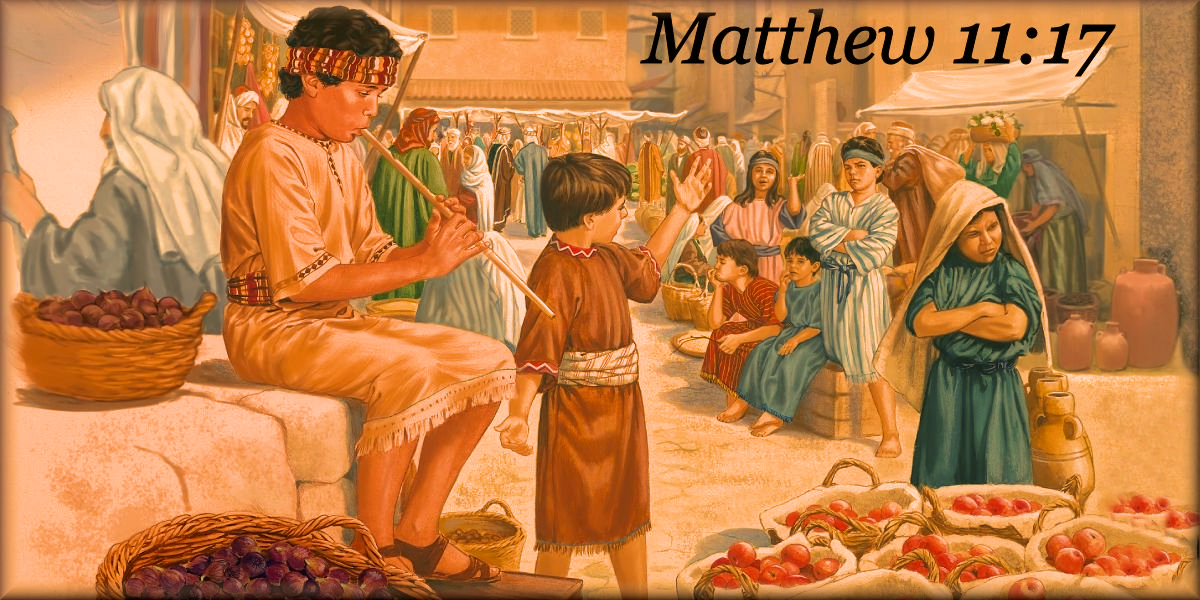

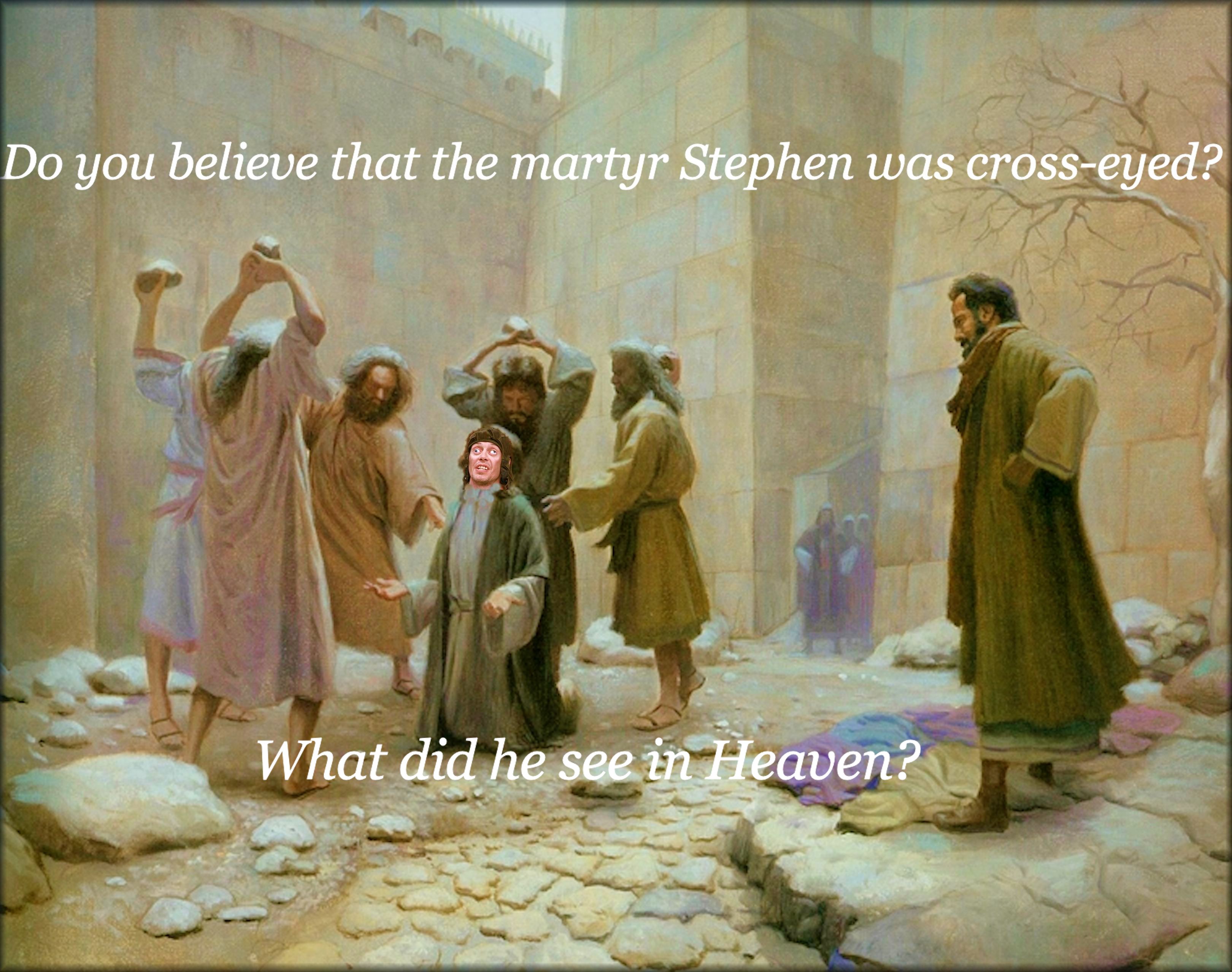


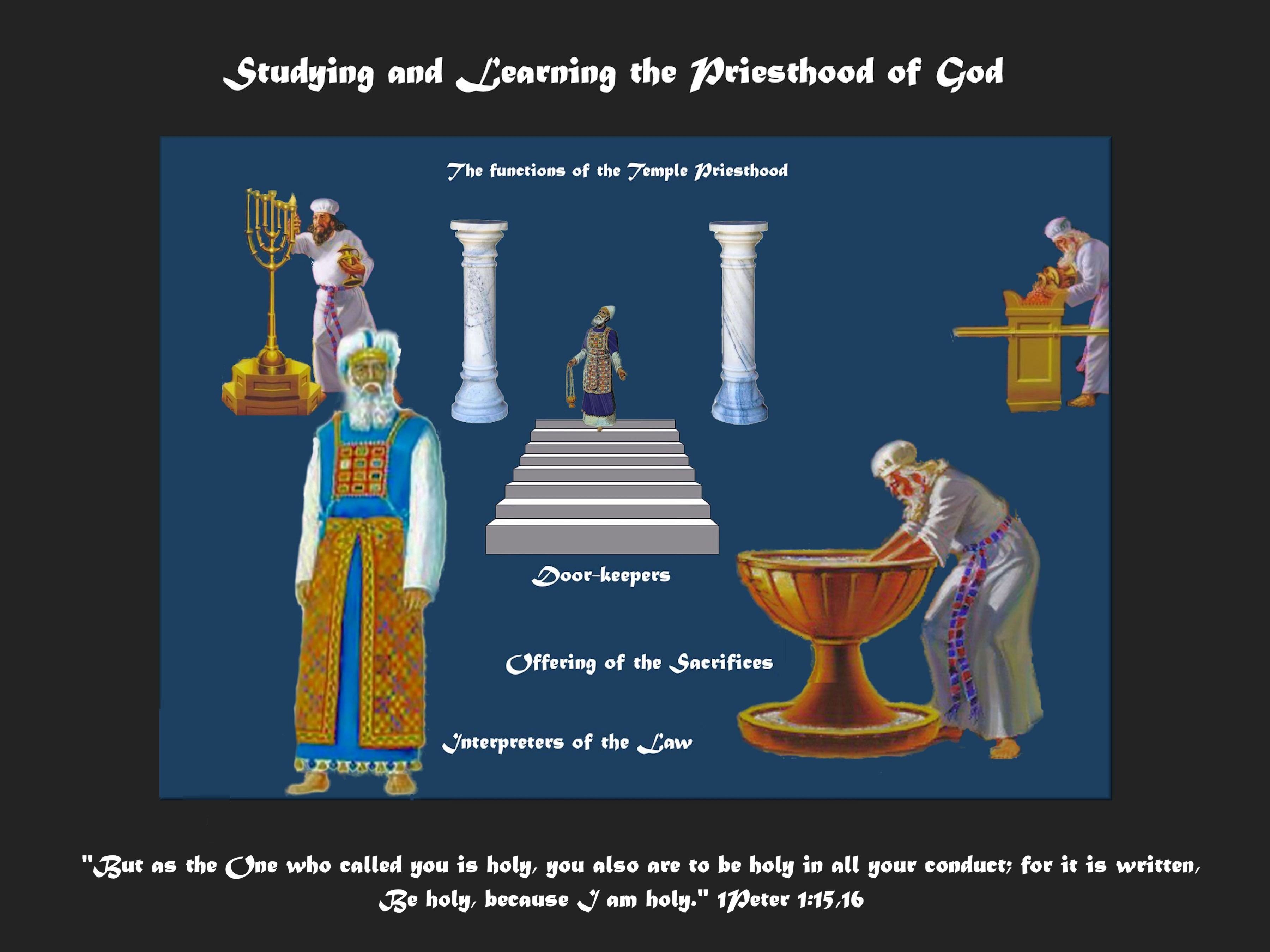
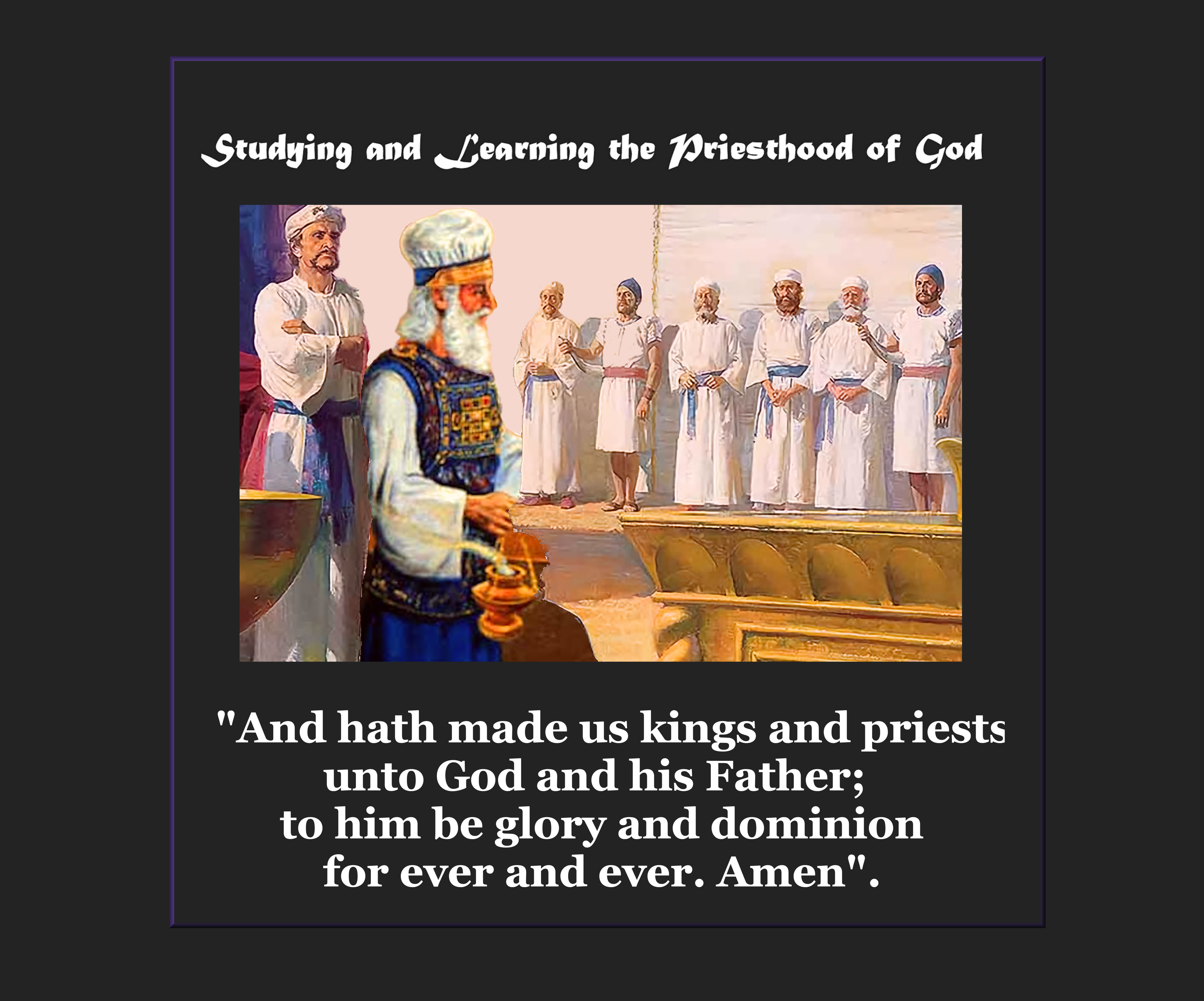













 brotherjohnsite.org