What Guided the Thinking of Charles Taze Russell?
History Hidden

What Guided the Thinking of Charles Taze Russell?
History Hidden

How will people behave in the “last days”?
2 Timothy 3:1-5
1 “Remember that there will be difficult times in the last days.
2 People will be selfish, greedy, boastful, and conceited; they will be insulting, disobedient to their parents, ungrateful, and irreligious;
3 they will be unkind, merciless, slanderers, violent, and fierce; they will hate the good;
4 they will be treacherous, reckless, and swollen with pride; they will love pleasure rather than God;
5 they will hold to the outward form of our religion, but reject its real power. Keep away from such people”.
1. LOVERS OF THEIR OWNSELVES – philantos; lover of oneself; selfish; fond of self
2. COVETOUS – philarguros; loving money (arguros, silver) money loving; fond of silver; avarice or greed for riches and wealth
3. BOASTERS – alazon; a boaster; primarily signifies a wanderer about the country a vagabond, an imposter; braggart; an empty pretender
4. PROUD – huperephanos; showing oneself above others; appearing above others; preeminent; arrogant; disdainful; proud; overtopping; overestimating one’s merits while despising or treating others with contempt
5. BLASPHEMERS – blasphemos; abusive; speaking evil; a railer; one who spreads false, malicious, and harmful statements meant to hurt someone’s reputation
6. DISOBEDIENT TO PARENTS – apeithes; unwilling to be persuaded; spurning belief; disobedient; incompliant
7. UNTHANKFUL– acharistos; ungrateful; thankless and unappreciative
8. UNHOLY – anosios; unholy; profane, impious; defile and make common
9. WITHOUT NATURAL AFFECTION – astorgos; hard-hearted towards kindred; especially of parents for children and children for parents (from a negative prefix “a”, plus “storge,” love of kindred affection)
10. TRUCEBREAKERS – aspondos; lit. denotes without libation; without a truce; without being poured out like a sacrifice; a libation (a sacrifice) accompanied the making of treaties and compacts; one who cannot be persuaded to enter into a covenant or one who is implacable; can also signify untrue to one’s promise;
11. FALSE ACCUSERS – diablos; a false accuser; slanderer; to say untrue or malicious things about; to defame, slander or vilify
12. INCONTINENT – akrates; without self control; intemperate; without self restraint; powerless
13. FIERCE – anemeros; not tame; savage; wild; crude; lacking polish and civility; distasteful and of a violently cruel nature
14. DESPISERS OF THOSE THAT ARE GOOD – aphilagathos; hostile to virtue; opposed to goodness and good men; not lovers of good (opposite of philogathos loving that which is good Titus 1:8)
15. TRAITORS – prodotes; a betrayer; traitor; giving forward into or handing over to an enemies hands; One who betrays cause, or friends; one who violates the allegiance owed
16. HEADY – propetes; lit. means falling forwards; headstrong – determined not to follow orders or advice but to do as one pleases; self-willed; reckless; rash; abrupt or curt in behavior or speech;
17. HIGH-MINDED – tuphoo; lit. to wrap in smoke; used metaphorically for conceit; puffed up; to inflate with self-conceit; to render insolent (boldly disrespectful in speech or behavior; arrogantly contemptuous; overbearing)
18. LOVERS OF PLEASURES – philedonos; loving pleasure (from hedone – pleasure); the self-indulgent pursuit of pleasure as a way of life; in psychology hedonism is the theory that a person acts in such a way as to seek pleasure and avoid pain
19. MORE THAN LOVERS OF GOD (a lover of God) – philotheos; fond of God; affectionate, tender,loving
20. HAVING A FORM OF GODLINESS – morphosis; a form or outline; an image or impress; an outward semblance
21. DENYING THE POWER THEREOF– arneomai; to contradict; to not accept; to reject something offered; to renounce, forsake or abrogate a thing.
1 Timothy 4:1
1 “But the Spirit says clearly that in later times some will be turned away from the faith, giving their minds to spirits of deceit, and the teachings of evil spirits,”
That false teachers would arise to deceive Christians is a clear prophetic teaching of Jesus:
Mark 13:22
22 For false messiahs and false prophets will rise up and perform signs and wonders so as to deceive, if possible, even God’s chosen ones.
And it is seen in other parts of the Bible as well. So, while the specific words in 1 Timothy 4:1 are not found elsewhere in the Bible, they reflect a truth which as Paul states the Holy Spirit has “expressly” taught would occur.
Matthew 24:12
12 “And because lawlessness is multiplied, the love of many will grow cold”.
The lawlessness spoken of is lawlessness in regard to God’s laws. It is TRUE apostasy.
The effect of this apostate lawlessness was lukewarmness and coolness among Christians.
By reason of these trials and persecutions from without, and these apostasies and false prophets from within, the love of many to Christ and his doctrine, and also their love to each other would wax cold.
Mark 13:12
12 “Brother will deliver up brother to death, and the father his child. Children will rise up against parents, and cause them to be put to death”.
Unbelieving family members shall betray and deliver to be imprisoned, tortured, and put to death their believing relatives, even their brothers or sister, fathers or mothers or their own children.
They will overlook the ties of nature and would be instrumental in putting to death their own relatives who followed the standard of Christ.
These negative behavior traits abound in these, the last days.
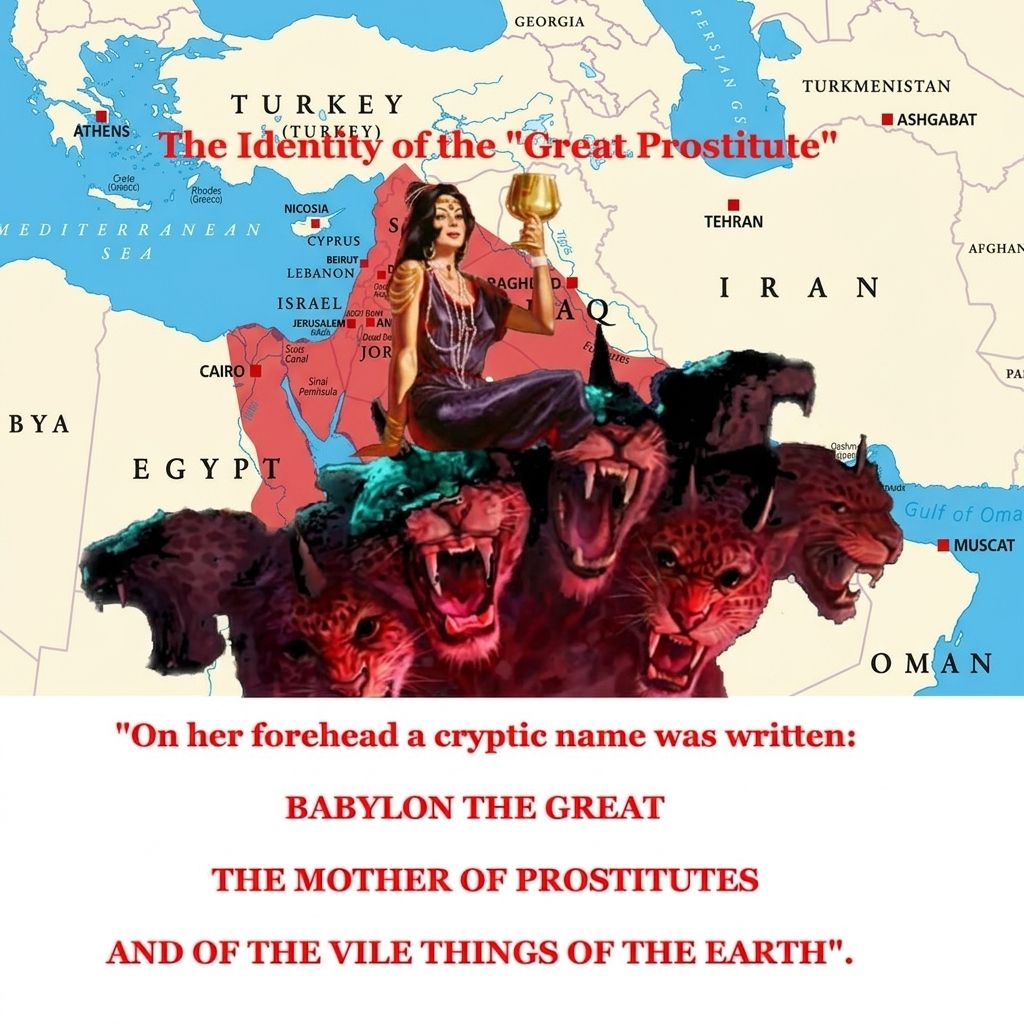
The Identity of the “Great Prostitute”
“Mystery Babylon”
The great prostitute mentioned in the Book of Revelation is the same mentioned in the Book of Ezekiel. This “prostitute” is an adulteress…a married woman.
According to the Bible, God made a covenant of marriage to natural Israelite which she repeatedly broke by intermingling with foreign nations against His law and by worshiping other gods. They also did so by making alliances with other nations in an attempt to circumvent the will of God.
In Ezekiel, the nation is likened to two sisters due to the fact that the nation existed divided (the ten-tribe northern kingdom of Israel and the southern two tribe kingdom of Judah).
If you read the text below from Ezekiel and then the text concerning Babylon the Great, you will find striking similarity.
Ezekiel 16:32-41
32 ”’A wife who commits adultery. who takes strangers instead of her husband.
33 They give gifts to all prostitutes; but you give your gifts to all your lovers, and bribe them, that they may come to you on every side for your prostitution.
34 You are different from other women in your prostitution, in that no one follows you to play the prostitute; and whereas you give hire, and no hire is given to you, therefore you are different.’
35 ”Therefore, prostitute, hear the word of the LORD:
36 Thus says the Lord GOD, ‘Because your filthiness was poured out, and your nakedness uncovered through your prostitution with your lovers; and because of all the idols of your abominations, and for the blood of your children, that you gave to them;
37 therefore see, I will gather all your lovers, with whom you have taken pleasure, and all those who you have loved, with all those who you have hated; I will even gather them against you on every side, and will uncover your nakedness to them, that they may see all your nakedness.
38 I will judge you, as women who break wedlock and shed blood are judged; and I will bring on you the blood of wrath and jealousy.
39 I will also give you into their hand, and they shall throw down your vaulted place, and break down your lofty places; and they shall strip you of your clothes and take your beautiful jewels; and they shall leave you naked and bare.
40 They shall also bring up a company against you, and they shall stone you with stones, and thrust you through with their swords.
41 They shall burn your houses with fire, and execute judgments on you in the sight of many women; and I will cause you to cease from playing the prostitute, and you shall also give no hire any more.

Ezekiel 23:1-49
1 The word of the LORD came again to me, saying,
2 ”Son of man, there were two women, the daughters of one mother:
3 and they played the prostitute in Egypt; they played the prostitute in their youth; there were their breasts pressed, and there was handled the bosom of their virginity.
4 Their names were Oholah the elder, and Oholibah her sister: and they became mine, and they bore sons and daughters. As for their names, Samaria is Oholah, and Jerusalem Oholibah.
5 ”Oholah played the prostitute when she was mine; and she doted on her lovers, on the Assyrians her neighbors,
6 who were clothed with blue, governors and rulers, all of them desirable young men, horsemen riding on horses.
7 She bestowed her prostitution on them, the choicest men of Assyria all of them; and on whoever she doted, with all their idols she defiled herself.
8 Neither has she left her prostitution since the days of Egypt; for in her youth they lay with her, and they handled the bosom of her virginity; and they poured out their prostitution on her.
9 Therefore I delivered her into the hand of her lovers, into the hand of the Assyrians, on whom she doted.
10 These uncovered her nakedness; they took her sons and her daughters; and her they killed with the sword: and she became a byword among women; for they executed judgments on her.
11 ”Her sister Oholibah saw this, yet was she more corrupt in her doting than she, and in her prostitution which were more than the prostitution of her sister.
12 She doted on the Assyrians, governors and rulers, her neighbors, clothed most gorgeously, horsemen riding on horses, all of them desirable young men.
13 I saw that she was defiled; they both took one way.
14 She increased her prostitution; for she saw men portrayed on the wall, the images of the Chaldeans portrayed with vermilion,
15 wearing belts on their waists, with flowing turbans on their heads, all of them looking like officers, after the likeness of the Babylonians in Chaldea, the land of their birth.
16 As soon as she saw them she doted on them and sent messengers to them into Chaldea.
17 The Babylonians came to her into the bed of love, and they defiled her with their prostitution, and she was polluted with them, and her soul was alienated from them.
18 So she uncovered her prostitution and uncovered her nakedness: then my soul was alienated from her, like as my soul was alienated from her sister.
19 Yet she multiplied her prostitution, remembering the days of her youth, in which she had played the prostitute in the land of Egypt.
20 She doted on their paramours, whose flesh is as the flesh of donkeys, and whose issue is like the issue of horses.
21 Thus you called to memory the lewdness of your youth, in the handling of your bosom by the Egyptians for the breasts of your youth.
22” Therefore, Oholibah, thus says the Lord GOD: ‘Look, I will raise up your lovers against you, from whom your soul is alienated, and I will bring them against you on every side:
23 the Babylonians and all the Chaldeans, Pekod and Shoa and Koa, and all the Assyrians with them; desirable young men, all of them governors and officials, officers and men of renown, all of them riding on horses.
24 They shall come against you from the north a with chariots, and wagons, and with a company of peoples; they shall set themselves against you with buckler and shield and helmet all around; and I will commit the judgment to them, and they shall judge you according to their judgments.
25 I will set my jealousy against you, and they shall deal with you in fury; they shall take away your nose and your ears; and your residue shall fall by the sword: they shall take your sons and your daughters; and your residue shall be devoured by the fire.
26 They shall also strip you of your clothes and take away your beautiful jewels.
27 Thus will I make your lewdness to cease from you, and your prostitution brought from the land of Egypt; so that you shall not lift up your eyes to them, nor remember Egypt anymore.
28 ”’For thus says the Lord GOD: Look, I will deliver you into the hand of them whom you hate, into the hand of them from whom your soul is alienated
29 and they shall deal with you in hatred, and shall take away all your labor, and shall leave you naked and bare; and the nakedness of your prostitution shall be uncovered, both your lewdness and your prostitution.
30 These things shall be done to you, because you have played the prostitute after the nations, and because you are polluted with their idols.
31 You have walked in the way of your sister; therefore I will give her cup into your hand.’
32 ”Thus says the Lord GOD: ‘You will drink of your sister’s cup, which is deep and large; you will be ridiculed and held in derision; it contains much.
33 You shall be filled with drunkenness and sorrow, with the cup of astonishment and desolation, with the cup of your sister Samaria.
34 You shall even drink it and drain it out, and you shall gnaw the broken pieces of it, and shall tear your breasts; for I have spoken it,’ says the Lord GOD.
35 ”Therefore thus says the Lord GOD: ‘Because you have forgotten me, and cast me behind your back, therefore you also bear your lewdness and your prostitution.’”
36 The LORD said moreover to me: “Son of man, will you judge Oholah and Oholibah? Then declare to them their abominations.
37 For they have committed adultery, and blood is in their hands; and with their idols have they committed adultery; and they have also caused their sons, whom they bore to me, to pass through the fire to them to be devoured.
38 Moreover this they have done to me: they have defiled my sanctuary in the same day, and have profaned my Sabbaths.
39 For when they had slain their children to their idols, then they came the same day into my sanctuary to profane it; and look, thus have they done in the midst of my house.
40 ”’Furthermore you have sent for men who come from far, to whom a messenger was sent, and look, they came; for whom you did wash yourself, paint your eyes, and decorate yourself with ornaments,
41 and sit on a stately bed, with a table prepared before it, whereupon you set my incense and my oil.’
42 The voice of a multitude being at ease was with her: and with men of the common sort were brought drunkards from the wilderness; and they put bracelets on their hands twain, and beautiful crowns on their heads.
43 Then I said of her who was old in adulteries, ‘Now will they play the prostitute with her, and she with them.’
44 They went in to her, as they go in to a prostitute: so went they in to Oholah and to Oholibah, the lewd women.
45 Righteous men, they shall judge them with the judgment of adulteresses, and with the judgment of women who shed blood; because they are adulteresses, and blood is in their hands.
46 ”For thus says the Lord GOD: ‘I will bring up a company against them and will give them to be tossed back and forth and robbed.
47 The company shall stone them with stones, and dispatch them with their swords; they shall kill their sons and their daughters and burn up their houses with fire.
48 ’Thus will I cause lewdness to cease out of the land, that all women may be taught not to do after your lewdness.
49 They shall recompense your lewdness on you, and you shall bear the sins of your idols; and you shall know that I am the Lord GOD.’”
Now compare the words of prophecy given to the apostle John in vision:
Revelation 17:1-9
1 One of the seven angels who had the seven bowls came and spoke with me, saying, “Come here. I will show you the judgment of the great prostitute who sits on many waters,
2 with whom the kings of the earth committed sexual immorality, and those who dwell in the earth were made drunk with the wine of her sexual immorality.”
3 He carried me away in the Spirit into a wilderness. I saw a woman sitting on a scarlet-colored animal, full of blasphemous names, having seven heads and ten horns.
4 The woman was dressed in purple and scarlet, and decked with gold and precious stones and pearls, having in her hand a golden cup full of abominations and the impurities of her sexual immorality.
5 And on her forehead a name was written, “MYSTERY, BABYLON THE GREAT, THE MOTHER OF THE PROSTITUTES AND OF THE ABOMINATIONS OF THE EARTH.”
6 I saw the woman drunk with the blood of the saints, and with the blood of the martyrs of Jesus. When I saw her, I wondered with great amazement.
7 The angel said to me, “Why do you wonder? I will tell you the mystery of the woman, and of the beast that carries her, which has the seven heads and the ten horns.
8 The beast that you saw was and is not; and is about to come up out of the abyss and is going a to destruction. Those who dwell on the earth and whose names have not been written in the Book of Life from the foundation of the world will marvel when they see that the beast was, and is not, but is to come.
9 Here is the mind that has wisdom. The seven heads are seven mountains, on which the woman sits.
The prostitute spoken of in the Book of Revelation chapter 17 is the apostate house of Israel in the Last Days. Other kingdoms were not responsible for the murder/blood of the faithful prophets including Lord Jesus’. (See Revelation 17:6)
If you read the Old Testament and examine who it was that was responsible for the slaying of God’s prophets, you will find that it was the Israelites who had apostatized against God. If you examine the New Testament, you will find that Christian believers such as Stephen were slain in martyrdom by fellow Jews who rejected Jesus.
Although many professed Christian teachers claim otherwise, these words are not to be applied to the apostate church (fake Christianity).
The Lambs marriage will not occur until after his second coming which has yet to occur. While it is true that his “bride” has been being gathered since the time of his death and resurrection, the marriage has not yet taken place. These verses did and still apply to natural Israel who was married by covenant to God but who committed adultery and broke the covenant.
Jesus Christ himself made this statement:
Luke 13:34
“Jerusalem, Jerusalem, that kills the prophets, and stones those who are sent to her. How often I wanted to gather your children together, like a hen gathers her own brood under her wings, and you refused.”
The teachers who claim that this “harlot” is the Catholic Church or other so-called Christian denominations are playing a part of the devil’s effort to deceive and mislead…hiding the true identity of the great prostitute.
Remember Jesus said:
Matthew 24:24
“For false Messiahs and false prophets will appear; they will perform great miracles and wonders in order to deceive even God’s chosen people, if possible.”
There is only one group portrayed as an adulteress in the Bible…the apostate nation of Israel.
As to the mystery of the name “Babylon”, this can be understood by reading from the book of Zechariah.
The angel speaking to the prophet, offers understanding to the mystery of the name and its association to Israel.
The Vision of the Woman in the Basket
Zechariah 5:5-11
5 Then the angel who had been talking to me came closer to me and said, “Look up and see what is appearing!”
6 I asked him, “What is it?” He replied, “It is a big basket for measuring grain. But it represents the sins that everyone in this nation has committed.”
7 Then the angel lifted the basket’s cover, which was made of lead. There was a woman sitting inside the basket!
8 The angel said, “She represents the wicked things that people do.” Then the angel pushed her back into the basket and closed the very heavy lid again.
9 Then I looked up and saw two women in front of me. They were flying toward us, with their wings spread out in the wind. Their wings were large, like storks’ wings. They lifted the big basket up into the sky.
10 I asked the angel who had been talking to me, “Where are they taking that basket?”
11 He replied, “They are taking it to Babylonia to build a temple for it. When the temple is finished, they will set the basket there on a pedestal for people to worship it.”
Instead of becoming a “kingdom of priest” that lead the nations of the Earth to obedience and pure worship of God, the nation of Israel broke His commandments.
How? By their alliances with foreign nations, the nation committed both literal and spiritual fornication making itself unclean and led the nations away from God. The nation set itself over the nations to be worshipped rather than directing worship to God.
She sits upon the beastly world rulers today as she continues to persecute disciples of Jesus Christ who are true worshippers of God. She continues to manipulate the kings of the Earth to meet her own nationalistic desires.
The Coming and the Revealing of the Antichrist
The King Who Calls Himself God
Daniel 12:36-45
36 “‘The king will do as he pleases. He’ll exalt and magnify himself above every god, speaking amazing things against the God of Gods. He’ll succeed until the indignation is completed, because what has been determined must be carried out.
37 He’ll recognize neither the gods of his ancestors nor those desired by women(most likely referring to Tammuz)—he won’t recognize any god, because he’ll exalt himself above everything.
38 He’ll glorify the god of fortresses, a god whom his ancestors never knew, honoring him with gold, silver, valuable jewels, and treasures.
39 He’ll take action against the strongest fortresses. With the help of a foreign god, he’ll recognize those who honor him, making them rule over many, and he’ll parcel out the land for a profit.
40 “‘At the time of the end, the southern king will oppose him, and the northern king will overrun him with chariots, cavalry, and many ships. He’ll invade countries, moving swiftly and sweeping through.
41 He’ll enter the Beautiful Land, and many will fall, even though these will escape his control: Edom, Moab, and certain Ammonite officials.
42 He’ll extend his power over other countries, and even the land of Egypt won’t escape.
43 He’ll capture treasures of gold, silver, and all the treasures of Egypt, with the Libyans and Cushites at his feet.
44 However, reports from the east and the north will alarm him, and he’ll march out in great anger, intending to destroy and to desolate many.
45 When he pitches his royal pavilions between the seas facing the mountain of holy Glory, he’ll come to his end, and no one will help him.’” (ISV)
2 Thessalonians 2:1-4
The Lawless One
1 Now we ask you, brothers, regarding the coming of our Lord Jesus, the Messiah, and our gathering together to him,
2 not to be so quickly upset or alarmed when someone claims that we said, either by some spirit, conversation, or letter that the Day of the Lord has already come.
3 Do not let anyone deceive you in any way, for it will not come unless the rebellion takes place first and the man of sin, who is destined for destruction, is revealed.
4 He opposes and exalts himself above every so-called god and object of worship. As a result, he seats himself in the sanctuary of God and himself declares that he is God.
5 Don’t you remember that I repeatedly told you about these things when I was still with you?
6 You know what it is that is now holding him back, so that he will be revealed when his time comes.
7 For the secret of this lawlessness is already at work, but only until the person now holding it back gets out of the way.
8 Then the lawless one will be revealed, whom the Lord will destroy with the breath of his mouth, rendering him powerless by the manifestation of his coming.
9 The coming of the lawless one will be accompanied by the power of Satan. He will use every kind of power, including miraculous signs, lying wonders,
10 and every type of evil to deceive those who are dying, those who refused to love the truth that would save them.
11 For this reason, God will send them a powerful delusion so that they will believe the lie.
12 Then all who have not believed the truth but have taken pleasure in unrighteousness will be condemned. (ISV)
What are the identifying characteristics of the Lawless One? It would be good at this point for a Bible student to carefully read 2 Thessalonians 2:1-12. Read it several times, perhaps in different translations, to thoroughly familiarize themselves with the passage.
Once a Bible student has thoroughly read 2 Thessalonians 2:1-12, it is possible for them to isolate certain tell-tale attributes of this diabolical force, and work toward a solution as to the identity of the “man of sin.”
Traits of the Man of Sin
Consider the following factors.
The Man of Sin and The Apostasy
The Man of Sin is the ultimate result of the falling away from the faith (v. 3).
The expression “falling away” translates the Greek term apostasia. Our English word “apostasy” is an anglicized form of this original term.
In the Bible, the word is used of a defection from the religion ordained by God. As a noun, it is employed of departure from the Mosaic system (Acts 21:21), and, in this present passage, of defection from Christianity. The verbal form of the term is similarly used in 1 Timothy 4:1 (Hebrews 3:12).
Note also that the noun is qualified by a definite article (the apostasia). A definite movement is in the apostle’s prophetic vision — not merely just the principle of defection.
The Man of Sin Was Yet to Be Revealed
This sinister force, from a first-century vantage point, was yet to be revealed (verse 3).
This appears to suggest that the movement had not evolved to the point where it could be identified definitely by the first century Church. It awaited future development.
The “Man of Lawlessness” and “Son of Perdition”
This persecuting power was designated as the man of sin (verse 3), because sin was its “predominating quality”. This character, referred to in both neuter and masculine genders (verses 6-7), is the son of perdition (verse 3), because its end is to be perdition, i.e., destruction, by the Lord himself (verse
.
The Lawless One
This opponent of God is called the lawless one (verse
. This power has no regard for the law of God. One cannot but be reminded of that infamous “little horn” in Daniel’s vision:
“[H]e shall think to change the times and the law” (Daniel 7:25).
Man of Sin: Opposes God, Exalts Himself, and Sits in the Temple of God
The Man of Sin opposes God and exalts himself against all that is genuinely sacred (verse 4). He feigns godly devotion, but his true character reveals that he is diabolic. His activity actually is according to the working of Satan (verse 9).
In some sense, the Man of Lawlessness will sit in the temple of God (verse 4). The “temple” is not a reference to the Jewish house of worship. The Greek word is naos, used by Paul eight times. Never does he employ this term of the Jewish temple.
In fact, after the death of Christ, the Jewish temple is never again called the temple of God. Rather it is used of the Christian’s body (1 Corinthians 6:19) or of the church as God’s spiritual house (1 Corinthians 3:16, 17; Ephesians 2:21).
The implication of Paul’s warning is this. This unholy being is viewed as being a “church” character.
The expression “sitteth” may hint of unparalleled arrogance. The wording of the text describes the Man of Lawlessness as attempting to exact “divine homage” from people only to be given the Almighty God.
Moreover, this Son of Perdition sets himself forth as God. The present participle (“sets forth continually”) reveals that this presumptive posture is characteristic of the Man of Lawlessness.
This person represents himself as God, either by making claims that belong only to deity; by receiving adoration reserved exclusively for God; or, by usurping prerogatives which only God can accomplish.
Clearly, the Man of Sin is an ecclesiastical character, relating to the Christian Church or its leadership. Recall the description of John’s lamb-like beast in Revelation 13:11?
“Then I saw another beast coming up out of the earth; he had two horns like a lamb, but he sounded like a dragon”. (HCSB)
The Man of Lawlessness Deceives with Lying Miracles
“He deceives those who love not the truth, by virtue of the lying wonders he effects” (verses 9-10).
These “pretended miracles”. These “wonders” are not real in the category of the miracles that Christ performed.
In identifying the Man of Sin, one must thus look for a post-apostolic movement that claims to prove its authenticity by miracles.
Restraining Force to Be Removed
The restraining force eventually would *be taken out of the way”, or, more correctly, “be gone.” And so, the Man of Sin, in “his own season,” would be revealed openly (verses 6, 7).
One must remember that the “little horn” of Daniel’s fourth beast only rose to prominence after three horns were plucked up to make room for it. (Daniel chapter 7)
Too, the earth-beast of John’s vision came into full power after the sea-beast had received a death-stroke but was healed. And so here, the restraining power will give way to the horrible revelation of the Man of Lawlessness.
Man of Sin Continues Until Second Coming
The Man of Lawlessness, though having roots in the world of ancient Christianity (verse 6), would nevertheless endure, in some form or another, until the end of time, i.e., until the Second Coming of Christ.
At that time, he will be destroyed by the Lord’s word of Judgment (verse 8; see also Revelation 19:15). In view of this, the Man of Lawlessness cannot be some persecuting enemy that faded into oblivion centuries ago.
Identity
Some have argued that the Man of Lawlessness is Satan himself. This view cannot be correct. Satan was not a part of “the falling away” (verse 3), and this “lawless one” is said to come “according to the working of Satan” (verse 9), which obviously distinguishes him from Satan personally.
Some allege that no specific power or person(s) are in view. Rather, the apostle merely has personified a principle or idea of evil, which may appear in various forms in different historical periods as an opponent of truth. It may be manifest as Islam, Fascism, Communism, etc.
But this concept does not fit the specific descriptions in this chapter. The text tells of a particular movement, “the falling away” (verse 3). How could this possibly refer to Islam, Communism, etc.? It could not.
Moreover, there are too many personal references within the narrative to dismiss it as mere personification.
Those who contend that all Bible prophecy, including the Second Coming of Christ, was fulfilled in the destruction of Jerusalem argue that the Man of Lawlessness was the “hardened, militant Jewish Zealots.
The concept is totally false. Judaism was no part of “the falling away”.
Moreover, Paul’s prophecy of the Second Coming was not fulfilled in A.D. 70, as evidenced by the fact that Christians were not “gathered together” unto the Lord in connection with Jerusalem’s fall. For this, we still wait in anticipation.
Millennialists (and some others) contend that the Man of Lawlessness “is an individual embodying anti-God power who is still to arise before the future day of the Lord”.
But Paul stated that the “mystery of iniquity,” characteristic of the Man of Lawlessness, was “already at work” (verse 7) in the first century.
The “little horn” mentioned in Daniel Chapter 7 and described in Daniel 12:36-45, Paul’s “Man of Lawlessness” mentioned in 2 Thessalonians, and “the beast” of the book of Revelation chapter 13 have much in common and seem to testify in concert regarding a force comprised of a group that have fallen away from true worship in modern times.
Back to top
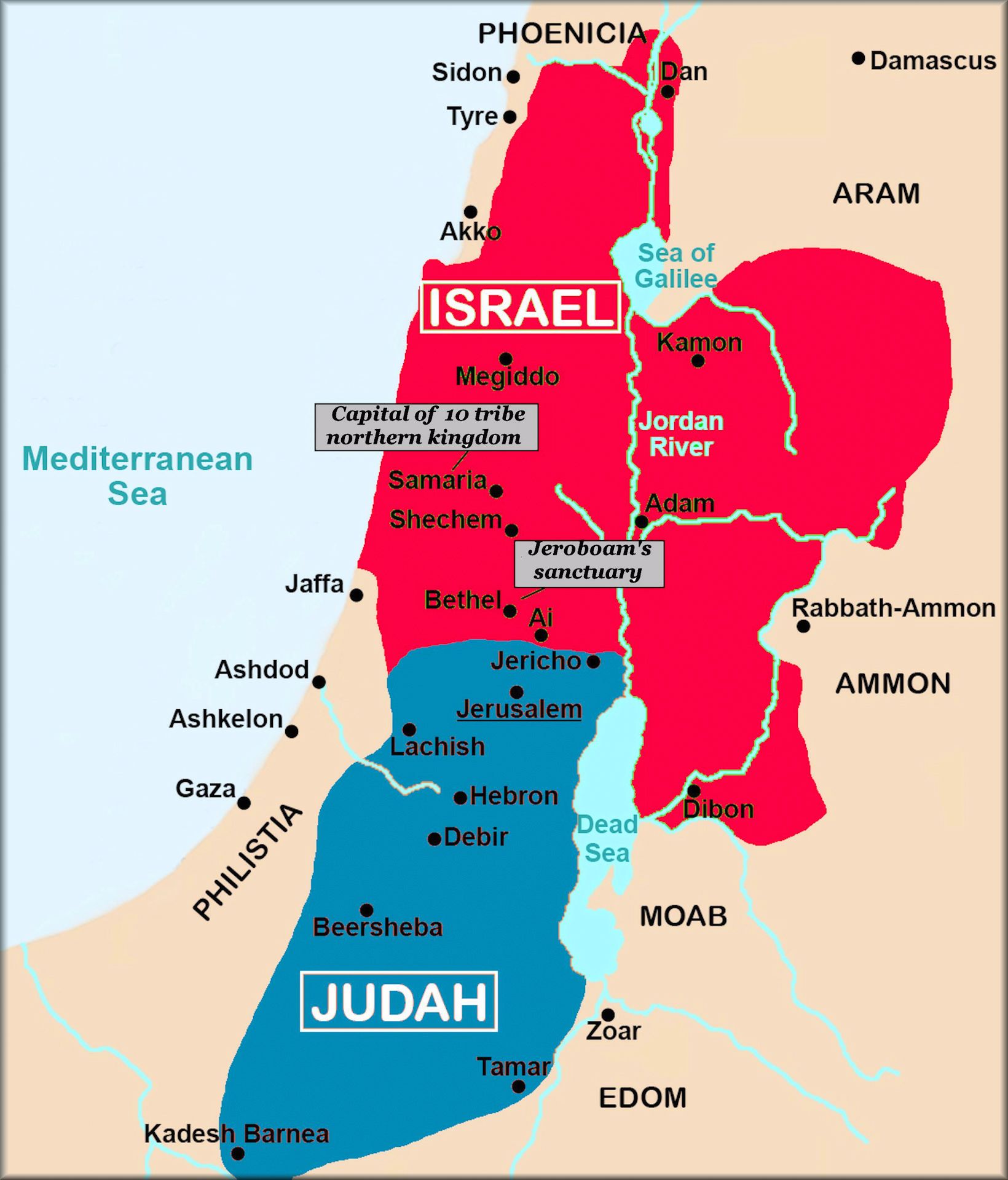
The northern ten-tribe kingdom of Israel (red)
The southern two-tribe kingdom of Judah (blue)
During the ministry of Jesus there was contact with a group of people known as the ‘Samaritans’.
Who were the Samaritans and what were their origins?
There are at least two conflicting theories as to the origin of the Samaritan people. The traditional view is that, when the Jews were captured by the Assyrians in 721 BC as part of the infamous Babylonian Captivity, the Assyrians then repopulated Israel with people from the land of Samaria to the east. Then, when the Jews finally returned from exile 200 years later, they found these Samaritans already living in their ancestral homeland.
However, other researchers argue that during the Babylonian Captivity, not all Jews were rounded up by the Assyrians. Some stayed behind, possibly marrying other Assyrian exiles who themselves had been relocated. This would make sense given that, even though Samaritans are not considered Jews, they share many of the same ancient Hebrew rituals. While these rituals have evolved for hundreds of years among most Jewish sects, they remain unchanged among the isolated Samaritans, even to this day. This also fits well with the historical animosity of Jews toward Samaritans because of their association with non-Jews. These researchers propose that the Samaritans were actually Hebrew descendants themselves.
The Samaritans were part Hebrew and part Gentile
The race came about after the Assyrian captivity of the northern kingdom of Israel in 721 B.C. Certain people from the nation of Israel stayed behind. These people intermarried with the Assyrians producing the Samaritans.
The foreigners brought with them their pagan idols, which the remaining Jews began to worship alongside the God of Israel. Intermarriages also took place. While many of the inhabitants of the city and the surrounding area of Samaria were led off into captivity, some farmers and others were left behind. They intermarried with new settlers from Mesopotamia and Syria. The kingdoms of Judah and Israel never reunited.
The Northern Kingdom of Israel was the first of the two kingdoms (Israel and Judah) to fall, when it was conquered by the Assyrian monarchs, Tiglath-Pileser III (Pul) and Shalmaneser V. The captivities began in approximately 734-732 BC.
The later Assyrian kings Sargon II and his son and successor, Sennacherib, finished the demise of Israel’s northern ten-tribe kingdom. In 724 BC, nearly ten years after the initial deportations, the capital city of the Northern Kingdom of Israel, Samaria, was finally taken by Sargon II.
The tribes exiled by Assyria later became known as the Ten Lost Tribes of Israel, as, unlike the Kingdom of Judah which was able to return from its Babylonian Captivity, the ten tribes of the Northern Kingdom never had a foreign edict granting permission to return to Israel and rebuild their homeland. King Crus, who defeated the Babylonians in 537 B.C.E returned exiled Judeans to their homeland. However, many chose to remain in Babylon and intermarried as well.
Herod conquered Judah in 37 B.C.E. In 19 B.C.E. , under his rule, the Temple was again rebuilt. The First Revolt against Rome occurred in 66 C.E. ; however, Jerusalem fell to the Romans in 70 C.E. The Temple was destroyed, and the majority of the Jews were dispersed throughout the world.
Reference https://www.everyculture.com/Ge-It/Israel.html#ixzz6ZYEIf4DH
Recent genetic research affirms that the Samaritans were of Jewish origin. One such study by Peidong Shen and colleagues in the Journal Human Mutation has used both mitochondrial DNA and Y-chromosome DNA of modern-day Samaritans to discover their origins and genetic relationship to Near Eastern Jews.
The mitochondrial DNA results, which show maternal history (i.e. your mother’s mother’s mother, etc.), reveal no major difference between the Samaritans, Jews, or Palestinians in the Levant who were also sampled. These three groups have relatively similar maternal genetic histories. However, the story of the Y-chromosome, which shows paternal history (i.e. your father’s father’s father) is quite different. Indeed, not only are the Y-chromosomes of the Jews and Samaritans more similar to each other than either is to the Palestinians’, the Y-chromosomes of the Samaritans show striking similarities to a very specific Y-chromosome most often associated with Jewish men. Although the Samaritan type is slightly different from the Jewish type, it is clear that the two share a common ancestor, probably within the last few thousand years.
This genetic evidence suggest that the traditional hypothesis, that the Samaritans were transported into the Levant (Mediterranean lands east of Italy) by the Assyrians and have no Jewish heritage, is largely incorrect. Rather, these Samaritan lineages are remnants of those few Jews who did not go into exile when the Assyrians conquered the northern kingdom of Israel in 721 BC. Those who remained in the Levant may have take non-Jewish wives, which would account for the genetic admixture on the female side. But according to the authors the Y-chromosome clearly shows that the Samaritans and the Jews share common ancestry dating to at least 2,500 years ago.
The question that begs to be answer is: How did these Herew descendant’s become mixed with non-Herews?
According to the ‘Encyclopedic Dictionary of the Bible’ by Louis F. Hartman, C.SS.R., feelings of ill will probably went back before the separation of the northern and southern Jewish kingdoms. Even then there was a lack of unity between the tribes of Jacob.
What Lead To The Dividing Of The Kingdom?
The once-united kingdom of Israel split into two. How did this happen?
It all started with Solomon. On the surface, his kingdom appeared to be very prosperous.
Unlike David, he did not engage in battle to enlarge his territory but used trade and marriages to wives from other nations to increase his power. His accumulated wealth contributed to his fame. Even the Queen of Sheba paid him a visit and was overwhelmed by his wealth and wisdom.
For tax purposes, Solomon divided his land into different administrative regions, each with its own governor. The people became embittered because of all the hard labor Solomon enforced and the heavy taxes he imposed on them to generate money for his building projects.
He even began worshipping the foreign gods that his wives worshiped. The Bible states that because of this, “The Lord was very angry with Solomon, for his heart had turned away from the Lord, the God of Israel, who had appeared to him twice” .
1 Kings 11:1-13
1 Solomon loved many foreign women. Besides the daughter of the king of Egypt he married Hittite women and women from Moab, Ammon, Edom, and Sidon.
2 He married them even though the Lord had commanded the Israelites not to intermarry with these people, because they would cause the Israelites to give their loyalty to other gods.
3 Solomon married seven hundred princesses and also had three hundred concubines. They made him turn away from God,
4 and by the time he was old they had led him into the worship of foreign gods. He was not faithful to the Lord his God, as his father David had been.
5 He worshiped Astarte, the goddess of Sidon, and Molech, the disgusting god of Ammon.
6 He sinned against the Lord and was not true to him as his father David had been.
7 On the mountain east of Jerusalem he built a place to worship Chemosh, the disgusting god of Moab, and a place to worship Molech, the disgusting god of Ammon.
8 He also built places of worship where all his foreign wives could burn incense and offer sacrifices to their own gods.
9 Even though the Lord, the God of Israel, had appeared to Solomon twice
10 and had commanded him not to worship foreign gods, Solomon did not obey the Lord but turned away from him. So the Lord was angry with Solomon
11 and said to him, “Because you have deliberately broken your covenant with me and disobeyed my commands, I promise that I will take the kingdom away from you and give it to one of your officials.
12 However, for the sake of your father David I will not do this in your lifetime, but during the reign of your son.
13 And I will not take the whole kingdom away from him; instead, I will leave him one tribe for the sake of my servant David and for the sake of Jerusalem, the city I have made my own.”
After Solomon’s death, a delegation from the people went to visit his son Rehoboam to ask him whether he was prepared to relieve their burden. After discussing it with his advisors, he told them that he would increase their burden even further.
1 Kings 12:14
14 and he spoke to them according to the advice of the young men, saying, “My father made your yoke heavy, but I will add to your yoke; my father chastised you with whips, but I will chastise you with scourges!”
The southern tribes, whom Solomon had treated better, remained loyal to Rehoboam. However, Rehoboam’s threats became too much for the northern tribes, and they broke away in 925 BC to form an independent kingdom under the reign of Jeroboam, an official in Solomon’s court.
The Northern Kingdom retained the name “Israel,” while the Southern Kingdom became known as “Judah.” Israel had more territory and wealth, but it was situated on an important trade route and was therefore exposed to attacks from other nations.
In short, Solomon’s disobedience caused the division of the kingdom. The Northern Kingdom (Israel) consisted of 10 tribes and had 19 kings before they were taken into exile by Assyria. All 19 kings committed evil. The Southern Kingdom (Judah) consisted of 2 tribes and had 20 kings before they were taken into exile by Babylon. Eight of the 20 kings were good, while 12 were bad.
After the separation of Judah and Israel in the ninth century, King Omri of the Northern Kingdom bought the hill of Samaria from Shemer. He built there the city of Samaria which became his capital. It was strong defensively and controlled the valley through which the main road ran between Jerusalem and Galilee.
1 Kings 16:24
24 And he bought the hill of Samaria from Shemer for two talents of silver; then he built on the hill, and called the name of the city which he built, Samaria, after the name of Shemer, owner of the hill.
In 722 BCE. the city fell to the Assyrians and became the headquarters of the Assyrian province of Samarina. Assyria conquered Israel and took most of its people into captivity. The invaders then brought in Gentile colonists “from Babylon, Cuthah, Ava, Hamath, and from Sepharvaim” (2 Kgs 17:24) to resettle the land.
2 Kings 17:24
24 Then the king of Assyria brought people from Babylon, Cuthah, Ava, Hamath, and from Sepharvaim, and placed them in the cities of Samaria instead of the children of Israel; and they took possession of Samaria and dwelt in its cities.
The Assyrians sent five eastern tribes to live in Northern Israel. These five tribes brought with them their own foreign religions and customs. The tribes were sent with the purpose of diminishing the Israelite identity and culture. The eastern foreigners intermarried with the remaining, much depleted Israelite population. This hybrid people group was the beginning of the Samaritans.
The foreigners brought with them their pagan idols, which the remaining Jews began to worship alongside the God of Israel.
2 Kgs 17:29-41
29 However every nation continued to make gods of its own, and put them in the shrines on the high places which the Samaritans had made, every nation in the cities where they dwelt.
30 The men of Babylon made Succoth Benoth, the men of Cuth made Nergal, the men of Hamath made Ashima,
31 and the Avites made Nibhaz and Tartak; and the Sepharvites burned their children in fire to Adrammelech and Anammelech, the gods of Sepharvaim.
32 So they feared the Lord, and from every class they appointed for themselves priests of the high places, who sacrificed for them in the shrines of the high places.
33 They feared the Lord, yet served their own gods–according to the rituals of the nations from among whom they were carried away.
34 To this day they continue practicing the former rituals; they do not fear the Lord, nor do they follow their statutes or their ordinances, or the law and commandment which the Lord had commanded the children of Jacob, whom He named Israel,
35 with whom the Lord had made a covenant and charged them, saying: “You shall not fear other gods, nor bow down to them nor serve them nor sacrifice to them;
36 but the Lord, who brought you up from the land of Egypt with great power and an outstretched arm, Him you shall fear, Him you shall worship, and to Him you shall offer sacrifice.
37 And the statutes, the ordinances, the law, and the commandment which He wrote for you, you shall be careful to observe forever; you shall not fear other gods.
38 And the covenant that I have made with you, you shall not forget, nor shall you fear other gods.
39 But the Lord your God you shall fear; and He will deliver you from the hand of all your enemies.”
40 However they did not obey, but they followed their former rituals.
41 So these nations feared the Lord, yet served their carved images; also their children and their children’s children have continued doing as their fathers did, even to this day.
Mixing by intermarriages began took place (Ezra 9:1-10:44; Neh 13:23-28).
Ezra 9:1, 2
9 When these things were done, the leaders came to me, saying, “The people of Israel and the priests and the Levites have not aseparated themselves from the peoples of the lands, bwith respect to the abominations of the Canaanites, the Hittites, the Perizzites, the Jebusites, the Ammonites, the Moabites, the Egyptians, and the Amorites.
2 For they have ctaken some of their daughters as wives for themselves and their sons, so that the dholy seed is emixed with the peoples of those lands. Indeed, the hand of the leaders and rulers has been foremost in this trespass.”
Nehemiah 13:23-28
23 In those days I also saw Jews who had married women of Ashdod, Ammon, and Moab. 24 And half of their children spoke the language of Ashdod, and could not speak the language of Judah, but spoke according to the language of one or the other people.
25 So I contended with them and cursed them, struck some of them and pulled out their hair, and made them swear by God, saying, “You shall not give your daughters as wives to their sons, nor take their daughters for your sons or yourselves.
26 Did not Solomon king of Israel sin by these things? Yet among many nations there was no king like him, who was beloved of his God; and God made him king over all Israel. Nevertheless pagan women caused even him to sin.
27 Should we then hear of your doing all this great evil, transgressing against our God by marrying pagan women?”
28 And one of the sons of Joiada, the son of Eliashib the high priest, was a son-in-law of Sanballat the Horonite; therefore I drove him from me.
While many of the inhabitants of the city and the surrounding area of Samaria were led off into captivity, some farmers and others were left behind. They intermarried with new settlers from Mesopotamia and Syria.
Though the Samaritans were condemned by the Jews, Hartman says they probably had as much pure Jewish blood as the Jews who later returned from the Babylonian exile. Each group fell into an apostate form of worship, mixing worship of Yahweh and Hebrew traditions with the worship of pagan gods they learned through association with foreign nations. The kingdom of Judah was not exempt from false worship and committing abominations before God.
2 Chronicles Chapter 33 recounts the sins against Yahweh of Manasseh, a Judean king:
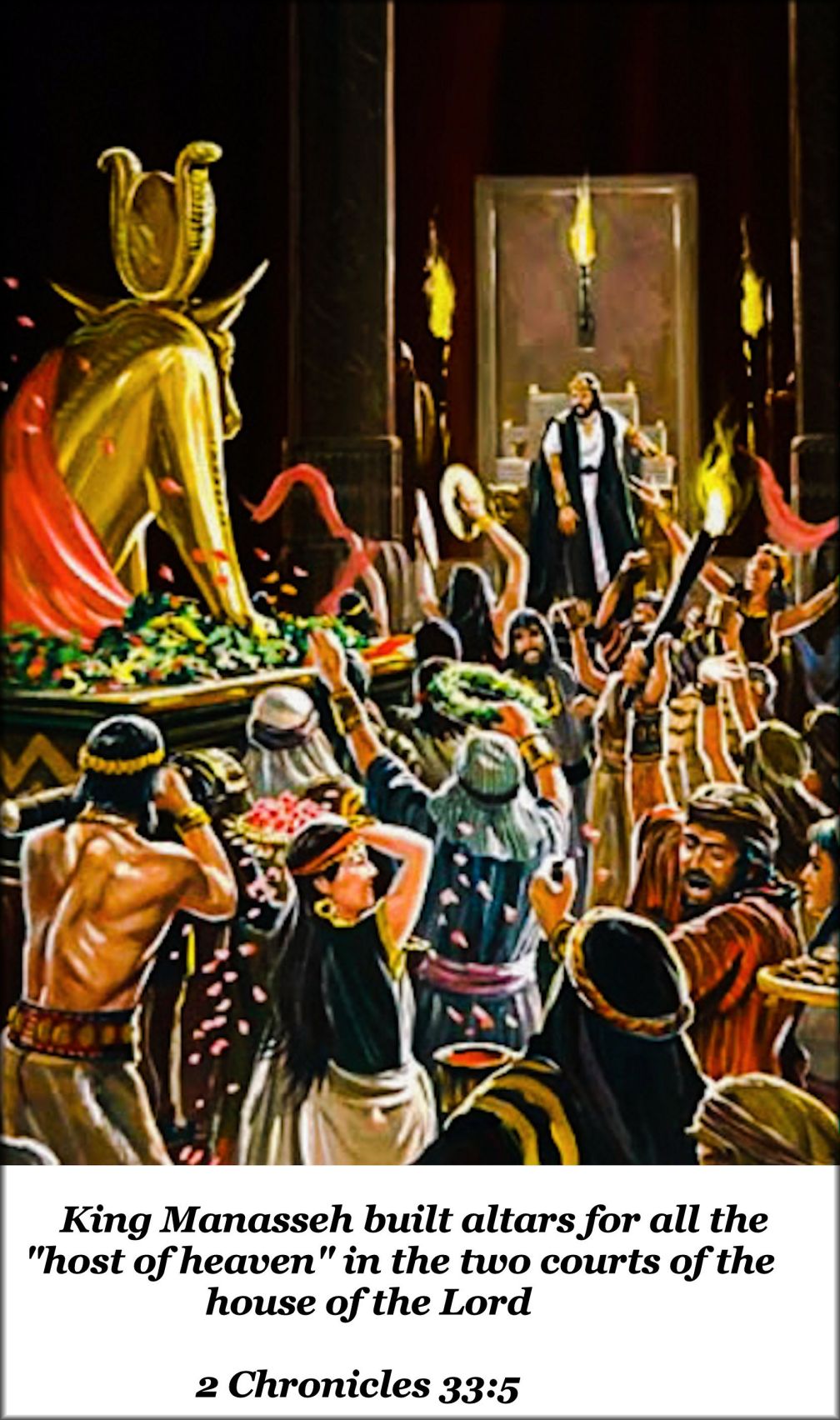
Wicked Judean King Mananasseh brought pagan idols into the Temple Courtyards
1 Manasseh was twelve years old when he became king, and he reigned fifty-five years in Jerusalem.
2 But he did evil in the sight of the Lord, according to the abominations of the nations whom the Lord had cast out before the children of Israel.
3 For he rebuilt the high places which Hezekiah his father had broken down; he raised up altars for the Baals, and made wooden images; and he worshiped all the host of heaven and served them.
4 He also built altars in the house of the Lord, of which the Lord had said, “In Jerusalem shall My name be forever.”
5 And he built altars for all the host of heaven in the two courts of the house of the Lord.
6 Also he caused his sons to pass through the fire in the Valley of the Son of Hinnom; he practiced soothsaying, used witchcraft and sorcery, and consulted mediums and spiritists. He did much evil in the sight of the Lord, to provoke Him to anger.
7 He even set a carved image, the idol which he had made, in the house of God, of which God had said to David and to Solomon his son, “In this house and in Jerusalem, which I have chosen out of all the tribes of Israel, I will put My name forever;
The story of both Israel’s and Samaria’s failures in keeping to the way of Yahweh is partly told in Chapter 17 of the Second Book of Kings. There, too, the sacred author tells how the king of Assyria sent a priest from among the exiles to teach the Samaritans how to worship God after an attack by lions was attributed to their failure to worship the God of the land. Second Kings recounts how worship of Yahweh was mixed with the worship of strange gods.
2 Kings Chapter 17
(Hoshea Reigns in Israel)
1 In the twelfth year of Ahaz king of Judah, Hoshea the son of Elah became king of Israel in Samaria, and he reigned nine years.
2 And he did evil in the sight of the Lord, but not as the kings of Israel who were before him.
3 Shalmaneser king of Assyria came up against him; and Hoshea became his vassal, and paid him tribute money.
4 And the king of Assyria uncovered a conspiracy by Hoshea; for he had sent messengers to So, king of Egypt, and brought no tribute to the king of Assyria, as he had done year by year. Therefore the king of Assyria shut him up, and bound him in prison.
(Israel Carried Captive to Assyria)
5 Now the king of Assyria went throughout all the land, and went up to Samaria and besieged it for three years.
6 In the ninth year of Hoshea, the king of Assyria took Samaria and carried Israel away to Assyria, and placed them in Halah and by the Habor, the River of Gozan, and in the cities of the Medes.
7 For so it was that the children of Israel had sinned against the Lord their God, who had brought them up out of the land of Egypt, from under the hand of Pharaoh king of Egypt; and they had feared other gods,
8 and had walked in the statutes of the nations whom the Lord had cast out from before the children of Israel, and of the kings of Israel, which they had made.
9 Also the children of Israel secretly did against the Lord their God things that were not right, and they built for themselves high places in all their cities, from watchtower to fortified city.
10 They set up for themselves sacred pillars and wooden images on every high hill and under every green tree.
11 There they burned incense on all the high places, like the nations whom the Lord had carried away before them; and they did wicked things to provoke the Lord to anger,
12 for they served idols, of which the Lord had said to them, “You shall not do this thing.”
13 Yet the Lord testified against Israel and against Judah, by all of His prophets, every seer, saying, “Turn from your evil ways, and keep My commandments and My statutes, according to all the law which I commanded your fathers, and which I sent to you by My servants the prophets.”
14 Nevertheless they would not hear, but stiffened their necks, like the necks of their fathers, who did not believe in the Lord their God.
15 And they rejected His statutes and His covenant that He had made with their fathers, and His testimonies which He had testified against them; they followed idols, became idolaters, and went after the nations who were all around them, concerning whom the Lord had charged them that they should not do like them.
16 So they left all the commandments of the Lord their God, made for themselves a molded image and two calves, made a wooden image and worshiped all the host of heaven, and served Baal.
17 And they caused their sons and daughters to pass through the fire, practiced witchcraft and soothsaying, and sold themselves to do evil in the sight of the Lord, to provoke Him to anger.
18 Therefore the Lord was very angry with Israel, and removed them from His sight; there was none left but the tribe of Judah alone.
19 Also Judah did not keep the commandments of the Lord their God, but walked in the statutes of Israel which they made.
20 And the Lord rejected all the descendants of Israel, afflicted them, and delivered them into the hand of plunderers, until He had cast them from His sight.
21 For He tore Israel from the house of David, and they made Jeroboam the son of Nebat king. Then Jeroboam drove Israel from following the Lord, and made them commit a great sin.
22 For the children of Israel walked in all the sins of Jeroboam which he did; they did not depart from them,
23 until the Lord removed Israel out of His sight, as He had said by all His servants the prophets. So Israel was carried away from their own land to Assyria, as it is to this day.
24 Then the king of Assyria brought people from Babylon, Cuthah, Ava, Hamath, and from Sepharvaim, and placed them in the cities of Samaria instead of the children of Israel; and they took possession of Samaria and dwelt in its cities.
25 And it was so, at the beginning of their dwelling there, that they did not fear the Lord; therefore the Lord sent lions among them, which killed some of them.
26 So they spoke to the king of Assyria, saying, “The nations whom you have removed and placed in the cities of Samaria do not know the rituals of the God of the land; therefore He has sent lions among them, and indeed, they are killing them because they do not know the rituals of the God of the land.”
27 Then the king of Assyria commanded, saying, “Send there one of the priests whom you brought from there; let him go and dwell there, and let him teach them the rituals of the God of the land.”
28 Then one of the priests whom they had carried away from Samaria came and dwelt in Bethel, and taught them how they should fear the Lord.
29 However every nation continued to make gods of its own, and put them in the shrines on the high places which the Samaritans had made, every nation in the cities where they dwelt.
30 The men of Babylon made Succoth Benoth, the men of Cuth made Nergal, the men of Hamath made Ashima,
31 and the Avites made Nibhaz and Tartak; and the Sepharvites burned their children in fire to Adrammelech and Anammelech, the gods of Sepharvaim.
32 So they feared the Lord, and from every class they appointed for themselves priests of the high places, who sacrificed for them in the shrines of the high places.
33 They feared the Lord, yet served their own gods—according to the rituals of the nations from among whom they were carried away.
34 To this day they continue practicing the former rituals; they do not fear the Lord, nor do they follow their statutes or their ordinances, or the law and commandment which the Lord had commanded the children of Jacob, whom He named Israel,
35 with whom the Lord had made a covenant and charged them, saying: “You shall not fear other gods, nor bow down to them nor serve them nor sacrifice to them;
36 but the Lord, who brought you up from the land of Egypt with great power and an outstretched arm, Him you shall fear, Him you shall worship, and to Him you shall offer sacrifice.
37 And the statutes, the ordinances, the law, and the commandment which He wrote for you, you shall be careful to observe forever; you shall not fear other gods.
38 And the covenant that I have made with you, you shall not forget, nor shall you fear other gods.
39 But the Lord your God you shall fear; and He will deliver you from the hand of all your enemies.”
40 However they did not obey, but they followed their former rituals.
41 So these nations feared the Lord, yet served their carved images; also their children and their children’s children have continued doing as their fathers did, even to this day.
Yahweh yielded the Israelites over to their hearts desire; that is, to mix with other races. As verse 24 above states, the Assyrians brought in populations of other nations into the region:
24 Then the king of Assyria brought people from Babylon, Cuthah, Ava, Hamath, and from Sepharvaim, and placed them in the cities of Samaria instead of the children of Israel; and they took possession of Samaria and dwelt in its cities.
All during this time, the animosity between Samaritan Jews and Judean continued. As mentioned earlier, though the Samaritans were condemned by the Jews, they probably had as much pure Jewish blood as the Jews who later returned from the Babylonian exile.
Both groups fell into an apostate form of worship, mixing worship of Jehovah and Hebrew traditions with the worship of pagan gods that they learned through association with foreign nations. The kingdom of Judah was not exempt from false worship and committing abominations before God; however, Judeans felt superior.
We are told that the Jews had no dealings with the Samaritans. In a conversation that Jesus had with a Samaritan woman we are told that she said the following.
Therefore the Samaritan woman said to him, “How is it that you, being a Jew, ask me for a drink since I am a Samaritan woman?” (For Jews have no dealings with Samaritans) (John 4:9).
Samaritans Had Their Own Temple And Religious System
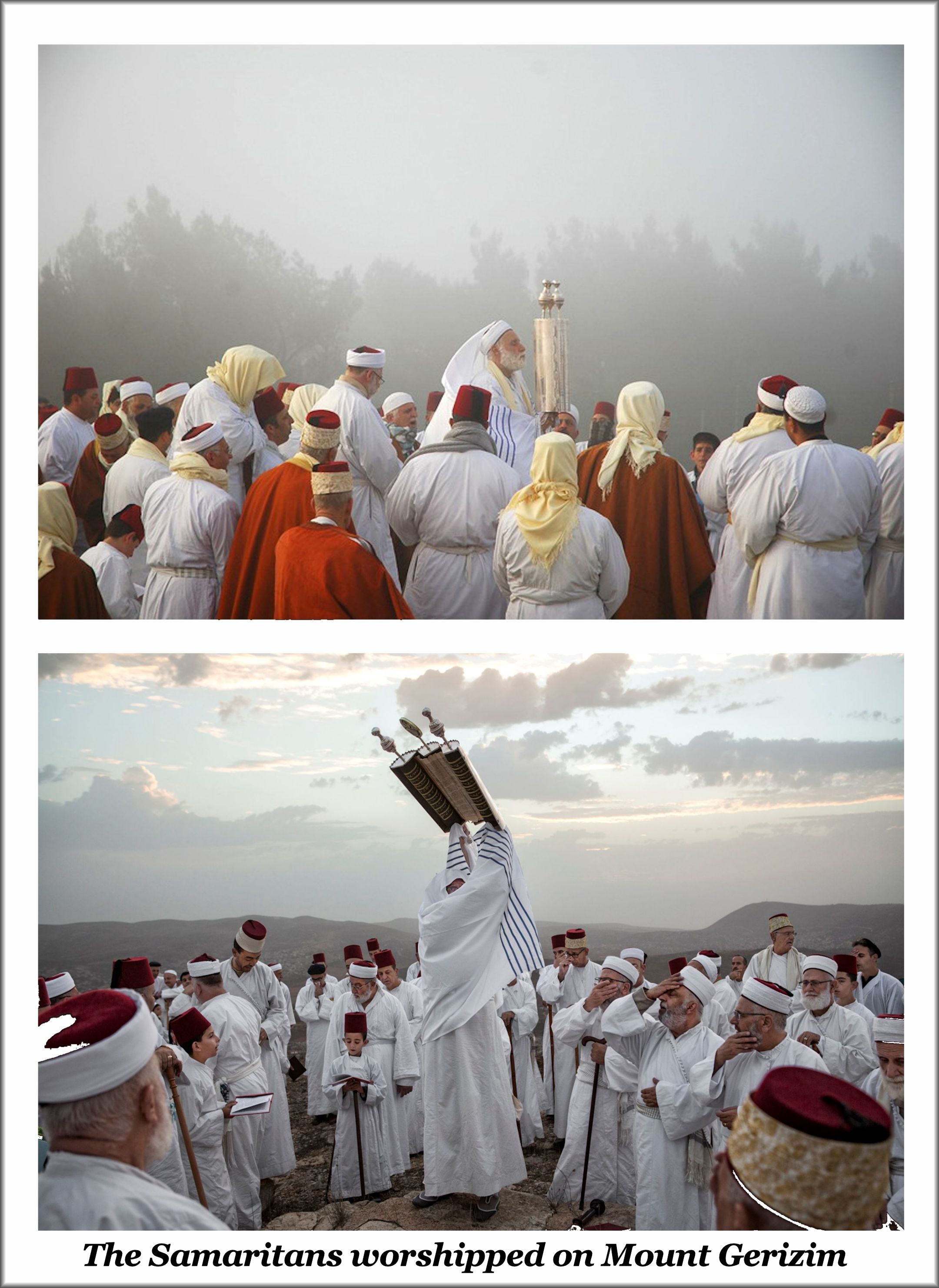
Samaritans Had Their Own Temple And Religious System
The Samaritans had their own temple, their own copy of the Torah – the first five books of the Old Testament – and their own religious system. There was an issue among the Jews and Samaritans as to where the proper place of worship. The following exchange took place between Jesus and the Samaritan woman.
John 4:19-23
19 The woman said to Him, “Sir, I perceive that You are a prophet.
20 Our fathers worshiped on this mountain, and you Jews say that in Jerusalem is the place where one ought to worship.”
21 Jesus said to her, “Woman, believe Me, the hour is coming when you will neither on this mountain, nor in Jerusalem, worship the Father.
22 You worship what you do not know; we know what we worship, for salvation is of the Jews.
23 But the hour is coming, and now is, when the true worshipers will worship the Father in spirit and truth; for the Father is seeking such to worship Him.
They Rejected Jesus When He Passed Through Their Region
When Jesus was on his way to Jerusalem to die for the sins of the world he passed through Samaria. The Samaritans did not receive him because he was on his way to Jerusalem.
As the time approached for him to be taken up to heaven, Jesus resolutely set out for Jerusalem. And he sent messengers on ahead, who went into a Samaritan village to get things ready for him; but the people there did not welcome him, because he was heading for Jerusalem.
Luke 9:51-53
51 Now it came to pass, when the time had come for Him to be received up, that He steadfastly set His face to go to Jerusalem,
52 and sent messengers before His face. And as they went, they entered a village of the Samaritans, to prepare for Him.
53 But they did not receive Him, because His face was set for the journey to Jerusalem.
Summary
The Samaritans were a group of people who lived in Samaria – an area north of Jerusalem. They were half-Jews and half-Gentiles. When Assyria captured the northern kingdom of Israel in 721 B.C. some were taken in captivity while others left behind. The ones left behind intermarried with the Assyrians. Thus these people were neither fully Hebrews nor fully Gentiles. The Samaritans had their own unique copy of the first five books of Scripture as well as their own unique system of worship. The Samaritans had developed their own version of Judaism.
At the time of Jesus the Jews and the Samaritans did not deal with one another. Most Jews regarded the Samaritans as ignorant, superstitious, and outside of God’s favour and mercy. Jesus, however, ministered to the people of Samaria preaching the good news to them.
The Samaritans were still very much part of God’s plans as shown in the fourth chapter of John’s gospel where Jesus brings the good news to Sychar, a Samaritan village. Moreover, Jesus specifically mentions Samaria in Acts 1:8 where he tells his disciples: “You will be my witnesses in Jerusalem and in all Judea and Samaria, and to the ends of the earth.” Christian churches were soon established there (Acts 9:31 cf. Acts 8:1, 4-5; 9:31; 15:3).
Back to top

“And their dead bodies shall lie in the street of the great city, which spiritually is called Sodom and Egypt, where also our Lord was crucified. Revelation 11:8
Sodom was a city full of injustices written in their laws.
Sodomite laws were completely backward and rewarded wrongdoing.
Details can be found in the Book of Jasher, Hebrew: סֵפֶר הַיׇּשׇׁר.
The Book of Jasher is referenced In Joshua 10:13; 2 Samuel 1:18; And 2 Timothy 3:8.
The following are some examples of the perverted sense of justice of the inhabitants of Sodom.
When Abraham sent his servant Eliezer to Sodom, this is what occurred:
Jasher 19:12-22
12. And Eliezer went to Sodom, and he met a man of Sodom fighting with a stranger, and the man of Sodom stripped the poor man of all his clothes and went away.
13. And this poor man cried to Eliezer and supplicated his favor on account of what the man of Sodom had done to him.
14. And he said to him, Why dost thou act thus to the poor man who came to thy land?
15. And the man of Sodom answered Eliezer, saying, Is this man thy brother, or have the people of Sodom made thee a judge this day, that thou speakest about this man?
16. And Eliezer strove with the man of Sodom on account of the poor man, and when Eliezer approached to recover the poor man’s clothes from the man of Sodom, he hastened and with a stone smote Eliezer in the forehead.
17. And the blood flowed copiously from Eliezer’s forehead, and when the man saw the blood he caught hold of Eliezer, saying, Give me my hire for having rid thee of this bad blood that was in thy forehead, for such is the custom and the law in our land.
18. And Eliezer said to him, Thou hast wounded me and requirest me to pay thee thy hire; and Eliezer would not hearken to the words of the man of Sodom.
19. And the man laid hold of Eliezer and brought him to Shakra the judge of Sodom for judgment.
20. And the man spoke to the judge, saying, I beseech thee my lord, thus has this man done, for I smote him with a stone that the blood flowed from his forehead, and he is unwilling to give me my hire.
21. And the judge said to Eliezer, This man speaketh truth to thee, give him his hire, for this is the custom in our land; and Eliezer heard the words of the judge, and he lifted up a stone and smote the judge, and the stone struck on his forehead, and the blood flowed copiously from the forehead of the judge, and Eliezer said, If this then is the custom in your land give thou unto this man what I should have given him, for this has been thy decision, thou didst decree it.
22. And Eliezer left the man of Sodom with the judge, and he went away.
Imagine being legally forced to pay someone for assaulting you as if they had done you a favor!
One of their laws for instance, forbade its residents to offer assistance to travelers who passed through the city. If one was caught even giving a traveler a drink of water or a morsel of bread, the punishment was death. This is what happened to a daughter of Lot:
Consider Jasher 19:12-24-35
24 At that time the wife of Lot bare him a daughter, and he called her name Paltith, saying, Because God had delivered him and his whole household from the kings of Elam; and Paltith daughter of Lot grew up, and one of the men of Sodom took her for a wife.
25 And a poor man came into the city to seek a maintenance, and he remained in the city some days, and all the people of Sodom caused a proclamation of their custom not to give this man a morsel of bread to eat, until he dropped dead upon the earth, and they did so.
26 And Paltith the daughter of Lot saw this man lying in the streets starved with hunger, and no one would give him any thing to keep him alive, and he was just upon the point of death.
27 And her soul was filled with pity on account of the man, and she fed him secretly with bread for many days, and the soul of this man was revived.
28 For when she went forth to fetch water she would put the bread in the water pitcher, and when she came to the place where the poor man was, she took the bread from the pitcher and gave it him to eat; so she did many days.
29 And all the people of Sodom and Gomorrah wondered how this man could bear starvation for so many days.
30 And they said to each other, This can only be that he eats and drinks, for no man can bear starvation for so many days or live as this man has, without even his countenance changing; and three men concealed themselves in a place where the poor man was stationed, to know who it was that brought him bread to eat.
31 And Paltith daughter of Lot went forth that day to fetch water, and she put bread into her pitcher of water, and she went to draw water by the poor man’s place, and she took out the bread from the pitcher and gave it to the poor man and he ate it.
32 And the three men saw what Paltith did to the poor man, and they said to her, It is thou then who hast supported him, and therefore has he not starved, nor changed in appearance nor died like the rest.
33 And the three men went out of the place in which they were concealed, and they seized Paltith and the bread which was in the poor man’s hand.
34 And they took Paltith and brought her before their judges, and they said to them, Thus did she do, and it is she who supplied the poor man with bread, therefore did he not die all this time; now therefore declare to us the punishment due to this woman for having transgressed our law.
35 And the people of Sodom and Gomorrah assembled and kindled a fire in the street of the city, and they took the woman and cast her into the fire and she was burned to ashes.
Sodomites were completely and demonically backward in their reasoning or more accurately, their lack of reasoning.
Most people think of Sodom in terms of gross sexual immorality; and it was. But their sins were even more extensive.
Remember that God had condemned the City to destruction prior to the two angels arrival after which the men of the city demanded they be brought out to them.
Sodom, according to the Book of Jasher, was a city where adultery (wife swapping) was also a custom. Orgies seemed to big a favorite pastime.
They also tortured strangers when they would happen through:
Jasher 19:3-10
And by desire of their four judges the people of Sodom and Gomorrah had beds erected in the streets of the cities, and if a man came to these places they laid hold of him and brought him to one of their beds, and by force made him to lie in them.
4 And as he lay down, three men would stand at his head and three at his feet, and measure him by the length of the bed, and if the man was less than the bed these six men would stretch him at each end, and when he cried out to them they would not answer him.
5 And if he was longer than the bed they would draw together the two sides of the bed at each end, until the man had reached the gates of death.
6 And if he continued to cry out to them, they would answer him, saying, Thus shall it be done to a man that cometh into our land.
7 And when men heard all these things that the people of the cities of Sodom did, they refrained from coming there.
God and Christ compared Jerusalem to Sodom.
Jerusalem was never known as a city of gross sexual immorality. So on what basis was the comparison made?
God stated the sin of Sodom and it can be read at Ezekiel 16:49:
49 Behold, this was the iniquity of thy sister Sodom, pride, fulness of bread, and abundance of idleness was in her and in her daughters, neither did she strengthen the hand of the poor and needy.
Now we have a basis for comparison.

God declared that the sins of Judah, whose capital was Jerusalem were worse than those of the break away ten tribe kingdom to its north whose capital was Samaria. And that they were even worse than those of Sodom.
And Jesus made a similar comment regarding Jerusalem two times. Once when alive on Earth and a second time after his resurrection to Heaven.

When sending out the 70 disciples to minister ahead of his coming to the towns and villages, this is what he said:
Luke 10:1-14
1 After these things the Lord appointed other seventy also, and sent them two and two before his face into every city and place, whither he himself would come.
2 Therefore said he unto them, The harvest truly is great, but the labourers are few: pray ye therefore the Lord of the harvest, that he would send forth labourers into his harvest.
3 Go your ways: behold, I send you forth as lambs among wolves.
4 Carry neither purse, nor scrip, nor shoes: and salute no man by the way.
5 And into whatsoever house ye enter, first say, Peace be to this house.
6 And if the son of peace be there, your peace shall rest upon it: if not, it shall turn to you again.
7 And in the same house remain, eating and drinking such things as they give: for the labourer is worthy of his hire. Go not from house to house.
8 And into whatsoever city ye enter, and they receive you, eat such things as are set before you:
9 And heal the sick that are therein, and say unto them, The kingdom of God is come nigh unto you.
10 But into whatsoever city ye enter, and they receive you not, go your ways out into the streets of the same, and say,
11 Even the very dust of your city, which cleaveth on us, we do wipe off against you: notwithstanding be ye sure of this, that the kingdom of God is come nigh unto you.
12 But I say unto you, that it shall be more tolerable in that day for Sodom, than for that city.
13 Woe unto thee, Chorazin! woe unto thee, Bethsaida! for if the mighty works had been done in Tyre and Sidon, which have been done in you, they had a great while ago repented, sitting in sackcloth and ashes.
14 But it shall be more tolerable for Tyre and Sidon at the judgment, than for you.
And Christ did so again at the time he gave his prophetic vision to John. He then likens Jerusalem to Sodom:
Revelation 11:8
8 And their dead bodies shall lie in the street of the great city, which spiritually is called Sodom and Egypt, where also our Lord was crucified.
Many believe that the “great city” that is mentioned here is the same great city mentioned in Revelation 16:19, “Babylon the Great”. But it could not be. Why not?
He gives a clue that he is speaking of Jerusalem as he refers to it as the place “where our Lord was crucified”.
The crowd of Israelites who demanded the death of an innocent man in exchange for the release of a guilty murder is very reminiscent of the mindset and behavior of the Sodomites.
Matthew 27:15–18 records the events:
Now at the feast the governor was accustomed to release for the crowd any one prisoner whom they wanted. And they had then a notorious prisoner called Barabbas. So when they had gathered, Pilate said to them, “Whom do you want me to release for you: Barabbas, or Jesus who is called Christ?”
“‘Which of the two do you want me to release for you?’ And they said, ‘Barabbas’”
Jesus had been accused of crimes that could not be proven and were in fact based on a false allegation.
Then there was Barabbas who was basically a terrorist.
The crowd chose a murderer over the one who brings the dead back to life.
They chose evil over the one who loves perfectly.
Pilate knew Jesus was innocent, but the crowds roared to free Barabbas and to crucify Jesus.
It is true that God used this travesty of justice to fulfill his will in that it provided an innocent, pure sacrificial offering to redeem mankind.
This did not relieve his murderers from guilt.
Consider for yourself in what ways the people of Israel (Jerusalem ) manifested a spirit and behaviors like those Sodom was condemned for and how its modern day counterpart is just as reprehensible.


Antichrist Opposition To The Only True Messiah
2 Thessalonians 2:1-4
“Now concerning the coming of our Lord Jesus Christ and our being gathered to Him: We ask you, brothers, 2 not to be easily upset in mind or troubled, either by a spirit or by a message or by a letter as if from us, alleging that the Day of the Lord has come. 3 Don’t let anyone deceive you in any way. For that day will not come unless the apostasy comes first and the man of lawlessness is revealed, the son of destruction. 4 He opposes and exalts himself above every so-called god or object of worship, so that he sits in God’s sanctuary, publicizing that he himself is God.”
The following article puts the ‘Interfaith Movement’ and ‘Christian Zionism’ ambitions and motivations into Biblical and historical context. As you read, reflect on what opposition the Lord Jesus and his first century disciples encountered.
What Is Antichrist?
Antichrist is that which is opposed to the complete acceptance of Jesus Christ as the only Messiah sent by God and the Kingdom of Heaven. Antichrist pose an ‘alternative’ means of salvation contrary to complete faith and obedience to Jesus Christ.
Christian Zionism and the Interfaith Movement is the modern-day antichrist.
The Interfaith Movement and Christian Zionism
It’s one of the most successful, and in some ways unlikely, interfaith movements in the modern world
On 23 June 1969, at the Midtown Manhattan headquarters of the American Jewish Committee, the evangelist Billy Graham met with two dozen rabbis and Jewish leaders. According to one rabbi, the meeting was to allow Graham to convey ‘the need for dialogue and communication’ between American evangelicals and American Jews, and to find common ground by explaining ‘his relationship with Israel’. It was a pivotal moment in the American Jewish and evangelical Protestant interfaith relationship.
Though some of the Jewish leaders were wary of the ‘wild raving fundamentalist’, Graham won them over. He cited the Hebrew Scriptures, or Old Testament, to describe his understanding of God’s covenant with the Jewish people, and explained his support for Israel as recompense for past Christian anti-Judaism. ‘All Christians are guilty as far as Jewish experience was concerned,’ he said. Graham also spoke of his conversations with the Israeli prime minister Golda Meir, and assured American Jewish leaders that the United States’ president Richard Nixon was ‘extremely sympathetic’ to Israel.
Today, for many evangelicals, Christian Zionism is no mere side issue. They believe that they are not only correcting the ancient injustice of anti-Semitism, but contributing to the salvation of the world and the completion of God’s redemptive plans. It is, for many, the metanarrative that makes sense of the biblical drama and current events, and provides a road map for the future.
That 1969 meeting contained all the essential elements characterising the exceptional support that evangelical Protestants in the US give to the state of Israel. The spirit of this meeting has since been replicated dozens of times. Graham weaved an evangelical reading of the Bible, a deep-seated longing to aid Israel, and the self-interested power calculations of both communities into a language of interfaith rapprochement and shared Jewish-Christian interests. His Jewish colleagues, concerned about the future of Israel, and cognizant of the evangelicals’ influence, were eager to create new lines of cooperation.
Pressed on theology, Graham would have affirmed his commitment to the exclusive truth claims of Christianity, while the American Jewish leaders undoubtedly retained their own theological exclusivity. Still, their peculiar set of shared interests led to a powerful and lasting partnership. Their alliance is one of the most notable instances of interfaith cooperation in recent history.
In the wake of Europe’s religious wars, exclusive claims to religious truth – ‘theological intolerance’, as Jean-Jacques Rousseau called them in The Social Contract (1762) – grew to be seen as an impediment to civil relations. ‘It is impossible to live at peace with those we regard as damned,’ wrote Rousseau, ‘to love them would be to hate God who punishes them: we positively must either reclaim or torment them.’ But the alliance of American evangelicals and American Jews proves that Rousseau’s dictum is not necessarily true.
Close to 50 years after that meeting, evangelicals and Jews remain at loggerheads on most theological and cultural issues. In the face of these vast differences, they have managed to unite – in ever closer cooperation – over support for Israel. No individual has inherited Graham’s stature atop American evangelicalism, and his multiple successors do not share uniform attitudes toward Israel. But many of them lead influential Christian Zionist organisations that constitute one of the most successful single-issue movements in modern US politics.
Christian Zionists have achieved exceptional unity and influence on support for Israel, using a sophisticated combination of religious, historical and political components. They emphasise a potent type of interfaith engagement that elevates biblical covenantal language, and offer a sanitized version of the Jewish-Christian past, yet also orient their work toward the pragmatic goal of increasing political influence.
Interfaith cooperation is a liberal ideal: the world can be a better place if different religions work together.
Understanding Christian Zionism as an important instance of interfaith cooperation helps us understand the powerful ways in which it has shaped not only relationships between Jews and Christians but the identity of American evangelicals.
Interfaith cooperation is at least as old as Moses’ flight to Midian, when he took refuge from his Egyptian pursuers with Jethro, a priest of an unknown religion, who became his father-in-law. Yet the mere fact of people of different religions working together is not the essence of interfaith cooperation. The term is a modern one, and its meaning is found in the 20th century.
Liberal ideas of interfaith cooperation lionize progressive values, expand tolerance, and help to build more democratic civil societies. And interfaith cooperation is a liberal ideal. From the British writer Karen Armstrong to the American campaigner Eboo Patel, its proponents claim that individuals and communities of different religious backgrounds will make the world a better place if they cooperate and work together.
Nonprofits such as Patel’s Interfaith Youth Core in Chicago and the World Faiths Development Dialogue in Washington, DC offer many historical examples of interfaith cooperation, and they’re always progressive. These include the civil rights partnership between Reverend Martin Luther King, Jr and Rabbi Abraham Joshua Heschel, and the collaboration between Mohandas Gandhi and Bacha Khan in the movement for Indian independence. Sometimes, proponents reach back further, to the cooperative culture of Al-Andalus in medieval Spain and the enlightened reign of Akbar the Great of the Mughal Empire. These examples stand for more peaceful cohabitation, more equality, more happiness, more justice, and more civilisation.
But Christian Zionism rejects progressive ideals and embraces a very different understanding of the world. That’s why it’s seen – by mostly liberal social scientists and journalists – not as a pioneer in interfaith cooperation but as an apocalyptic movement, a Right-wing political grouping, or even a neocolonial venture. To be sure, these analyses offer useful insights, but as a movement of Christians seeking cooperation with Jews, Christian Zionism also represents one of recent history’s most important interfaith cases.
Christian Zionists are seeking to enact what they consider the values of Jewish-Christian cooperation in political and religious terms. Starting with a specific political issue – the wellbeing of Israel – Christian Zionism structures the interfaith relationship in its service. The movement is built to make the case that this goal is vital to evangelical Christians and their identity.
Christian Zionism projects a specific vision of God’s covenantal guarantees and their eschatological fulfilment. In short, it makes God’s promises and their scope more certain, more selective, more exclusive in understanding God’s dealings with humanity. This specificity sets Christian Zionism apart from other interfaith movements, and goes far in explaining its affinity to a certain understanding of Jewish identity.
The issue in which this specificity pays interfaith dividends is in securing Jewish possession of Israel’s covenanted land. The ‘land’ consists of the sites of biblical history and the biblically mandated borders that God in Genesis grants to Israel’s patriarchs. For Christian Zionists, these make up the ideal borders of the state of Israel and include the contested West Bank.
It’s key that US evangelicals’ political Zionism took shape after the Arab-Israeli War of June 1967. This timing meant that, post-1967, evangelical understandings of Israel became preoccupied with its sovereignty over the covenanted land. In the wake of that war, which saw Israel take control of the West Bank, Gaza Strip and East Jerusalem, Jews themselves were undecided on Israel’s significance. The trend, more obvious and expected in Israel, was to emphasise the centrality of land to Jewish identity. The entirety of Judaism could be distilled, in the words of the Israeli official Yona Malachy, to ‘the tripartite union of religion-people-land’. ‘The recognition of the tie between the Jewish people and their country must become the central theme of any future dialogue between Christianity and Jewry,’ he warned in 1969.
Among American Jews, there was less consensus on the preeminence of land to the meaning of Israel, though certainly many came to see the success of Israel as core to their own identity. One of the leading US conservative rabbis, Arthur Hertzberg, claimed in 1971 that ‘the state of Israel … is necessary for the continuity of Judaism and Jews’. Rabbi Marc Tanenbaum, the American Jewish Committee’s director of interreligious affairs and an organiser of Graham’s 1969 meeting, insisted that ‘Christians face and accept the profound historical, religious, cultural and liturgical meaning of the land of Israel and of Jerusalem to the Jewish people’.
American Protestant evangelicals found these demands compelling, mostly for reasons related to their own ideas about the ‘end times’ and Christ’s second coming. For some evangelicals, Israel represented ‘God’s timepiece’ and the centre of the fulfilment of biblical prophecy. For others, it was a testament to God’s fidelity to his chosen people. Many of these eschatological interests also emphasised the central role of Israel in the end times.
Each step that Christian Zionists take toward Jews in practice means a step away from Muslims.
Post-1967, Christian Zionists adopted the emerging Jewish emphasis on Israel as their own. For the US evangelical educator and activist G Douglas Young, the tragedy was that ‘Christians in the US did not, nor do they, understand the Jews’ self-understanding of themselves and their interest in the land of Israel’. Young headed an evangelical graduate school in Jerusalem dedicated to the mission of helping students ‘com[e] to grips with the problem of the Jew’s self-evaluation and his interest in the land’. His selectivity of who defined the Jewish interpretation of Israel (largely Israeli Zionists) should not detract from his explicitly interfaith understanding of his mission.
Other evangelicals soon followed. Along with Graham, the presidents of the National Association of Evangelicals and the Southern Baptist Convention in the late-1960s indicated an openness to adopting what they called a ‘Jewish self-understanding’ of Israel. It was basically a ceding of what Israel meant and should mean in the world today, while holding fast to an eschatology that forecast a bad ending for all non-Christians, including the vast majority of Jews.
After 1967, from the narrow starting point of overlapping concern for the security of Israel, Christian Zionists and their Jewish partners developed a shared set of values. Christian Zionists soon extended their thinking to related issues of anti-Semitism, religious persecution and secularism. Today, they are the most active partisans for Israel on US university campuses. They oppose the Boycott, Divestment and Sanctions movement, and lobby governments around the world to favour Israel.
A shared fixation on those deemed Israel’s enemies has been integral to this worldview. Arab Palestinians (both Christian and Muslim) hardly receive a hearing by Christian Zionists – a justification often voiced on grounds of interfaith solidarity with Israel. Each step that Christian Zionists take toward Jews, however, in practice means a step away from Muslims. The promise of an ‘Abrahamic’ dialogue or a tri-faith cooperative is nowhere dimmer than in Christian Zionism. In the name of interfaith cooperation, Christian Zionists find theological justifications for most Israeli policies.
Regardless of these political choices, Christian Zionists understand their support for Israel as participation in the redeeming work of God. At the dawn of US evangelical organisation for Israel, Young called for action as a necessary extension of Christian faith. ‘Are you helping the new nation of Israel?’ he asked in The Bride and the Wife (1960). ‘Are you helping them in material and physical ways? Are you expressing real friendship always?’ Assuming the burden of Israel’s security, Young argued, was a Christian duty and a tangible expression of interfaith solidarity between God’s two chosen people, the Church and Israel.
The influence of Zionism also led to recasting interfaith cooperation with Jews as a realisation, rather than a deviation, of evangelical identity. This is evident in the area of evangelical missions to the Jews – long the most contentious barrier to any type of Jewish-Christian rapprochement. Largely as a result of Christian Zionist activism, evangelical leaders – from John Hagee, the founder of Christians United for Israel (the largest Christian Zionist organisation in the US) to the European leadership of the International Christian Embassy Jerusalem (the largest Christian Zionist organisation in the world) – have disavowed missions.
Hagee’s book In Defense of Israel (2007) sought to curb the evangelical obligation of Jewish missions by claiming that Jesus never really meant to save the Jews. ‘The Jews did not reject Jesus as Messiah; it was Jesus who rejected the Jewish desire for him to be their Messiah,’ he wrote, seemingly opening the way for Jews to be saved through their own covenant with God. Outcry by fellow evangelicals led Hagee to revise this specific language, but not his organisation’s refrain from missions.

Men like Hagee would make reocognizing Jesus as the only Messiah optional, opening the way for Jews to be saved through their own covenant with God.
Rather than endorse missions, Hagee and other Christian Zionists recast support for Israel as necessary Christian penance for the Church’s past mistreatment of Jews. The guilt felt by Christian Zionists is often palpable. ‘Anti-Semitism,’ Hagee wrote, ‘has its origin and its complete root structure in Christianity, dating from the early days of the Christian Church.’ This language is an echo of post-Holocaust Christian theologians – including Father Edward Flannery, whose book The Anguish of the Jews (1965) Hagee cites as formative to his understanding of Jewish-Christian history.
Support for Israel is just one side of the recent evangelical revaluation of Judaism. Once maligned as the religion of ‘Christ-killers’ and ‘Pharisees’, Judaism is now seen by evangelicals in a better light. The reasons for the change include a decline, following the Holocaust, in anti-Semitic views among all Americans, the pluralism of postwar ‘Judeo-Christian’ civil religion, and, less well-known, a revolution in biblical studies and related fields that emphasise ‘Hebraic’ over ‘Hellenistic’ influences on the Bible. Yet it was not principled commitment to pluralism that raised the change in evangelical views of Jews and Judaism, but rather a confluence of politicised eschatology with new intellectual authority urging closer Jewish-Christian cooperation.
Even outside the Christian Zionist movement, evangelical scholars of early Christianity and Judaism have changed their understanding of Jewish-Christian relations. In evangelical colleges and seminaries across the US, instead of Judaism as the negative mirror image of Christianity (the ‘law’ to Christianity’s ‘grace’; the ‘particularism’ to Christianity’s ‘universalism’), scholars now emphasise the Jewish heritage of Christianity and the mutually reinforcing values of the two traditions.
They managed to link academic insights and political organising as two sides of evangelical identity
In the past couple of generations, many evangelical scholars propelling this trend have studied at Jewish institutions: Marvin Wilson, whose book Our Father Abraham: Jewish Roots of Christian Faith (1989) earned a PhD from Brandeis University in Massachusetts, which is sponsored by the Jewish community; the aforementioned Young, founder of Bridges for Peace, the oldest Christian Zionist organisation, earned a PhD from what was then Dropsie College in Pennsylvania and is now the Herbert D Katz Center for Advanced Judaic Studies. A later generation of evangelical scholars studied at the Hebrew University of Jerusalem, including Brad Young (no relation to G Douglas Young), now a professor of Judaic-Christian studies at Oral Roberts University in Oklahoma who recently graduated his first Orthodox Israeli student in the same field. These scholars have, to varying degrees, personally supported Christian Zionist causes, all arguing that partnering with Jews on Israel is a moral and theological good.
Jewish voices have encouraged this change of attitude. David Brog, the director of Christians United for Israel, calls Jews and evangelicals ‘blood brothers’. Rabbi Shlomo Riskin, a founder of the West Bank settlement of Efrat, heads the Center for Jewish-Christian Cooperation and Understanding, organising joint Jewish-evangelical prayer groups, Bible reading groups and pro-Israel rallies.
The constituent parts of Christian Zionist thinking arise from this milieu of shifting and interacting evangelical and Jewish thought. Less acknowledged but no less important, other Christian work has also informed the transformation of evangelical attitudes. The pioneering scholarship of E P Sanders on Paul’s Hebrew background, the biblical archaeology of William Foxwell Albright, the New Testament research of the Israeli scholar David Flusser provided the foundations for the remarkable Jewish-Christian dialogues that have emerged across North America and Europe, from the Catholic Church’s Nostra Aetate declaration of 1965 to the World Council of Churches’ denunciations of anti-Semitism.
Unlike most interfaith encounters in the 20th century, Christian Zionists managed to bundle these insights and claims with an argument that cooperation was meaningful only if realised through political action. They managed, in essence, to link academic insights and political organising as two sides of evangelical identity. Few if any activists or special-interest groups have more effectively brought scholarship and political action into concert.
Like most American Jews, Israeli Jews differ with American evangelicals on a host of religious, cultural and political issues, from the economy to abortion to women in combat service. The cultural differences between evangelicals and Israelis are vast. Yet Christian Zionism shows that shared values need not be the basis of interfaith cooperation. The evangelical-Zionist bond has faced great challenges and has lasted by clinging to a very narrow set of shared interests. Yet the ideas underpinning Christian Zionism shape both evangelical identity and Israeli understandings of the US.
This is far from an endorsement of Christian Zionism. Criticisms of the movement’s politics, theology, tendency toward apocalypticism, ignoring and ignorance of the Palestinian experience and interests, anti-Muslim stereotyping, and near-unquestioning allegiance to Israel are all worthy of discussion. But Christian Zionism should not be misrepresented. A fundamentally interfaith alliance has informed and propelled Christian Zionists into the very halls of power. They have succeeded, in a way few interfaith movements have.
Reference:


|
Go To Hebrew-English Interlienear |

|
Go To Greek-English Interlienear |


“Neither is there salvation in any other: for there is none other name under heaven given among men, whereby we must be saved.”Acts 4:12
Who Is Your Savior? On Whom Does Your Salvation Depend?
Do you look at your pastor as your savior? Do you look to your religious group or organization for salvation?
If you do, you are not following the instruction found in the Holy Bible and Jesus Christ is not your Savior.
Efforts to exalt fellow human beings instead of the Lord, Jesus Christ as Savior are not a new phenomenon. There were many who were doing this very thing in the first century at the formation of the Christian assembly.
So much was the case that the apostle Paul had to write a sternly worded letter about this subject to the Body members who resided in Corinth.
He had to remind them that they were not baptized in his nor any other man’s name that ministers as a servant to Christ.
He had to remind them whom it was that died in their behalf in order that the door to salvation would be opened to them.
The apostle pointed out to the Corinthians that what they were doing when they claimed to be followers of a specific minister of Christ, was actually attempting to divide Christ.
In 1 Corinthian 1:29, Paul tells them and us, that God purposed things in the way He did so that no human had cause to be boasting in themselves. But rather, that the glory be to God and Christ.
In Chapter 3 verse one, Paul said that their behavior was “self-directed” according to their “fleshly nature” and he said that their actions were based on jealousy.
Lastly, Paul makes clear that it is not the minister that spiritual growth is dependent upon, but that growth is dependent upon the Holy Spirit of God.
Please read the text of the first of letter Paul wrote to the congregation of Corinthian and then ask yourself “Am I looking to Jesus Christ as my Savior, or someone or something else”?
1 Corinthians 1
1 Paul, called as an apostle of Christ Jesus by God’s will, and Sosthenes our brother:
2 To God’s church at Corinth, to those who are sanctified in Christ Jesus and called as saints, with all those in every place who call on the name of Jesus Christ our Lord—both their Lord and ours.
3 Grace to you and peace from God our Father and the Lord Jesus Christ.
4 I always thank my God for you because of God’s grace given to you in Christ Jesus,
5 that by Him you were enriched in everything—in all speech and all knowledge.
6 In this way, the testimony about Christ was confirmed among you,
7 so that you do not lack any spiritual gift as you eagerly wait for the revelation of our Lord Jesus Christ.
8 He will also strengthen you to the end, so that you will be blameless in the day of our Lord Jesus Christ.
9 God is faithful; you were called by Him into fellowship with His Son, Jesus Christ our Lord.
10 Now I urge you, brothers, in the name of our Lord Jesus Christ, that all of you agree in what you say, that there be no divisions among you, and that you be united with the same understanding and the same conviction.
11 For it has been reported to me about you, my brothers, by members of Chloe’s household, that there is rivalry among you.
12 What I am saying is this: Each of you says, “I’m with Paul,” or “I’m with Apollos,” or “I’m with Cephas,” or “I’m with Christ.”
13 Is Christ divided? Was it Paul who was crucified for you? Or were you baptized in Paul’s name?
14 I thank God that I baptized none of you except Crispus and Gaius,
15 so that no one can say you were baptized in my name.
16 I did, in fact, baptize the household of Stephanas; beyond that, I don’t know if I baptized anyone else.
17 For Christ did not send me to baptize, but to evangelize—not with clever words, so that the cross of Christ will not be emptied of its effect.
18 For the message of the cross is foolishness to those who are perishing, but it is God’s power to us who are being saved.
19 For it is written: I will destroy the wisdom of the wise, and I will set aside the understanding of the experts.
20 Where is the philosopher? Where is the scholar? Where is the debater of this age? Hasn’t God made the world’s wisdom foolish?
21 For since, in God’s wisdom, the world did not know God through wisdom, God was pleased to save those who believe through the foolishness of the message preached.
22 For the Jews ask for signs and the Greeks seek wisdom,
23 but we preach Christ crucified, a stumbling block to the Jews and foolishness to the Gentiles.
24 Yet to those who are called, both Jews and Greeks, Christ is God’s power and God’s wisdom,
25 because God’s foolishness is wiser than human wisdom, and God’s weakness is stronger than human strength.
26 Brothers, consider your calling: Not many are wise from a human perspective, not many powerful, not many of noble birth.
27 Instead, God has chosen what is foolish in the world to shame the wise, and God has chosen what is weak in the world to shame the strong.
28 God has chosen what is insignificant and despised in the world—what is viewed as nothing—to bring to nothing what is viewed as something,
29 so that no one can boast in His presence.
30 But it is from Him that you are in Christ Jesus, who became God-given wisdom for us—our righteousness, sanctification, and redemption,
31 in order that, as it is written: The one who boasts must boast in the Lord.
1 Corinthians 3
1 My fellow believers, when I was with you previously, I was not able to teach you as I would teach people who are controlled by the Holy Spirit. Instead, I had to teach you as I would teach people whom their fleshly nature controls. I taught very simple concepts to you who had recently believed in Christ, as a parent would speak very simple words to a baby.
2 I did not teach you things that were difficult for you to understand, just like a woman does not give her baby solid food that the baby cannot chew and digest. And just like a woman gives her baby milk, I taught you simple spiritual concepts, because at that time you were not able to understand difficult things. And you are still not able to understand difficult concepts,
3 because you are still controlled by your self-directed, fleshly nature. Some of you are jealous and quarreling. Does not that prove your self-directed nature is controlling you? It shows that you are acting like unbelievers act.
4 By some of you saying, “I am loyal to Paul,” and others saying, “I am loyal to Apollos,” does not it show that you are acting like unbelievers?
5 So what you really ought to think about Apollos and me is that we are merely men who serve God. As a result of our telling you the message about Christ, you trusted in him. Both of us are merely doing the work that the Lord appointed us to do.
6 I was the first one who preached God’s message to you. I was like someone who plants seeds. Later, Apollos taught you more of God’s message. That was like someone who waters plants after they start to grow. But it is God who enables people to grow spiritually, just like he is the one who causes plants to grow.
7 So the person who first preaches God’s message to people is not important, and the person who later teaches people more of God’s message is not important, just like it is not the person who plants the seeds or the person who waters the plants who is important. Instead, it is God, who causes plants to grow and who causes people to grow spiritually, who is important.
8 The person who first preaches God’s message to people and the one who later teaches them more of God’s message both are trying to reach the same goal. And God will reward each of them according to how they served Him.
9 Remember that Apollos and I are both working together for God. You do not belong to us. Just like a field belongs to its owner, not to those who work in it, you belong to God, not to us who work for him.
Also, a house belongs to its owner. It does not belong to the man who built it. Similarly, God is the one to whom you belong.
10 Just like a skilled person puts a foundation in the ground before he builds a house, as a result of God kindly helping me, I was the first one who declared the message about Christ to you. And, just like others build a house on its foundation, there were others who later taught you more about Christ. But just like each person who builds a house must be careful about what materials he uses to build it, each person who teaches God’s truth must be careful about what he teaches.
11 Just like people can put in only one foundation for a house, there is only one message that we can give to people. That message is about Jesus Christ. (Translation for Translators)
There is no doubt that a true disciple of Jesus only looks at him as their Savior and only look at him as God’s means of salvation.
Preachers and religious organization that teach that you must be their follower to gain salvation, are lying to you and leading you away from the true Savior, Jesus Christ.
At 1 Corinthian 1:13, the apostle Paul mentions an all-important fact that many professed believers have either overlooked or have chose to disregard.
1 Corinthian 1:13
“Is Christ divided? Was it Paul who was crucified for you? Or were you baptized in Paul’s name?”
A Christian disciple is to make their vow to God at their baptism according to the instructions that Jesus himself left to follow.
Matthew 28:19, 20
19 Go, then, to all peoples everywhere and make them my disciples: baptize them in the name of the Father, the Son, and the Holy Spirit,
20 and teach them to obey everything I have commanded you. And I will be with you always, to the end of the age.”
Did your baptismal vow include more than the “name of the Father, the Son, and the Holy Spirit”? Did it also include the name of a religious denomination? Then was it really a valid baptism in God’s eyes?
Please consider these questions by reviewing the post entitled “Is a Denominational Baptism Scriptural? Is it Valid? Is it a Sin?

Luke 18:7-8
7 Won’t God avenge his chosen ones, who are crying out to him day and night, and yet he exercises patience with them?
8 I tell you that he will avenge them quickly. Nevertheless, when the Son of Man comes, will he find faith on the earth?”
These are the words of Jesus Christ. The Lord’s question should cause a professed disciple of his to wonder why he would ask such a question.
Jesus’ statement does not imply that he himself felt that true faith would be abundant among humankind when he returned. In fact, he questioned whether there would be any at all.
Yet, according to the Pew Research Center, in 2015, there were 2.3 billion Christians of all ages living in the world. The Center for the Study of Global Christianity (CSGC) at Gordon-Conwell Theological Seminary, reported that the number of Christians in the world edged past 2.5 billion in 2019. This represents almost one third of the Earth’s population.
Given Jesus’ question, something doesn’t add up does it?
Note also what he is quoted as saying found in the gospel of Matthew:
Matthew 7:13-14
13 “Enter in by the narrow gate; for wide is the gate and broad is the way that leads to destruction, and many are those who enter in by it.
14 How narrow is the gate, and difficult is the way that leads to life. Few are those who find it.
Here he says that “few” are those who truly find and who truly travel the pathway of righteousness.
Paul spoke prophetically about this phenomenon in his first letter to Timothy:
1 Timothy 4:1-2
1 But the Spirit says expressly that in later times some will fall away from the faith, paying attention to seducing spirits and doctrines of demons,
2 through the hypocrisy of liars, branded in their own conscience as with a hot iron;
He is saying that many in the last days would succumb to teachings that do not equate with true Christian discipleship and that their conduct would not demonstrate true faith.
In his second letter to Timothy, Paul specifically described one of two contributing factors that would result in a scarcity of true faith.
2 Timothy 4:3-4
3 For the time will come when people will not tolerate healthy doctrine, but with itching ears will surround themselves with teachers who cater to their people’s own desires.
4 They will refuse to listen to the truth and will turn to myths.
The second main contributor is the infiltration of false teachers into the church brotherhood.
The apostle Peter warned about them:
2 Peter 2:1-2, 12, 17-19
1 Now there were false prophets among the people, just as there also will be false teachers among you, who will secretly introduce destructive heresies and even deny the Master who bought them, bringing swift destruction on themselves.
2 Many people will follow their immoral ways, and because of them the way of truth will be maligned.
12 These people, like irrational animals, are mere creatures of instinct that are born to be caught and killed. They insult what they don’t understand, and like animals they, too, will be destroyed,
17 These men are dried-up springs, mere clouds driven by a storm. Gloomy darkness is reserved for them.
18 By talking high-sounding nonsense and using sinful cravings of the flesh, they entice people who have just escaped from those who live in error.
19 Promising them freedom, they themselves are slaves to depravity, for a person is a slave to whatever conquers him.
These false teachers have a confusing and a divisive effect that stumbles many seeking true faith.
1Timothy 6:3-5
3 If anyone teaches false doctrine and refuses to agree with the sound words of our Lord Jesus, the Messiah, and godly teaching,
4 he is a conceited person and does not understand anything. He has an unhealthy craving for arguments and debates. This produces jealousy, rivalry, slander, evil suspicions,
5 and incessant conflict between people who are depraved in mind and deprived of truth. They think that godliness is a way to make a profit.
Even though many profess to be Christ’ disciples, the reality is that few truly are. They have not heeded the apostle Peter’s warning found in 2 Peter 2:1.
The apostle Peter pointed out that it is the one who earnestly seeks God that is manifesting true faith.
Hebrews 11:6:
6 But without faith it is impossible to please him: for he that cometh to God must believe that he is, and that he is a rewarder of them that diligently seek him.
Jesus’ question regarding the presence of true faith when he returns, emphasized how scarce it would be and how hard it would be to maintain it.
Will you fight to be one of the few?
What does it mean to fear God?
Does the Bible contradict itself on this matter?
Ecclesiastes 12:13 exhorts:
Let us hear the conclusion of the whole matter: Fear God, and keep his commandments: for this is the whole duty of man. KJVlite
Over and over in the Bible we are exhorted to fear God, to have the fear of the Lord, to live in godly fear.
Deuteronomy 6:24
So the Lord commanded us to observe all these statutes, to fear the Lord our God for our good always and for our survival, as it is today.
Deuteronomy 10:12
And now, Israel, what doth the LORD thy God require of thee, but to fear the LORD thy God, to walk in all his ways, and to love him, and to serve the LORD thy God with all thy heart and with all thy soul
Psalm 31:19
How great is Your goodness,
Which You have stored up for those who fear You,
Which You have wrought for those who take refuge in You,
Before the sons of men!
Psalm 147:11
The Lord favors those who fear Him,
Those who wait for His lovingkindness.
Proverbs 19:23
The fear of the LORD leads to life, then contentment; he rests and will not be touched by trouble.
But why should we fear God? Isn’t God love?
1 John 4:18 clearly tells us that: “There is no fear in love; but perfect love casts out fear, because fear involves torment. But he who fears has not been made perfect in love.”
Is this a contradiction?
Godly fear isn’t the same as fear of a tyrant, or a dictator. We don’t need to fear His anger, unless we fear punishment due to a bad conscience and an unrepentant heart because of sin. (Romans 2:5-9)
To fear God is absolute reverence and awe for Almighty God, the Creator of all things, including we ourselves individually.
This causes us to fear to sin against Him, because we want nothing else in this world than to be pleasing to Him, and to bring honor to His name. We fear to cause Him sorrow or grief, knowing how incredibly wicked willful sin is, how much God hates it, and how much it hurts Him when we sin.
Please re-read the passage above from Deuteronomy 10:12.
Proverbs 8:13 states very succinctly what the fear of God means:
The fear of the LORD is to hate evil. I hate pride, arrogance, the evil way, and the perverse mouth.
Some attempt to pit Ecclesiastes 10:12 and 1 John 4:18 against each other and claim the Bible contradicts itself. There is no contradiction.
1 John 4:18 is stated to a specific group who obediently accept Jesus as Messiah. Refer to verse two of the same chapter:
1 John 4:2
By this you know the Spirit of God: every spirit who confesses that Jesus Christ has come in the flesh is of God,
These words are specifically spoken to those truly in union with Christ by accepting him. It is not a general statement to all humankind.
These words are directed toward those who love God and keep His commandment out of love for Him. They have no reason to fear.
That cannot be said of all people. There are those who should properly be in fear because they do not obey him out of love.
For them, Paul's words found in Romans 2:5-9 apply:
5 But according to your hardness and unrepentant heart you are storing up for yourself wrath in the day of wrath and revelation of the righteous judgment of God;
6 who “will pay back to everyone according to their works:”
7 to those who by perseverance in good works seek glory and honor and immortality -- everlasting life.
8 But to those who are self-seeking, and do not obey the truth, but obey wickedness -- wrath and anger,
9 affliction and distress, on every human being who does evil, to the Jew first, and also to the Greek.
The Bible does not contradict itself on this matter nor any other matter.

Watch Your Footsteps Carefully
Watch Your Footsteps Carefully…Watch How You Walk
The word ‘Christian’ does not mean an admirer of Christ, nor recipient of Christ’s blessings, nor even one who simply believes in Christ. It means much more than that.
‘Christian’ means to be a follower of Jesus Christ. A Christian is a disciple of Christ.
According to the Cambridge Dictionary, this is the definition of what a disciple is:
“a person who believes the ideas and principles of someone famous and tries to live the way that person does or did”.
Jesus came as a man and left us an example to follow in our conduct of how we are to think and behave.
1 Peter 2:21
For even hereunto were ye called: because Christ also suffered for us, leaving us an example, that ye should follow his steps:
Sin has a grip on all people, and we have all fallen short of God’s will in our lives at some time.
Even those of us who attempt to lead a godly life must be honest with ourselves and admit that we are imperfect sinners and must therefore pay constant attention to our behavior.
Consider our thoughts. Are they always so pure and noble, loving and forgiving as we make ourselves out to be? Or do we harbor hatred in our heart?
Consider our words. Are all our words a blessing? Do we offer blessings and yet curse with the same tongue?
Consider our conduct. Are all our deeds unselfish? Do we do things for God’s glory or our own? Are we really following in Jesus’ footsteps?
Because of the perversion of real Christianity you may never have heard of this kind of Christianity, but God’s Word speaks of no other kind. Pick up your Bible today, and rather than reading what Jesus did in your place, read how you can follow in Jesus’ footsteps to become like Him!
Ask yourself, “Am I really a Christian, according to the Bible?” If this is the life you want, don’t hesitate. Pray that God will give you His Spirit, and then start following in Jesus’ footsteps in the way you behave.
We have this Scriptural admonition as a reminder and as a warning:
Hebrews 3:12-14
12 Beware, brothers, lest perhaps there be in any one of you an evil heart of unbelief, in falling away from the living God;
13 but exhort one another day by day, so long as it is called “today;” lest any one of you be hardened by the deceitfulness of sin.
14 For we have become partakers of Christ, if we hold fast the beginning of our confidence firm to the end:
The Holy Scriptures long ago counseled worshipers of the living and only true God to watch their steps in order to maintain pure worship and good standing before Him:
Ecclesiastes 5:1
Walk prudently when you go to the house of God; and draw near to hear rather than to give the sacrifice of fools, for they do not know that they do evil.
Proverbs 4:26
26 Ponder the path of thy feet, and let all thy ways be established.
Proverbs 4:12-17
12 When you walk, your steps will be sure. And when you run, you will not fall.
13 Always remember what you have learnt. Do not forget it. The things that you have learnt will give you life. So keep them well.
14 Do not go where bad people go. Do not follow the ways of bad people.
15 Do not do it! Keep away from every bad thing! Refuse it and go on your way.
16 Bad people cannot sleep unless they have done something wrong. They lie awake unless they have caused someone to fall.
17 To do bad things is like food and drink to bad men.
The apostle Paul also offered similar counsel to the 1st century Christian congregation:
Ephesians 5:15-18
15 So, you must be very careful how you live. Live like people who understand what is right and good. Do not live like people who do not understand anything.
16 These are bad times, so use every moment well.
17 Do not be fools. But instead, understand what the Lord wants.
18 Do not drink too much wine, because that will cause bad things. It will stop you ruling yourself properly. But instead, let God’s Spirit fill you.
Everyone is a follower of someone or something. Some people follow in the footsteps of their family and tradition. Others follow their own instincts, drawing from a variety of philosophies, religion, friends, and family. They do whatever they feel is right in their gut. That is doing according to one’s own will.
However, true Christians do not follow any of these paths, but rather the path of Christ as his footstep followers. A true Christian listens to the complete teachings of Jesus and obey all of his commandments. They do not cherry-pick through his teachings and commandments selecting to believe and obey only the ones that appeal to their personal will and desires.
A well known entertainment figure who promoted many different so-called ‘spiritual’ belief systems, would often speak of Jesus Christ in personal perception terms. She would say, “My Jesus is like…”.
Jesus was a real historical person and not some mythological character. There is no my Jesus, your Jesus, or his/her Jesus. There is but the one Jesus and we either choose to accept him or not. We can’t make him into something according to our personal preferences.
We can tell if we’re Jesus’ followers if we live out His truth and walk in the light as He is in the light.
We cannot think and behave like those alienated from God and please Him. There is no fellowship between “light” and “darkness”. There is no fellowship between Christ and the devil.

“And whatsoever ye do, do it heartily, as to the Lord, and not unto men;”
Colossians 3:23
Whose Approval Should We Be Seeking?
Whose Approval Are You Seeking?
“And whatsoever ye do, do it heartily, as to the Lord, and not unto men”
Colossians 3
1 If ye then be risen with Christ, seek those things which are above, where Christ sitteth on the right hand of God.
2 Set your affection on things above, not on things on the earth.
3 For ye are dead, and your life is hid with Christ in God.
4 When Christ, who is our life, shall appear, then shall ye also appear with him in glory.
5 Mortify therefore your members which are upon the earth; fornication, uncleanness, inordinate affection, evil concupiscence, and covetousness, which is idolatry:
6 For which things’ sake the wrath of God cometh on the children of disobedience:
7 In the which ye also walked some time, when ye lived in them.
8 But now ye also put off all these; anger, wrath, malice, blasphemy, filthy communication out of your mouth.
9 Lie not one to another, seeing that ye have put off the old man with his deeds;
10 And have put on the new man, which is renewed in knowledge after the image of him that created him:
11 Where there is neither Greek nor Jew, circumcision nor uncircumcision, Barbarian, Scythian, bond nor free: but Christ is all, and in all.
12 Put on therefore, as the elect of God, holy and beloved, bowels of mercies, kindness, humbleness of mind, meekness, longsuffering;
13 Forbearing one another, and forgiving one another, if any man have a quarrel against any: even as Christ forgave you, so also do ye.
14 And above all these things put on charity, which is the bond of perfectness.
15 And let the peace of God rule in your hearts, to the which also ye are called in one body; and be ye thankful.
16 Let the word of Christ dwell in you richly in all wisdom; teaching and admonishing one another in psalms and hymns and spiritual songs, singing with grace in your hearts to the Lord.
17 And whatsoever ye do in word or deed, do all in the name of the Lord Jesus, giving thanks to God and the Father by him.
18 Wives, submit yourselves unto your own husbands, as it is fit in the Lord.
19 Husbands, love your wives, and be not bitter against them.
20 Children, obey your parents in all things: for this is well pleasing unto the Lord.
21 Fathers, provoke not your children to anger, lest they be discouraged.
22 Servants, obey in all things your masters according to the flesh; not with eye-service, as men pleasers; but in singleness of heart, fearing God:
23 And whatsoever ye do, do it heartily, as to the Lord, and not unto men;
24 Knowing that of the Lord ye shall receive the reward of the inheritance: for ye serve the Lord Christ.
25 But he that doeth wrong shall receive for the wrong which he hath done: and there is no respect of persons.
Often, humans have a propensity to seek praise of their fellow human beings. They judge their good standing based on how much praise they garner from other people. But quite often, they find themselves seeking the approval of men above the approval of God.
Lord Jesus warned against coveting the praise of other people. He said this:
Luke 6:26
“How terrible when all people speak well of you; their ancestors said the very same things about the false prophets”.
But why would people heap praise on a false prophet? The reason can be found in the Books of Isaiah and Jeremiah:
Isaiah 30:10
They tell the seers, “Stop seeing visions!” They tell the prophets, “Don’t tell us what is right. Tell us nice things. Tell us lies. (NLT)
Jeremiah 5:31
The prophets give false prophecies, and the priests rule with an iron hand. Worse yet, my people like it that way! But what will you do when the end comes? (NLT)
Much of the time, what gets the approval of other human beings isn’t a matter of right and wrong but, is a matter of doing what pleases them. So there have been many who corrupted themselves and their teachings in order to appease ungodly people.
The gospel writer John made this comment primarily concerning the chief rulers of the Jews, many of whom believed that Jesus was the hoped-for Messiah, but were afraid to confess him for fear that they would incur ostracism and shame from the Pharisees.
John 12:43
“They loved human approval rather than the approval of God”.
This was not only true of those leaders, but it was also true of many of the common people. In essence, they were more concerned with being approved by other human beings rather than whether or not they had God’s approval. Their concern was driven by fear.
While it is true that often we are taught through a system that uses praise as an incentive for good behavior but uses criticism and often disapproval as a disincentive of bad behavior, getting praise is not the end objective. The end objective is the production of good behavior. To seek praise for praise’s sake alone is wrong.
Whose Approval Should We Be Seeking?
The answer to that question is a simple one. On whom does our existence and life depend upon? God.
The apostle Paul who was the writer of the Letter to the Colossian church, also wrote these words to the brothers in Rome:
Romans 12:1
I appeal to you therefore, brothers, by the mercies of God, to present your bodies as a living sacrifice, holy and acceptable to God, which is your spiritual worship.
And Paul wrote this in his second letter to Timothy:
2 Timothy 2:15
Do your best to present yourself to God as one approved, a worker who has no need to be ashamed, rightly handling the word of truth.
Of the fact that it is pleasing to God that we obediently follow His son Jesus, there can be no doubt. God himself spoke from Heaven and said so.
Recall the transfiguration experience that Peter, James, and John were witnesses of?
Matthew 17:1-5
1 Six days later Jesus took with him Peter and the brothers James and John and led them up a high mountain where they were alone.
2 As they looked on, a change came over Jesus: his face was shining like the sun, and his clothes were dazzling white.
3 Then the three disciples saw Moses and Elijah talking with Jesus.
4 So Peter spoke up and said to Jesus, “Lord, how good it is that we are here! If you wish, I will make three tents here, one for you, one for Moses, and one for Elijah.”
5 While he was talking, a shining cloud came over them, and a voice from the cloud said, “This is my own dear Son, with whom I am pleased—listen to him!”
God said both that He was pleased with (approved of) His son Jesus and that we should “listen to him”.
It is God’s approval as disciples of Christ we should always seek and many times that will mean the disapproval of other humans.
We cannot become more concerned with the approval of men than we are with living a godly life and seeking the approval of God.

Retribution and Reward
James 5:1-8
1 Now I have something to say to the rich people who do not believe in Christ and who oppress and cause others to suffer. Listen to me, you rich people! You should weep and wail loudly because you will experience terrible troubles!
2 Your wealth of various kinds is worthless, as though it were rotted. Your fine clothes are worthless, as though termites had ruined them.
3 Your gold and silver are worthless, as though they were corroded. When God judges you, this worthless wealth of yours will be evidence that you are guilty of being greedy, and as rust and fire destroy things, God will severely punish you. You have in vain stored up and accumulated wealth at a time when God is about to judge you.
4 Think about what you have done! You have not paid wages to the workmen who have harvested your fields for you, with the result that those reapers are crying out to God for him to help them. And God, the all-powerful Lord, has heard their loud cries.
5 You have lived luxuriously, just to have pleasure here on earth. Just like cattle fatten themselves, not realizing that they will be slaughtered, you have lived just for pleasure, not realizing that God will severely punish you.
6 You have arranged for judges to condemn innocent people. You have arranged for others to kill people. And even though those people had not done anything wrong, they were not able to defend themselves against you. My fellow believers, that is what I say to the rich people who oppress you and cause you to suffer.
7 So, my fellow believers, although rich people cause you to suffer, be patient until the Lord Jesus Christ comes back. Remember that when farmers plant a field, they wait for their valuable crops to grow. They must wait patiently for the rain that comes at the planting season and for more rain that comes just before the harvest season. They wait for the crops to grow and mature before they can harvest them.
8 Similarly, you also should wait patiently and trust the Lord Jesus firmly, because he is coming back soon and will judge all people fairly.

“And cried with a loud voice, and said, What have I to do with thee, Jesus, thou Son of the most high God? I adjure thee by God, that thou torment me not”.
What Does Mark 5:7 Prove?
Mark 5:7
“And cried with a loud voice, and said, What have I to do with thee, Jesus, thou Son of the most high God? I adjure thee by God, that thou torment me not”.
These are the words of a group of demons called “Legion”. These demons uttered these words just before Jesus called them out of the man they possessed.
While the demons were pleading with Jesus not to send them to their final destination, these wicked spirits acknowledged what many stubbornly deny. The fallen angels clearly called Jesus “Son of the Most High God”.
These demons knew Jesus was not God on Earth in flesh.
This is further proven in the next words by the one speaking in their behalf:
” I adjure (beseech) thee by God, that thou torment me not.”
He did not ask Jesus to withhold from tormenting him in Jesus’ own name, but rather by or in the name of “God”.
Clearly as all the fallen angels know, Legion knew that Jesus isn’t God Almighty, but rather the Son of God.
While lying preachers teach the false doctrine a Trinity Godhead and that Jesus was God on Earth in the flesh, the demons confess knowledge of the real truth that these professed ministers of Christ refuse to accept.

Fully Understanding What Jesus Meant
In Revelation 3:15-17, Jesus is talking to the church in Laodicea. Laodicea was a city in Asia Minor, which is now the location of modern-day Turkey. (See map)
In these verses, the Lord uses the terms “hot,” “cold,” and
“lukewarm" (tepid).
He says this:
“I know what you have done; I know that you are neither cold nor hot. How I wish you were either one or the other!"
“But because you are lukewarm, neither hot nor cold, I am going to spit you out of my mouth!"
"Because thou sayest, I am rich, and increased with goods, and have need of nothing; and knowest not that thou art wretched, and miserable, and poor, and blind, and naked:" (GNT)
To fully understand what Jesus meant when making these statements, it is necessary to examine this text in its original, historic context. Whether or not you get the full understanding of biblical text depends largely on how you read the Bible. There are two ways to read the Bible to develop an interpretation of what you are reading.
One is called ‘exegesis’ interpretation. The other is called ‘eisegesis’ interpretation.
Basically, exegesis relies on the original context of a biblical passage to determine what that passage means, while eisegesis relies on things other than the original context of a biblical passage to determine that passage’s meaning.
Using an exegesis approach to understanding Revelation 3:15 and 16 brings a more in-depth and accurate understanding of what Jesus was referring to and meant. Let’s examine these verses in their historical context. But first let’s examine the conclusions that have been drawn by those not examining the historical context.
In many religious circles, it might be said that someone is “on fire” for the Lord. So, someone might understand “hot” to mean “on fire,” religiously zealous, or completely committed to God.
In many religious circles, it may also be said that someone is spiritually “cold” when they are not religious, or not committed to God at all. So, someone might understand “cold” in Revelation 3:15-16 to mean a non-believer, or someone who is not committed to God.
Lastly, since lukewarm is neither hot nor cold, we might understand “lukewarm” to mean someone who is religious but who is not fully committed to God, or who does not display the outward signs of religious zeal that we associate with someone who is on fire or “hot” for the Lord.
All of this makes sense, in English. It takes contemporary connotations of modern, English expressions for “hot,” “cold,” and “lukewarm,” and brings those connotations to Revelation 3:15-16. It brings meaning to the text, without asking whether this meaning is coming from the original, historical context or not. This is an example of eisegesis. An eisegetical method would use a modern understanding of those terms in a religious context to understand what that passage means.
Exegetical methodology, on the other hand, looks to the original context of these verses. This approach will examine the original Greek words for “hot”, “cold”, and “lukewarm” and then explores how these words would have been understood by the original author (Jesus) and audience of this passage of Scripture.
In this case, references to “hot”, “cold”, and “lukewarm” are probably referring to water temperature, using the water situation at Laodicea as a metaphor for the people’s behavior in the church at Laodicea.
Laodicea was a rich city with many industries thriving in it. For all of its wealth and prestige, however, it also had hard, unpleasant water (Strabo, Geog,). Two neighboring cities, Hierapolis and Colossae, had much better water.
These three cities, Laodicea, Hierapolis, and Colossae, were so close to one another that they are mentioned together by Paul when he wrote the congregation in Colossae:
Colossians 4:12, 13
12 Greetings from Epaphras, another member of your group and a servant of Christ Jesus. He always prays fervently for you, asking God to make you stand firm, as mature and fully convinced Christians, in complete obedience to God's will.
13 I can personally testify to his hard work for you and for the people in Laodicea and Hierapolis.
Archaeological studies of the ancient world tell us that Hierapolis was known for its hot springs. The hot water (zestos) of Hierapolis was used by the Romans as a health spa, similar to the way natural hot springs are used today. The warm water was invigorating.
Archeological studies on the other hand, reveals that Colossae had cold (psuchros), refreshing water. In the intense heat of the summertime, one can appreciate the value of cold water.
Laodicea, unfortunately, did not have enough water for its population. It had to pipe water into the city, and when the water got there it was neither hot nor cold but was lukewarm. It wasn’t useful, hot water for healing, and it wasn’t useful, cold water for refreshing. So, for all their wealth and prestige in the ancient world (v 17), Laodicea had an embarrassing situation with their water. And Jesus as recorded in Revelation 3:15-17, uses that embarrassing situation to make a point about the Christians in Laodicea.
Revelation 3:17
"Because thou sayest, I am rich, and increased with goods, and have need of nothing; and knowest not that thou art wretched, and miserable, and poor, and blind, and naked:"
When it says, “I wish you were either one or the other,” Jesus is saying that he wishes they were useful, that they were either healing or refreshing to people. Apparently, based on the rest of this section in Revelation, this rich city of Laodicea was content to be blessed, but they were not doing anything with it. They weren’t being good witnesses on behalf of the Lord. They were not helping other people. They weren’t even looking to Jesus for their provision, but instead boasted in their own capabilities. In other words, they were lukewarm Christians who talked big, but were not producing Christian fruit.
This examination of Revelation 3:15-16 is an example of exegesis. We looked into the original historical context of the passage, and how this passage would have been understood in its original context.

The Letter of Jude
The Letter of Jude
1 I am Jude. I serve Jesus Christ like a voluntary slave. I am a younger brother of James, the leader of all the congregations. I am writing to you whom God has chosen to belong to him. You are loved by God our Father and protected by Jesus Christ.
2 I pray that you will continue to experience very much God acting mercifully toward you, causing you to have inner peace, and loving you.
3 You whom I love, I was very eager and very much wanted to write to you about that which we all share and have in common, which is how God through Jesus Christ has saved us. But now I realize that it is necessary for me to write to you in order to exhort you to defend the truth about Christ that we believe. Jesus and his apostles gave that truth once and for all to us who belong to God, and we must not let it be changed by anyone nor revise or change by anyone.
4 Some people falsely teach that because God kindly does for us what we do not deserve, it does not matter and is all right if we continue to sin. Those people show by the way that they conduct their lives that they do not want to admit and accept that Jesus Christ is our only Master and Lord. It was written long ago that God would condemn such ungodly people and people whose lives are displeasing to him. But some of those people have entered like crawling snakes into your congregations and oppose the truth about Christ, so you must resist and oppose them.
5 Although you previously knew all these things, there are certain things about which I desire to remind you. Do not forget that although the Lord rescued His people from Egypt, He later destroyed most of those same people, ones who did not believe in Him.
6 And there were many angels to whom God assigned positions of authority in Heaven. But many did not continue to rule with authority in those positions. Instead, they abandoned the place that God gave them to live in Heaven. So, God has put those angels in chains forever in the darkness. They will stay there until the great day when God will judge and punish them.
7 Similarly, the people who lived in Sodom and Gomorrah and the nearby cities committed sexual immorality. They sought all kinds of sexual relations that differ from what God permits. So, God destroyed their cities. What happened to those people and those angels shows that God will punish people, such as the ones who teach false doctrine, in the eternal fire of Hell.
8 Similarly, these ungodly people in your midst also defile their own bodies by living immorally, because they claim and say that God revealed in visions that they should act that way. They refuse to allow anyone to have authority over them, and they speak evil about God's glorious, wonderful angels.
9 When the devil (Satan) argued with the chief angel Michael about who would take away the body of the prophet Moses to bury it, Michael did not do as these teachers of false doctrine do. Even though Michael has much more authority than they do, he did not disrespectfully, revile, or say evil things to Satan nor accuse or condemn him. Instead, he only said, “I desire that the Lord God will rebuke you!”
10 But the ones in your midst who teach false doctrine revile and speak evil against the spiritual beings that they do not understand. They also do the evil things that they desire. Things that they know about naturally and without needing to think. Things that they just do without considering the consequences like animals. So, they destroy themselves. But they will also be punished by God.
11 God will do terrible things to those who teach false doctrine! They conduct their lives wickedly like Cain, who murdered his brother because he was jealous and angry because God accepted his brother's sacrifice and did not accept his. These false teachers devote themselves to doing wrong things like Balaam, who tried to induce God's people to sin in order to get the money that was offered to him. They will perish like Korah, who rebelled against the authority that God gave to Moses.
12 Those teachers of false doctrine are as dangerous to you as hidden rocks on a reef, like rocks underneath the surface of the ocean are to a boat. When you gather together to eat the meals that help you believers to love each other more and have a closer relationship with each other, they join you and carouse shamelessly, caring only for themselves and not for others. Because they do not do anything to help others, they are as useless as clouds that are blown along by the wind but that do not produce any rain. They are as disappointing as trees that do not produce fruit in the autumn as we expect them to. They are not only spiritually dead themselves, but they are not able to cause others to be alive spiritually, just like trees that have been uprooted and as a result are unable to produce any fruit.
13 They are restless, like the pounding waves of the ocean. Just like waves produce foul-smelling foam on the shore, those teachers of false doctrine do shameful deeds. We cannot depend or rely on them to show us how to conduct our lives, just like we cannot depend or rely on falling stars to show us the way when we travel. God has reserved intense darkness for them forever in Hell.
14 Enoch, the sixth person in the line of people who descended from Adam, prophesied this about those teachers of false doctrine: “Listen carefully to this: The Lord will certainly come with a countless number of his holy angels in order
15 to judge everyone, and to punish all wicked and ungodly people, those whose lives are displeasing to God for all the ungodly things that displease God that they did in an ungodly way, and for all the harsh things that ungodly sinful people have spoken against him.”
16 Those teachers of false doctrine grumble about the things that God does. They complain about what happens to them. They do the sinful things that their bodies desire. They talk boastfully. They flatter and say nice things to people, only in order to get those people to give them the things that they want.
17 But you people whom I love need to remember the things that were predicted by the apostles of our Lord Jesus Christ, the things that the apostles of our Lord Jesus Christ said would happen.
18 They told you, “In the final period of time in which we are now living there will be people who will laugh at the truths that God has revealed. They will do the ungodly things that are displeasing to God that their bodies desire.”
19 That describes the teachers of false doctrine well, because they are the ones who cause divisions among believers. They do what their own minds tell them to do. The Spirit of God does not live within them.
20 But you people whom I love, hold and continue to trust firmly the very sacred truths that you believe. Pray letting the Holy Spirit enable and empower you.
21 Keep conducting your lives in a way that is appropriate for those whom God loves. Keep constantly expecting that our Lord Jesus Christ will act mercifully toward you. Keep expecting that until the time when we begin living eternally with him.
22 Mercifully help those who are not certain what teaching they should believe.
23 Rescue others from the influence of those who teach what is false, as you would rescue things by snatching them from a fire. Pity those whom the teachers of false doctrine have completely convinced but beware that they do not influence you. Detest doing or even thinking about the sins that those people commit, just like you would detest touching not only filthy things but the clothes that were stained by those things.
24 God is able to keep you from ceasing to trust in him and from sinning, and he is able to bring you into his glorious presence. As you stand before Him, there will be nothing for which you will be condemned, and you will be rejoicing greatly.
25 He is the only true God. He has saved us as a result of what Jesus Christ our Lord did for us. God was glorious and great and mighty, and He ruled with great authority before time began. He is still like that, and he will remain like that forever! Amen! That is true!
Jude wrote this letter to warn its readers against false teachers. These were teachers who claimed to be Christians but were not as evidenced by their ungodliness. They posed a great danger to the faith of anyone who listened to them.
Jude said they were “as dangerous to you as hidden rocks on a reef, like rocks underneath the surface of the ocean are to a boat”. These false Christian teachers want to shipwreck you and your faith.
He also likened them to uprooted trees saying, “just like trees that have been uprooted and as a result are unable to produce any fruit”. In verse 19 he states, “The Spirit of God does not live within them”.
In this same verse, Jude describes the division they cause because they teach things contrary to the Word of God. “They do what their own minds tell them to do”.
How can one keep from being misled by false teachers?
Verses 20 and 21
20 But you people whom I love, hold and continue to trust firmly the very sacred truths that you believe. Pray letting the Holy Spirit enable and empower you.
21 Keep conducting your lives in a way that is appropriate for those whom God loves. Keep constantly expecting that our Lord Jesus Christ will act mercifully toward you. Keep expecting that until the time when we begin living eternally with him.

Following the Example Set By The Apostle Paul
“And these things, brethren, I have in a figure transferred to myself and to Apollos for your sakes; that ye might learn in us not to think of men above that which is written, that no one of you be puffed up for one against another”.
1 Corinthians 4
1 Let a man so account of us, as of the ministers of Christ, and stewards of the mysteries of God.
2 Moreover it is required in stewards, that a man be found faithful.
3 But with me it is a very small thing that I should be judged of you, or of man’s judgment: yea, I judge not mine own self.
4 For I know nothing by myself; yet am I not hereby justified: but he that judgeth me is the Lord.
5 Therefore judge nothing before the time, until the Lord come, who both will bring to light the hidden things of darkness, and will make manifest the counsels of the hearts: and then shall every man have praise of God.
6 And these things, brethren, I have in a figure transferred to myself and to Apollos for your sakes; that ye might learn in us not to think of men above that which is written, that no one of you be puffed up for one against another.
7 For who maketh thee to differ from another? and what hast thou that thou didst not receive? now if thou didst receive it, why dost thou glory, as if thou hadst not received it?
8 Now ye are full, now ye are rich, ye have reigned as kings without us: and I would to God ye did reign, that we also might reign with you.
9 For I think that God hath set forth us the apostles last, as it were appointed to death: for we are made a spectacle unto the world, and to angels, and to men.
10 We are fools for Christ’s sake, but ye are wise in Christ; we are weak, but ye are strong; ye are honourable, but we are despised.
11 Even unto this present hour we both hunger, and thirst, and are naked, and are buffeted, and have no certain dwellingplace;
12 And labour, working with our own hands: being reviled, we bless; being persecuted, we suffer it:
13 Being defamed, we intreat: we are made as the filth of the world, and are the offscouring of all things unto this day.
14 I write not these things to shame you, but as my beloved sons I warn you.
15 For though ye have ten thousand instructors in Christ, yet have ye not many fathers: for in Christ Jesus I have begotten you through the gospel.
16 Wherefore I beseech you, be ye followers of me.
17 For this cause have I sent unto you Timotheus, who is my beloved son, and faithful in the Lord, who shall bring you into remembrance of my ways which be in Christ, as I teach every where in every church.
18 Now some are puffed up, as though I would not come to you.
19 But I will come to you shortly, if the Lord will, and will know, not the speech of them which are puffed up, but the power.
20 For the kingdom of God is not in word, but in power.
21 What will ye? shall I come unto you with a rod, or in love, and in the spirit of meekness?
Resist those who want you to follow them instead of helping you become a better follower of Christ.
We find these words in the Book of Acts Chapter 16:
30 and brought them out and said, “Sirs, what must I do to be saved?”
31 They said, “Believe in the Lord Jesus, and you will be saved, you and your household.” (NHEB)
Some point to the above verses and believe and preach to others that belief is all that is required.
However that idea is not born out in a thorough examination of the Holy Scriptures.
Two men are mentioned in the Book of Acts Chapter 8. Both came to believe in Christ.
Acts 8:9-24
9 But there was a certain man, Simon by name, who used to practice sorcery in the city, and amazed the people of Samaria, making himself out to be some great one,
10 to whom they all listened, from the least to the greatest, saying, “This man is that power of God which is called Great.”
11 They listened to him, because for a long time he had amazed them with his sorceries.
12 But when they believed Philip as he preached good news concerning the kingdom of God and the name of Jesus Christ, they were baptized, both men and women.
13 Simon himself also believed. Being baptized, he continued with Philip. Seeing signs and great miracles occurring, he was amazed.
14 Now when the apostles who were at Jerusalem heard that Samaria had received the word of God, they sent Peter and John to them,
15 who, when they had come down, prayed for them, that they might receive the Holy Spirit;
16 for he had not yet fallen upon any of them. They had only been baptized in the name of the Lord Jesus.
17 Then they laid their hands on them, and they received the Holy Spirit.
18 Now when Simon saw that the Spirit was given through the laying on of the apostles’ hands, he offered them money,
19 saying, “Give me also this power, that whomever I lay my hands on may receive the Holy Spirit.”
20 But Peter said to him, “May your silver perish with you, because you thought you could obtain the gift of God with money.
21 You have neither part nor lot in this matter, for your heart is not right before God.
22 Repent therefore of this, your wickedness, and ask the Lord if perhaps the thought of your heart may be forgiven you.
23 For I see that you are in the gall of bitterness and in the bondage of iniquity.”
24 Simon answered, “Pray for me to the Lord, that none of the things which you have spoken happen to me”. (NHEB)
The account does not recount what reply, if any, Peter gave to Simon. However, after this Phillip had an encounter with an Ethiopian man who came to understand that Jesus was the Messiah and then desired to be baptized.
Acts 8:36, 37
36 And as they went on their way, they came unto a certain water: and the eunuch said, See, here is water; what doth hinder me to be baptized?
37 And Philip said, If thou believest with all thine heart, thou mayest. And he answered and said, I believe that Jesus Christ is the Son of God. (KJV)
Both of these men believed; and yet they displayed contrasting behavior in how their belief effected them.
Simon believed yet his heart and his motives were not pure. He thought he could purchase the Holy Spirit.
Concerning belief in God, the Book of Hebrews has this to say:
Hebrews 11:6
6 Now without faith it is impossible to be well pleasing to him, for he who comes to God must believe that he exists, and that he is a rewarder of those who seek him.
And since God has established his resurrected only-begotten son Jesus as High Preist, he is the only means of approach and reconciliation with Him. We must first believe this to be so.
But is belief sufficient?
The Bible tells us that the fallen angels “believe”.
James 2:19
19 You believe that God is one. You do well. The demons also believe, and shudder. (NHEB)
Clearly their belief is not a saving belief because it does not cause them to obey the Lord.
And in speaking of the “rulers” among the Jews, John 12:42 says:
“Nevertheless even among the rulers many believed in Him, but because of the Pharisees they did not confess Him”.
More than belief was necessary. Confession is required to be saved and yet confession is something in addition to belief.
Belief in itself is not an end. Rather it is the beginning. It is prerequisite.
The Bible writer James tells us that there must be deeds or “works” consistent with our faith.
We can do things—or can refuse to do things—that disqualify us from receiving the free gift of salvation from God.
We can offer others a ‘free’ gift for example a meal, clothing, or shelter. But even though it is offered without charge, isn’t it true that the recipient has to avail themselves appropriately to take advantage of the opportunity? Consider Matthew 22:1-14.
The fact is, that the Bible shows us that God sets certain conditions for determining whether or not we receive the free gift of salvation. Some conditions enable us to receive that gift, and other conditions disqualify us from receiving it.
Jesus made this clear:
Matthew 7:31:
“Not everyone who says to Me, ‘Lord, Lord,’ shall enter the kingdom of heaven, but he who does the will of My Father in heaven.”
Jesus has already told us that merely acknowledging Him as Lord and Master—saying “Lord, Lord”—is not sufficient.
The Bible in the Book of Acts, tells us about a group of people the Apostles had witnessed to concerning Christ and who believed. Note what question they asked the Apostles and what reply was given to them:
Acts 2:37, 38
37 Now when they heard this, they were cut to the heart, and said to Peter and the rest of the apostles, “Brothers, what should we do?”
38 Peter said to them, “Repent, and be baptized, every one of you, in the name of Jesus Christ for the forgiveness of your sins, and you will receive the gift of the Holy Spirit.
We must live a life reflective of our faith. We must live a life of obedience to God’s commandments and submission to His anointed High Preist.
We must repent from our former way of life and become obedient “doers of the word” as the Bible writer James admonished us to be.
James 1:22-25
22 But be doers of the word, and not only hearers, deluding your own selves.
23 For if anyone is a hearer of the word and not a doer, he is like someone looking at his natural face in a mirror;
24 for he sees himself, and goes away, and immediately forgets what kind of person he was.
25 But he who looks into the perfect Law of freedom, and continues, not being a hearer who forgets, but a doer of the work, this person will be blessed in what he does.
If we believe that belief in Jesus alone is sufficient, we deceive ourselves and those who listen to us.

Satan's Information Ball of Confusion
The wicked powers that rule of this world are very active mixing (also known as pairing) everything they can into a confusing mess hoping to befuddle people, so they won't be able to think clearly or know the truth.
Their hope is to have a similar effect of what God achieved when he confused the language of the Babylonians in Nimrod's lifetime. Because He did so, they were not able to complete their project. It turned out to be a failure.
In a copycat reversal in these last days, Satan is causing general confusion by tainting the knowledge and information bases with misleading information. Also, by mixing things that have nothing in common. For one example, oxymoronic expressions like "wicked good". Wicked and good are opposite to one another. What goes on in the mind when you pair them together? It causes mental angst/frustration.
Also, sources of disinformation rule the media sources. While decrying the dissemination of misleading disinformation and propaganda on the part of their adversaries, news sources then hypocritically proceed to do the same thing based on their own social and political agendas. In the course of doing so, they cause more and more confusion. What’s right and what is wrong?
If you observe, virtually every knowledge base has been corrupted from unbiased knowledge to the biased, skewed information one finds on television, radio, and in print today. There is no such thing as “the truth, the whole truth, and nothing but the truth”. It is extremely difficult to get any kind of untainted information.
If you do happen to find what seems a reliable news source, it won’t stay that way for long. They all use ‘bait and switch’ tactics to gain your trust. Once you are confident in their coverage, they will turn at some point to steering your thoughts in a specific direction.
Tainting the sources of knowledge is what is described in the Book of Revelation as poisoning the streams and rivers with "wormwood". Many died from drinking from those polluted springs.
Revelation 8:10, 11
10 The third angel sounded, and a great star fell from the sky, burning like a torch, and it fell on one third of the rivers, and on the springs of the waters.
11 The name of the star is called “Wormwood.” One third of the waters became wormwood. Many people died from the waters, because they were made bitter.
Wormwood is highly toxic. High doses of wormwood may result in digestive upset, kidney failure, nausea, vomiting, seizures, and can ultimately be fatal.
Lies and disinformation are toxic too and can also be fatal. This is what the devil is counting on.
The devil believes that if he mixes everything together, no one will be able to separate real from false, truth from lie, fact from fiction, or right from wrong.
Satan is the father of the lie. That is what Jesus said. And his intent from the Garden of Eden until this day is to murder as many humans as he possibly can.
John 8:44
44 You are of your father the devil, and your will is to do your father's desires. He was a murderer from the beginning, and does not stand in the truth, because there is no truth in him. When he lies, he speaks out of his own character, for he is a liar and the father of lies.
Satan, the devil, is the mastermind behind the present campaign of the dissemination of false narratives and outright lies. Don’t allow yourself to be deceived. Satan is being successful among the apathetic and those who see it as too much hard work to search for the truth.
It’s high time to start thinking outside the mind controlling box the wicked powers that have created for you. Fact-find to verify what you read and hear.
No one normal finds happiness in pain, suffering, and persecution. And the Holy Scriptures do not imply that a disciple of Christ feels pleasure from experiencing pain.
What then is meant by the expression "We rejoice in our afflictions?
The Apostle Paul explains:
We also rejoice in our afflictions, because we know that affliction produces endurance, endurance products proven character, and proven character produces hope. This hope will not disappoint us, because God’s love has been poured out in our hearts through the Holy Spirit who was given to us.
Romans 5:3-5
Rejoicing in the midst of suffering focuses our attention on the knowledge of what the Spirit produces in us through that suffering. The result is threefold: suffering produces endurance, endurance produces character, and character produces hope.
A mother birthing a child often suffers agonizing pain. But the remembrance and joy in what is about to be produced, keeps her from being overcome by the birth pangs she experiences.
So too as disciples of Christ, we understand why we suffer, the cause of our sufferings, and know what will be produced if we endure these various trials and sufferings faithfully.
Rejoice!

Are You Sheep-like or a Goat in Personality?
What are the distinguishing differences between a “sheep-like” disciple and the “goat-like” disciple?
Matthew 25:31-33: “the Son of Man … will separate the people one from another as a shepherd separates the sheep from the goats. He will put the sheep on his right and the goats on his left,”
In several prophecies written in the Old Testament, the coming Messiah is referred to as a ‘Shepherd’:
Genesis 49:24
Yet his bow remained steady, and his strong arms were made agile by the hands of the Mighty One of Jacob, by the name of the Shepherd, the Rock of Israel,
Isaiah 40:11
He protects His flock like a shepherd; He gathers the lambs in His arms and carries them in the fold of His garment. He gently leads those that are nursing.
Ezekiel 34:23
I will appoint over them a single shepherd, My servant David, and he will shepherd them. He will tend them himself and will be their shepherd.
Ezekiel 37:24
My servant David will be king over them, and there will be one shepherd for all of them. They will follow My ordinances and keep My statutes and obey them.
Jesus identified himself as the foretold of “shepherd” that would guide God’s obedient children to salvation.
John 10:11,14:
11 I am the good shepherd. The good shepherd lays down his life for the sheep.
14 I am the good shepherd. I know my own, and my own know Me,
A drove of sheep is led by its shepherd, whereas a goatherd is led by a lead goat.
A flock doesn’t lead each other. A flock of sheep look towards the guidance of its shepherd to not only lead them, but also to protect them from dangers such as predators or dangerous environments. Quite opposite, goats lead a goatherd wherever THEY wish to go, while destroying the environment around them along the way.
The male goat represents strong-mindedness, singleness of purpose, and leadership rather than following. Goats follow their own will. The Scripture contrast these two distinct character traits found in sheep and goats in order to show the proper disposition of a true disciple of Jesus.
Perhaps this is so because people who exercise these characteristics are frequently offensive to their fellow brothers and sisters by tending to go off in their own direction in their drive to achieve their own will and goals. Unfortunately, often a great deal of self-pride accompanies the desire to lead others.
The goat-like disciple’s thinking and behavior is very different from that of the obedient disciple.
They have little sympathy for God’s way and remain indifferent to their brothers and sisters. Jesus spoke about this sort of indifference when he chastised the church in Laodicea:
Revelation 3:
15 I know your works, that you are neither cold nor hot. I wish that you were cold or hot.
16 So, because you are lukewarm, and neither hot nor cold, I am going to vomit you out of My mouth.
If you continue reading the following verses, the Laodiceans were doing just fine according to their own judgment, but not according to the judgment of the Shepard, Christ.
Revelation 3:17-18
17 Because you say, ‘I’m rich; I have become wealthy and need nothing,’ and you don’t know that you are wretched, pitiful, poor, blind, and naked,
18 I advise you to buy from Me gold refined in the fire so that you may be rich, white clothes so that you may be dressed, and your shameful nakedness not be exposed, and ointment to spread on your eyes so that you may see
In reading the context of Jesus’ statements found at Matthew chapter 25, you will see that the goat-like disciples are condemned because of their sins of omission. They are condemned for what they didn’t do.
Matthew 25:41-46:
41 “Then he will say to those on his left, ‘Away from me, you that are under God’s curse! Away to the eternal fire which has been prepared for the Devil and his angels!
42 I was hungry, but you would not feed me, thirsty but you would not give me a drink;
43 I was a stranger, but you would not welcome me in your homes, naked but you would not clothe me; I was sick and in prison, but you would not take care of me.’
44 Then they will answer him, ‘When, Lord, did we ever see you hungry or thirsty or a stranger or naked or sick or in prison, and we would not help you?’
45 The King will reply, ‘I tell you, whenever you refused to help one of these least important ones, you refused to help me.’
46 These, then, will be sent off to eternal punishment, but the righteous will go to eternal life.”
There are sins of commission which are things we do: and there are sins of omission….sins of failing to act and do what is right in God’s eyes.
Why did Jesus label such people as goats? What characteristics possessed by a goat caused Jesus to use them in such a negative light?
Goats are ‘capricious’. Here are some synonyms for that term:
fickle · inconstant · changeable · variable · unstable · mercurial · volatile · erratic · vacillating · irregular · inconsistent · fitful · arbitrary · impulsive · temperamental · wild · ungovernable · whimsical · fanciful · flighty · wayward · quirky · faddish · freakish · unpredictable · random · chance · haphazard
Goats are impulsive and unpredictable, devious and contrary. When they are not poking their heads through fences, they may be standing on their hind legs, stretching for those tender leaves just out of reach. Goats are never content with what they have.
They are clever in opening gates and squirming through small gaps because they hate to be limited and confined. While a fence will usually handle sheep, cattle, and horses; it will not hold goats. They will work tirelessly to spring themselves from any situation they deem inhibiting.
Consequently, goats are not very good followers. Sheep are ‘gregarious’ in their behavior. This word describes the nature of a flock or herd and is an instinct which is found strongly in sheep, cattle, and horses. Again, this quality is rather weak in goats; they prefer leading or going off on their own.
Goats may have some admirable qualities such as intelligence, sensitivity, playfulness, they are quick to respond to individual attention and affection. While all of that sounds good, they also so have many negative bad traits that will not allow them to be good followers.
Goats possess a stubborn streak. If you attempt to move a goat in a certain direction, say by grabbing its horns or by pushing and tugging, a goat will resist you. While Christ doesn’t force anyone, a goat-like disciple is rarely moved even if force is applied.
Goats are not very good followers; nor are many ‘professed’ Christian disciples of Christ. That is why Jesus compared his disobedient, self-willed followers to goats. Goats seem to want to forge their own way almost as if they are saying, “I don’t need the shepherd! I will do it all by myself”.
What would we call a Christian who is unpredictable? A goat! Or one who thinks he is above it all? A goat! Or one who independently does his own thing? A goat! What would we call a Christian who wants to take over, has trouble functioning in a group, and does not want to be led? A goat!
In contrast, sheep tend to be more cooperative and inclined to stay with the herd while goats tend to be more independent. Sheep tend to be dependent on the shepherd and more inclined to stay with him and near him.
Christ is separating the “sheep” from the “goats” now.





 brotherjohnsite.org