
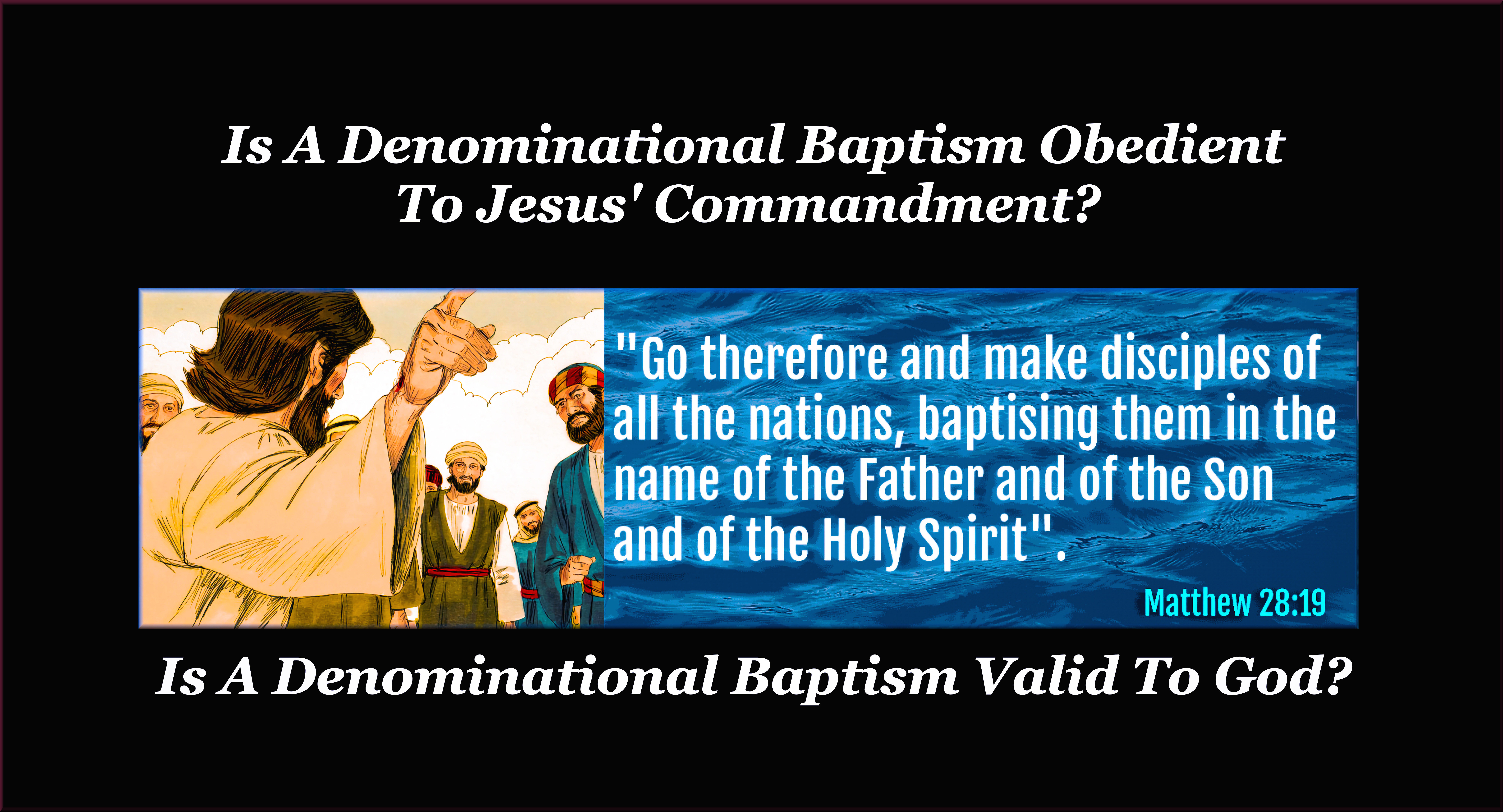
Is A Denominational Baptism Scriptural? Is It Valid? Is It A Sin?
For a Christian believer, no vow is more important than the vow we publicly make known when we get baptized.
Jesus in his parting words explicitly stated the terms of that oath. From several Bible Translations:
Matthew 28:19, 20
19 “Go, therefore, and make disciples of all nations, baptizing them in the name of the Father and of the Son and of the Holy Spirit, Holman Christian Standard Bible
“Go, then, to all peoples everywhere and make them my disciples: baptize them in the name of the Father, the Son, and the Holy Spirit,: Good News Translation
“Go ye therefore, and teach all nations, baptizing them in the name of the Father, and of the Son, and of the Holy Ghost:” King James Version
” Go, therefore, and make disciples of people of all the nations, baptizing them in the name of the Father and of the Son and of the holy spirit,” New World Translation (NWT)
The New World Translation is the Bible translation created and published by the Watchtower Bible and Tract Society and is the translation of the Bible solely used by “Jehovah’s Witnesses”. In regard to Matthew 28:19, it reads similarly to other well-recognized translations of the Bible. The verse clearly states Jesus as instructing his disciples to baptize in the “name of the Father and of the Son and of the Holy Spirit (not capitalized)”.
In the following verse Jesus continues, 20 “and teach them to obey everything I have commanded you. And I will be with you always, to the end of the age.” GNT
Have “Jehovah’s Witnesses kept Jesus command? Have their spiritual leaders obeyed everything He commanded to do?
The answer is NO, and particularly in regard to His command concerning baptism.
Most professed Christian at least understand that it is a sin to alter the commandments given by God and Christ. Yet this is exactly what the Watchtower organization did in 1985 by changing long-standing baptismal vows so that they became a denominational vow.
Watchtower Society Changes to a Denominational Vow
In 1985, the Watchtower Society changed its baptismal vows so that new Jehovah’s Witnesses committed themselves not only to God, but to the Watchtower Society.
This is evident from the baptismal vows published over the years. The baptismal questions from the Aug. 1, 1966 Watchtower (p. 465) were:
(1) Have you recognized yourself before Jehovah God as a sinner who needs salvation, and have you acknowledged to him that this salvation proceeds from him, the Father, through his Son Jesus Christ?
(2) On the basis of this faith in God and in his provision for salvation, have you dedicated yourself unreservedly to God to do his will henceforth as he reveals it to you through Jesus Christ and through the Bible under the enlightening power of the holy spirit?
The May 15, 1970 (p. 309) and May 1, 1973 (p. 280) issues printed slightly revised vows. They were different, but did not change concerning the baptismal candidate vow of dedication in the name of the Father, the Son, and the Holy Spirit.
I was baptized April 18, 1964 and thank God that I was baptized with a pure, unadulterated vow of dedication.
But in 1985, they did make a meaningful change in the wording that baptismal candidates were asked to swear to.
The newest baptismal questions were set forth in the June 1, 1985 (p. 30) Watchtower:
(1) On the basis of the sacrifice of Jesus Christ, have you repented of your sins and dedicated yourself to Jehovah to do his will?
(2) Do you understand that your dedication and baptism identify you as one of Jehovah’s Witnesses in association with God’s spirit-directed organization?
Note how different the second vow is from the earlier versions. The Society now ask newer members coming into association with them to, in effect, swear allegiance to their denomination from which their membership can be terminated at any time by the Society by disfellowshipping while at the same time convincing these newcomers that they have solely made an oath of dedication to God, Christ, and the Holy Spirit.
Can this legitimately be considered a real Christian baptism?
At the end of this post, there is the link to a video. The video is of a recorded phone call to the Service Desk at the Watchtower Headquarters. The Service Desk among other functions, is tasked with answering questions that writers of letters and phone calls asked about various matters.
The caller asked a “Jehovah’s Witness” elder at the desk questions about the validity of his baptism and the statements in Watchtower publications that are contradictory. He points to an article published not long before that baptismal question change in 1984, that states emphatically that being baptized by “”Jehovah’s Witnesses” was NOT a baptism into an organization. He also cites other previous articles expressing the same sentiment.
Listen to the video and how through double-talk, the elder tries to explain away the contradictions.
Denominational Baptism: Is It Valid?
In the first century, there weren’t various denominations of Christians groups or beliefs. While there were various groups of Christian disciples who met in different places, they did not act as different religious groups with competing views nor were they to divides themselves into different followings.
When a problem did arise when some disciples sought to do so, this is what the Apostle Paul told them in admonishment:
1 Corinthians 1:11-16:
11b My brothers and sisters, some from Chloe’s household have informed me that there are quarrels among you.
12 What I mean is this: One of you says, “I follow Paul”; another, “I follow Apollos”; another, “I follow Cephas”; still another, “I follow Christ.”
13 Is Christ divided? Was Paul crucified for you? Were you baptized in the name of Paul?
14 I thank God that I did not baptize any of you except Crispus and Gaius,
15 so no one can say that you were baptized in my name.
16 (Yes, I also baptized the household of Stephanas; beyond that, I don’t remember if I baptized anyone else.)
The disciples he spoke to were creating competing factional denominations or ‘cliques’. They sought to further identify themselves as specific followers of individuals.
Denominations imply that there is diversity of viewpoints among the one body of Christ. Christ himself said “A house divided cannot stand”. Those that Paul counseled were attempted to divide the Church.
Paul could very well make the statement above today to groups such as “Jehovah’s Witnesses” who display the same conduct of those he spoke to in the first century.
How do they claim to be “God’s spirit-directed organization” while being disobedient to Jesus Christ? They undermine His sole position as Lord.
A denominational baptism is the act of immersing someone in water based upon the teachings of a group of people who practice division by off naming and un-appointing Christ from divine Lordship; the act of being baptized according to the dictates and teachings of a denomination. Based upon what a denomination is, what it does, and what it stands for indicates that any baptism by a denomination administers is invalid and unaccepted by God. It is a sin.
Let’s consider again Paul’s words found in 1 Corinthian 1:10-13. The Bible reads:
10 Now I urge you, brothers, in the name of our Lord Jesus Christ, that all of you agree in what you say, that there be no divisions among you, and that you be united with the same understanding and the same conviction.
11 For it has been reported to me about you, my brothers, by members of Chloe’s household, that there is rivalry among you.
12 What I am saying is this: Each of you says, “I’m with Paul,” or “I’m with Apollos,” or “I’m with Cephas,” or “I’m with Christ.”
13 Is Christ divided? Was it Paul who was crucified for you? Or were you baptized in Paul’s name? HCSB
In these same verses, Christians are commanded to speak the same thing. This does not mean we become puppets of each other and practice being copy cats to everything a preacher preaches.
Peter makes it very clear what it means to speak the same thing in 1 Peter 4:11, where the Bible reads:
“If anyone speaks, let him do so as speaking pronouncements from God; if anyone ministers, let him do so as depending on the strength that God supplies; so that in all things God may be glorified through Jesus Christ. The glory and the might are his forever and ever. Amen”. (NWT)
As Christian disciples, if we are going to speak, then we need to speak the words of God. God’s word is the Bible.
Therefore, we need to speak where the Bible speaks and remain silent where the Bible is silent. The Bible speaks against denominationalism because denominationalists do not speak the same thing. They speak as spokesmen of their preachers, leaders, and creeds, and not as the spokesmen of God. In fact, we too are to speak against denominationalism.
The Bible speaks nothing about denominational baptism. So, since the scriptures are silent on this subject, then God has nothing to do with it. As far as God is concerned, there is no such thing as denominational baptism. So, how can it be valid?
Christians are to be perfectly joined together in the same mind and in the same judgment. The true church is to be united in understanding, resolution, counsel, and consent. Denominations do not have the same understanding because if they did, they would be trying to restore unity and not promote division.
Denominations do not have the same resolution because each denomination teaches a different methodology on how to get to God and Christ and serve Them.
They are not of the same counsel because if they were, they would follow the deliberate purpose and design of the Bible.
They are not of the same consent because when it comes to God’s word, they cannot agree on anything. The only thing they can agree on is to disagree.
Jesus Christ did not die for something He is against, but rather Christ prayed we all be one.
John 17:20-21:
20 “I do not ask for these only, but also for those who will believe in me through their word,
21 that they may all be one, just as you, Father, are in me, and I in you, that they also may be in us, so that the world may believe that you have sent me.
Denominationalism does not represent oneness: unity among the body of Christ. According to the dictates of the Bible, denominationalism is wrong and false to the core. Therefore, ANY baptism for ANY purpose that is predicated upon this foundation and its teachings of this satanic trick to drive individuals away from Christ and break unity among the body members of Christ. Hence, their baptisms are invalid.
Many rightly believe with all their being denominationalism is wrong. They believe if a person is in a denomination, then that person is lost. They believe everybody practicing denominational-ism should repent of this religious error and give their life to Christ.
However, they still will believe that if a person is baptized and understands their baptism was for the remission of sins, then God has saved this person and added them to the church, thus making this person’s baptism valid. Some have pointed out that God through Jesus promised remission (forgiveness) of sins to the person who is baptized. So, since God promised it, He has to give it to you.
Biblical Baptism Makes a Person One with Christ….. Denominational Baptism Does Not
The problem that arises as a result of this reasoning is limiting baptism to a two-fold purpose, which is remission of sins and salvation. Although baptism accomplishes both, it does so much more.
Baptism makes a person one with Christ. To affirm a denominational baptism is for the supposed remittance a person’s sins and for the supposed provision of salvation, but it does not put a person at one with Christ.
In Galatians 3:26-27, the Bible reads:
26 For ye are all the children of God by faith in Christ Jesus.
27 For as many of you as have been baptized into Christ have put on Christ.
If a person claims to be in Christ, then they must be aware it was their baptism that put them in Him. If an individual does not believe their baptism put them into Christ, then their baptism is invalid.
If a person was baptized, then it was because of their faith.
The Bible teaches in Romans 10:17:
“So then faith cometh by hearing, and hearing by the word of God.”
Faith is based upon what a person “hears”. Faith only comes by the word of God. If a person’s “faith” has prompted them to be baptized, then that same faith has prompted them into believing denominational-ism or the doctrine of the denomination they identified with is right also.
Since, the Bible does not teach denominationalism as being “right before God”, then the person who accepted it and practiced it based upon what they were taught and embraced it as a result of their baptism could not have been baptized by an accurate faith to begin with. If their baptism was not based upon faith, which only comes by hearing God’s word, then their baptism is not pure and it did not make them one with Christ.
The Bible teaches us that salvation is only in Christ Jesus. In 2 Timothy 2:10, the Bible states:
“For this reason I go on enduring all things for the sake of the chosen ones, so that they too may obtain the salvation that is through Christ Jesus, along with everlasting glory”.
If salvation is only in Jesus Christ, and baptism is the only thing that puts an individual into Christ, then baptism has to be predicated upon faith, faith only comes by hearing the word of God. Denominationalism is not a result of faith because the Bible speaks out against it, then anybody and everybody baptized with a denominational baptism was not baptized into Christ, thus making denominational baptism invalid. Hence, any and all baptisms taught and administered by any and all denominations are invalid. This includes “Jehovah’ Witnesses” since 1985.
God Gives Holy Spirit to Those Baptized with Biblical Baptism and Not a Denominational Baptism
When we are baptized, God gives us His Holy Spirit. In Acts 5:32:
“And we are his witnesses of these things; and so is also the Holy Ghost, whom God hath given to them that obey him.” KJV
“We are witnesses of these things and so is the Holy Spirit, who is given by God to those who obey him.” GNT
“And we are witnesses of these matters, and so is the holy spirit, which God has given to those obeying him as ruler.” NWT
If we can find out what the Holy Spirit is suppose to do in the life of a Christian, then we will also know whether this person’s denominational baptism is valid or not.
In 1 John 3:22-24, note what the Bible says:
22 “And whatsoever we ask, we receive of him, because we keep his commandments, and do those things that are pleasing in his sight.
23 And this is his commandment, That we should believe on the name of his Son Jesus Christ, and love one another, as he gave us commandment.
24 And he that keepeth his commandments dwelleth in him, and he in him. And hereby we know that he abideth in us, by the Spirit which he hath given us.”
The Holy Spirit of God enables us to live a righteous life by keeping the commandments of God and by doing those things, which are pleasing to the eyesight of God. Denominationalism is not pleasing to God.
If we practice denominationalism, then we are disobeying the commandments of God. So, this simply means the person baptized with a denominational baptism, who believes they are keeping a commandment by attending, identifying, practicing, and worshiping according to the creeds of a denomination, has just received an invalid baptism for the Holy Spirit of God does not lead an individual into a denomination.
Based upon this person’s baptism into a denomination, they never received the Holy Spirit God promised to all them who obey Him. Although, they were baptized, they were not baptized according to the dictates of the Bible, for if they were, they would have received the Spirit of God, but they did not. Hence, if denominational baptism fails to accomplish the purpose of an individual to receive the Holy Spirit, then denominational baptism has also failed in its purpose to put an individual at one with Christ, to save a person’s soul, and to forgive them of their sins.
Born Again by Way of Bible Baptism…. Denominational Baptism Does Not Accomplish This
When a person is baptized, then they have been born again. You cannot be born again without baptism. If denominational baptism is valid, then the person baptized with it has been born again. If it can be proven that a person baptized with a denominational baptism has not been born again, then a denominational baptism is invalid.
Jesus himself explained for all of humanity what it means to be “born again”.
John 3:3-5:
3 “Jesus answered and said unto him, Verily, verily, I say unto thee, Except a man be born again, he cannot see the kingdom of God.
4 Nicodemus saith unto him, How can a man be born when he is old? can he enter the second time into his mother’s womb, and be born?
5 Jesus answered, Verily, verily, I say unto thee, Except a man be born of water and of the Spirit, he cannot enter into the kingdom of God.” KJV
Compare with the New World Translation:
3 “In response Jesus said to him: “Most truly I say to you, unless anyone is born again, he cannot see the Kingdom of God.”
4 Nic·o·deʹmus said to him: “How can a man be born when he is old? He cannot enter into the womb of his mother a second time and be born, can he?”
5 Jesus answered: “Most truly I say to you, unless anyone is born from water and spirit, he cannot enter into the Kingdom of God”. (NWT)
If a person wants to be born again, then they have to be born of the water and of the Spirit. Those advocating denominational baptism are placing emphasis only on the water and not on the Spirit. They understand what it means to be born of the water, but have failed in their understanding to know what it means to be born of the Spirit.
This is the process in which one is born of the Spirit. First, this person must receive (that is to accept) Christ and His teachings to be true and not false.
John 1:12:
12 “But to all who did receive Him, He gave them the right to be children of God, to those who believe in His name,”
If an individual can accept this, then God gives this person the right, the ability, the power to become a child of His. This is where the Holy Spirit comes in and does His part in the born again process. The tool the Holy Spirit uses to accomplish this purpose is the word of God, which is His sword.
Note Ephesians 6:17:
“And take the helmet of salvation, and the sword of the Spirit, which is the word of God.”
No individual can obey God’s commands in regards to their salvation without knowing what “Thus saith the Lord.” The Spirit uses the word of God to instruct the lost soul what they must do to be saved and what salvation does for them.
This all takes place by way of the word of God and obedience to what is written in it.
This is reaffirmed at 1 Peter 1:22-23:
“Seeing ye have purified your souls in obeying the truth through the spirit unto unfeigned love of the brethren, see that ye love one another with a pure heart fervently: Being born again, not of corruptible seed, but of incorruptible, by the word of God, which liveth and abideth forever”.
The Holy Spirit is very crucial to the process of being born again. When an individual has been born of the Spirit, they are not born again with a corruptible seed, but of an incorruptible seed. If an individual believes the denomination they “joined” is PART of the true church of Christ, then this person has been born of corruptible seed and their denominational baptism is invalid.
If a person believes they have the right to “join” themselves to a denomination before and after baptism based upon what they have been taught by a denomination, then this person has been born of corruptible seed and their denominational baptism is invalid.
If a person believes God has added them to the denomination that they identify themselves with believing it is the true church of Christ , then this person has been born of corruptible seed and their denominational baptism is invalid.
If a person believes it is okay to worship, accept, and identify with a denomination, then the Holy Spirit of God had nothing to do with this individual’s baptism because the Holy Spirit would not neglect to inform an individual by way of the word of God denominationalism is wrong and God only has but one church and He only adds the saved to His church.
Since the Holy Spirit had nothing to do with denominational baptism, then although they might have obeyed the water part of the plan, but their baptism is still invalid because it was based upon the teachings of a corruptible seed and not an incorruptible seed.
With Bible Baptism, One Is Added to the Church of Christ….With Denominational Baptism They are Not
When a person is baptized into Christ, then God adds them to the church.
Acts 2:47:
47 “praising God and enjoying the favor of all the people. And the Lord added to their number daily those who were being saved.”
Those who believe denominational baptism deny this point. They believe God adds this person to the church regardless of their core beliefs concerning the church. The church are the heirs of the kingdom of God.
In Matthew 16:18-19, the Bible reads:
“And I say also unto thee, That thou art Peter, and upon this rock I will build my church; and the gates of hell shall not prevail against it. And I will give unto thee the keys of the kingdom of heaven: and whatsoever thou shalt bind on earth shall be bound in heaven: and whatsoever thou shalt loose on earth shall be loosed in heaven.”
So, if God “added” this person baptized with a denominational baptism to the church, then He also “added” them to His kingdom because the church and the kingdom are the same thing according to doctrine.
However, this is untrue according to the context of John 3:5. The Bible teaches unless an individual is born of the water AND of the Spirit, he CANNOT enter into the kingdom of God (the church). All individuals baptized with a denominational baptism may have been born of the water, but due to their resolve that denominationalism is right, they have not been born of the Spirit because this person has been baptized with a “corruptible seed”.
According to Luke 8:11, the “seed” is the Word of God:
“Now the parable is this: The seed is the word of God.”
The seed is the word of God and according to what Peter wrote, the word of God is the incorruptible seed.
1 Peter 1:21-25:
22 Having purified your souls by your obedience to the truth for a sincere brotherly love, love one another earnestly from a pure heart,
23 since you have been born again, not of perishable seed but of imperishable, through the living and abiding word of God;
24 for “All flesh is like grass and all its glory like the flower of grass. The grass withers, and the flower falls,
25 but the word of the Lord remains forever.” And this word is the good news that was preached to you.”
Valid baptism is the result of an incorruptible seed, which is the word of God by way of the Spirit; whereas, denominational baptism is a result of a corruptible seed. To even suggest denominational baptism is valid is to suggest the word of God is corrupt, but the word of God is not.
1 Timothy 3:16, 17:
16 “All scripture is given by inspiration of God, and is profitable for doctrine, for reproof, for correction, for instruction in righteousness:
17 That the man of God may be perfect, thoroughly furnished unto all good works.”
God has spoken by His Word. If a person is not born of the water AND of the Spirit, he CANNOT enter into the kingdom of God. Since a person baptized with a denominational baptism of corruption, then that person was not born of the Holy Spirit, and therefore God has not drawn this person to His church and they are not allowed entranced into the kingdom.
In Colossians 1:12-14, the Bible reads:
“Giving thanks unto the Father, which hath made us meet to be partakers of the inheritance of the saints in light: Who hath delivered us from the power of darkness, and hath translated us into the kingdom of his dear Son: In whom we have redemption through his blood, even the forgiveness of sins.”
When God adds an individual to His church:
(1) He has delivered or rescued them from the power of darkness (sin and error) and
(2) He has translated, transferred, or carried them away into the kingdom of His dear Son. The true Christian disciple has been “delivered” and “translated” because he/she has been redeemed by way of the blood of Christ and by such, their sins have been forgiven.
Denominational baptism does not accomplish this purpose. Therefore, a person baptized with a denominational baptism has not been delivered from darkness, has not been translated into the kingdom, has not been redeemed by the blood of Christ, and has not had their sins forgiven, thus making denominational baptism invalid.
Wrong Teaching Equals Wrong Baptism
The right baptism is predicated upon the right teachings.
The same word that produces a saving faith is the same word that instructs an individual to be baptized.
The same word that instructs a person to be baptized is the same word that teaches denominationalism to be wrong.
The same word that teaches denominational-ism to be wrong is the same word that teaches the truth about the church. This is a result of faith coming by hearing the word of God. (Romans 10:17).
The Bible further teaches in Hebrews 11:6, “But without faith it is impossible to please him: for he that cometh to God must believe that he is, and that he is a rewarder of them that diligently seek him.” KJV
Denominationalism is not pleasing to God. If denominationalism is not pleasing to God, then its baptism is not pleasing to God because it is not a result of faith solely on the word of God and whatsoever is not of faith based on God’s word is therefore sin.
Romans 14:23
“But if they have doubts about what they eat, God condemns them when they eat it, because their action is not based on faith. And anything that is not based on faith is sin”.
In Peter 3:21, the Bible reads:
“which was a symbol pointing to baptism, which now saves you. It is not the washing off of bodily dirt, but the promise made to God from a good conscience. It saves you through the resurrection of Jesus Christ”.
Therefore, what we hear must instruct us of the fact of how baptism in the name of Jesus saves us.
In Acts 8:4, the Bible reads:
“Therefore they that were scattered abroad went everywhere preaching the word.”
If we can come to an accurate understanding of what it means to preach the word, then we will have a true understanding of what needs to be taught to the individual lost in their sins.
In 2 Timothy 4:2, the Bible admonishes:
2 “to preach the message, to insist upon proclaiming it (whether the time is right or not), to convince, reproach, and encourage, as you teach with all patience.”
When an individual preaches the word, then they must present the true gospel message when people want to hear it and when people don’t want to hear it. When an individual preaches the word, they must tell the world of their faults (sins). Denominationalism is sin. A denominational preacher is not going to convince someone of the Biblical facts when he himself is practicing a sin before God. He is going to convince you that denominational-ism this is a part of God’s plan for saving man. This is a falsehood!
It is the teaching of the gospel according to what is written in the Bible that should lead a person to baptism in the first place. If I was baptized based upon a lie, then my baptism is invalid. Denominational-ism is one of the biggest deceptions of the devil. If your baptism is based upon the teachings of a denomination, then your baptism is invalid.
It is the responsibility of a proclaimer of the gospel to make sure you understand what you are about to do and what is in store for you. When an individual preaches the word, then they must comfort the hearers with the good news of the gospel with all patience and instruction. The preacher or teacher cannot comfort the sinner with lies and deceit with instructions and conclusions not found in the Bible.
The Watchtower Organization claims to be “God’s spirit-directed organization” inspite of the fact that there is no Biblical support for that assertion. Such an assertion goes contrary to what the Word of God actually teaches.
Millions of people they have baptized since 1985 have been baptized with an invalid baptism as the Scriptures have shown.
The person who has been baptized with a denominational baptism either believed prior to baptism that denominational-ism is wrong or they believed denominational-ism is right. This has to be the case or they would not have made the conscience decision to attend and identify with a denominational church and continue to adhere to their doctrine believing it is okay before God.
Those that have been baptized into a particular denomination still have opportunity to seek out someone to baptize them correctly as Christ commanded. If they choose not to do so, not only do they remain alienated from Christ, but they also bear the stain of corruption due to mixing a vow of dedication to God and Christ with a vow of loyalty to a man-made organization.













 brotherjohnsite.org